
Lugh
Master of every skill — the young god admitted to Tara because he alone could do all the crafts at once, and who killed his own grandfather Balor.
Tricephalic Celtic god (Lugus / Lugh), Gallo-Roman relief, from Bas-reliefs, statues et bustes de la Gaule romaine · CC BY-SA 4.0 · source
The Man at the Gate
The scene that defines Lugh takes place at a door. In Cath Maige Tuired a young stranger arrives at the royal hall of Tara and the porter demands to know what art he practises, since no one enters without a skill the household lacks 1. He offers himself as a wright, and is told they have a wright; as a smith, a champion, a harper, a warrior, a poet and historian, a sorcerer, a physician, a cupbearer, a brazier — and each time he is told the position is filled 1.
Then he asks the porter to go and check whether the king has any one man who possesses all of these arts together, and if so he will not seek entry 1. There is no such man. He is admitted, wins a game of fidchell against the best player in the house, and is seated in the sage's seat 1. From this he is called Samildanach, "equally skilled in many arts," and his other standing epithet is Lamfada, "of the long arm" or "long hand," usually understood as a reference to his spear or his reach as a caster 1,6.
Balor and the Second Battle
Lugh's ancestry is mixed by design. His father is Cian of the Tuatha De Danann, and his mother is Ethne, daughter of Balor, king of the Fomorians, the hostile people the Tuatha De must defeat 1,2. Later folk versions add the familiar prophecy pattern — Balor shuts his daughter away because he is fated to be killed by his grandson — but the medieval text is less interested in that machinery than in the outcome 1,6.
Balor's weapon is his eye, kept closed and opened only in battle by four men hauling on a handle through the lid; whatever it looks at is destroyed 1. Lugh, moving through the field, catches it opening and puts a sling-stone through it so that the eye is driven out the back of Balor's head and its power falls on the Fomorian army behind him 1. He then spares the captured Fomorian king Bres on condition that he tell the Irish when to plough, sow, and reap — a bargain that converts a war into an agricultural calendar, and one of the most striking endings in the whole corpus 1.
Father of Cu Chulainn
Lugh appears at one remove in the Ulster Cycle. Compert Con Culainn makes him the otherworldly father of Cu Chulainn, conceived on Deichtine in a version of the story where the god comes to her in a dream and identifies himself 4,6. In the Tain Bo Cuailnge, when the boy-hero has fought alone for months and is broken with wounds and sleeplessness, a tall warrior comes across the plain unseen by the armies, announces himself as Lugh mac Ethlenn, "your father from the fairy mound," and stands guard while Cu Chulainn sleeps for three days as herbs are put into his wounds 3.
The episode is one of the few places in early Irish literature where a divine parent openly intervenes for a mortal child, and the hero's first act on waking is to ask how long he slept and to go straight back to fighting 3,6.
Lughnasadh
Lugh's name is attached to one of the four quarter-days of the Irish year. Lughnasadh, at the beginning of August, is described in the tradition as a festival he founded in memory of his foster mother Tailtiu, who died clearing the plains of Ireland for agriculture; the games and assembly at Teltown in County Meath are its stated origin 6,7. The festival marks the start of harvest, and its later forms — hilltop gatherings, fairs, matchmaking, the Puck Fair at Killorglin, the pilgrimage to Croagh Patrick — persisted in Ireland into modern times 6,7.
The place-name evidence is broad: Lugh is embedded in the calendar, in Louth (Lughbhaidh), and in a long list of continental toponyms 7.
Lugus on the Continent
Outside Ireland, a related name appears across the Celtic-speaking world. Lugdunum, "fort of Lugus," is the ancient name of Lyon, and the same element lies behind Laon, Leiden, Legnica, and Carlisle's neighbours; dedications to the plural Lugoves are known from Spain and Switzerland 7. In Wales, Lleu Llaw Gyffes, "Lleu of the skilful hand," in the Fourth Branch of the Mabinogi, shares both the name element and the epithet pattern 7.
Caesar, describing Gaulish religion in the mid first century BCE, says the god the Gauls honour most is "Mercury," inventor of all arts, guide on roads and journeys, and patron of trade — an interpretatio Romana that assigns a Roman name to a Gaulish god he never names 5. Many scholars have connected that description to Lugus on the strength of the "all arts" element, and the argument is reasonable, but it is inference from a Roman general's summary and not a Gaulish statement 5,7.
What Is Attested and What Is Inferred
Lugh is securely a major figure of medieval Irish literature, attested in manuscripts from the eleventh century onward drawing on older material, with a consistent character across texts: young, radiant, expert in everything, and lethal at a distance 1,2,6. The festival and the place-names are real and well documented 7.
The pan-Celtic god behind the Irish, Welsh, and Gaulish names is a reconstruction — well supported by the linguistic evidence, but a reconstruction all the same, and the once-popular etymology deriving Lugus from a root meaning "light" is now generally rejected in favour of roots meaning "oath" or "lynx"/"raven," with no consensus 7. Green's caution applies to the whole area: continental iconography and insular narrative are different bodies of evidence, and the join between them is argued rather than documented 8. What is not in doubt is the figure the Irish texts actually give us, standing at a gate and refusing to be turned away 1.
Continue Exploring
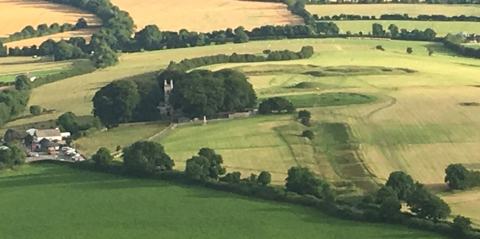
A low Meath hilltop layered with 5,000 years of earthworks, remembered as the seat of Ireland's High Kings — a title the archaeology alone cannot confirm.
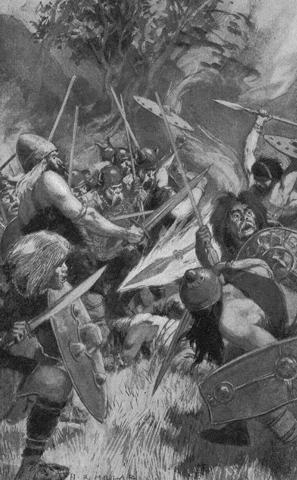
Ireland's race of gods — arriving with four treasures from four lost cities, winning Ireland twice, then losing it once and withdrawing into the mounds.
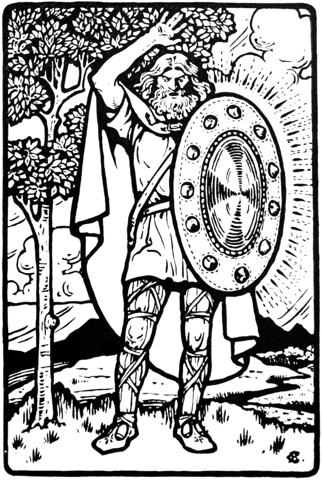
The Irish sea god — ferryman between worlds, master of illusion and the mist of invisibility, and the presiding figure of the Otherworld voyages.
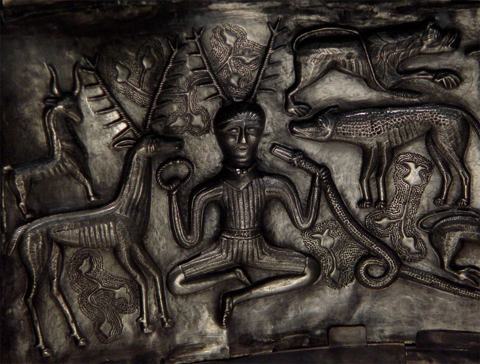
The horned one — an antlered Gaulish god known from images alone, whose name survives on exactly one damaged stone and who has no surviving myth at all.
The mother goddess of the Tuatha De Danann — and the most famous Irish deity who may never have existed under that name.
Ireland's disqualified king — the Tuatha De Danann's first ruler, who loses an arm, loses the throne, and wins both back with a physician's graft.
Also mentioned inBalor of the Evil EyeBrigid (Brigit, Brighid)Cu ChulainnLebor Gabala Erenn (The Book of Invasions)OgmaTain Bo Cuailnge (The Cattle Raid of Cooley)Taranis (Celtic Thunder God)The Fomorians (Fomoire)The Four Treasures of the Tuatha De Danann
Sources & Further Reading
- 1.Cath Maige Tuired: The Second Battle of Mag Tuired, ed. and trans. Elizabeth A. Gray. Irish Texts Society vol. 52, 1982.
- 2.Lebor Gabala Erenn (The Book of the Taking of Ireland), ed. R. A. S. Macalister. Irish Texts Society, 1938–1956.
- 3.Tain Bo Cuailnge, Recension I, ed. and trans. Cecile O'Rahilly. Dublin Institute for Advanced Studies, 1976.
- 4.Compert Con Culainn (The Conception of Cu Chulainn), Old Irish.
- 5.Julius Caesar, De Bello Gallico VI.17 (c. 50 BCE).
- 6.MacKillop, James. Dictionary of Celtic Mythology. Oxford University Press, 1998.
- 7.Koch, John T. (ed.). Celtic Culture: A Historical Encyclopedia. ABC-CLIO, 2006.
- 8.Green, Miranda J. Dictionary of Celtic Myth and Legend. Thames & Hudson, 1992.
Spot an error or have a source to suggest? Write to info@viseterna.com. We cite primary sources and modern scholarship, and we correct fast.