
Nuada (Nuada Airgetlam)
Ireland's disqualified king — the Tuatha De Danann's first ruler, who loses an arm, loses the throne, and wins both back with a physician's graft.
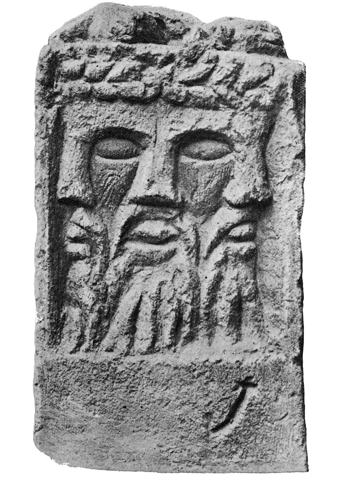
Bronze plaque from the temple of Nodens at Lydney Park, engraving, published 1919 (Folklore Society) · Public domain · source
A King Disqualified by His Own Body
Nuada is the first king of the Tuatha De Danann in Irish tradition, and the saga that introduces him is built around a legal technicality. At the First Battle of Mag Tuired, fought to win Ireland from the Fir Bolg, Nuada loses an arm to the Fir Bolg champion Sreng in single combat before the general fighting starts 1. The battle is won, but a rule the tradition treats as fixed disqualifies him from the kingship regardless: no king of the Tuatha De Danann may hold the throne while bearing a blemish 1,4. Sreng is offered half of Ireland in the settlement that follows and takes Connacht, which Lebor Gabala Erenn uses to account for that province's separate character within the pseudohistorical scheme 2,5.
Two Arms
The physician Dian Cecht fits Nuada with a working arm of silver, jointed and mobile, and the tradition takes the repair literally enough to make it his standing epithet: Airgetlam, "of the Silver Arm" 1,4. It is a genuine prosthesis, not a cosmetic one, but it is still silver rather than flesh, and the blemish law is read strictly enough that Nuada steps down anyway. The kingship passes to Bres, son of a Fomorian father and a Tuatha De mother, whose seven years on the throne are remembered as a disaster of stinginess and Fomorian tribute rather than any particular cruelty 1.
Nuada's cure is completed not by Dian Cecht but by his son. Miach examines the silver arm, judges it inadequate, and regrows flesh and sinew over Nuada's stump joint by joint until the arm is whole again. Dian Cecht's response is to kill him, striking his son's head four times until the last blow reaches the brain; herbs are said to have grown from Miach's grave in the pattern of every ailment they could cure, until his sister Airmed, gathering and sorting them by property, has her furious father scatter the collection so that the full order of the cure is lost 1. The episode sits oddly inside a saga otherwise concerned with the war against the Fomorians, and its cruelty toward a healer is one of the details readers tend to remember longest 1,4.
The Young Stranger at Tara
With Bres deposed, Nuada is restored to the kingship he held before his injury. His second reign is the one still in place when Lugh arrives at Tara and is admitted past the door-porter because he alone possesses every craft the household needs at once 1. Rather than displacing Nuada outright, the text has the king cede the seat of the war-council to Lugh for the length of the planning that follows — a gesture usually read less as abdication than as Nuada recognising which of them should actually direct the coming battle 1,4.
Killed by the Eye He Once Faced
Nuada remains king in name through the Second Battle of Mag Tuired, and it is Nuada, not Lugh, who meets Balor in the field. Balor's destroying eye kills him before Lugh closes on the same enemy and ends him with a sling-stone 1. The king who lost an arm to open the cycle of these two wars loses his life to close it, and the throne passes for good to the generation Lugh represents 1,4.
Nodens Across the Sea
Nuada's name has a documented cousin outside Ireland. A late Roman temple at Lydney Park on the Severn estuary in Gloucestershire, excavated in 1928-29, produced dedications to a god Nodens, associated there with healing, hunting, and dogs. The excavators' 1932 report included an appendix by the young philologist J. R. R. Tolkien, arguing that Nodens, Old Irish Nuadu, and Welsh Nudd all descend from a single Celtic name, which he connected to a root meaning "to catch" or "to snare" 3. The Welsh evidence is genuinely there but genuinely tangled: Nudd is named father of Gwyn ap Nudd in the tale Culhwch and Olwen, while a related figure, Lludd Llaw Eraint, "Lludd of the Silver Hand" — the same epithet, translated — appears in the Mabinogion's Lludd and Llefelys and in the Welsh Triads, his name shifted from Nudd by a documented Welsh sound-change rather than by coincidence 5,6.
What Is Text and What Is Reconstruction
Nuada himself is secure: a major figure of the medieval Irish Mythological Cycle, present in Cath Maige Tuired from its opening scene to its last battle 1. The wider claim — that Nuada, Nodens, and Nudd all preserve one pre-Christian Celtic god of healing, hunting, and sovereignty — is a comparative reconstruction built from a shared name across three languages and centuries of unrelated documentation, and it should be read as exactly that: well supported, not directly attested 3,5,6. No Gaulish or British text explains what Nodens meant to the worshippers who prayed to him at Lydney; only the Irish literature gives him a story, and that story is the one this entry can actually tell 3.
Continue Exploring
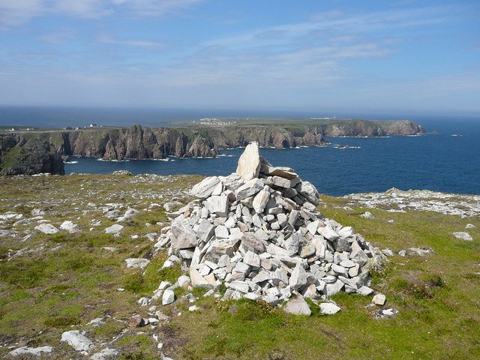
The Fomorian king whose single destroying eye must be lifted open by four men — and who dies exactly as prophesied, by his own grandson's hand.
Master of every skill — the young god admitted to Tara because he alone could do all the crafts at once, and who killed his own grandfather Balor.
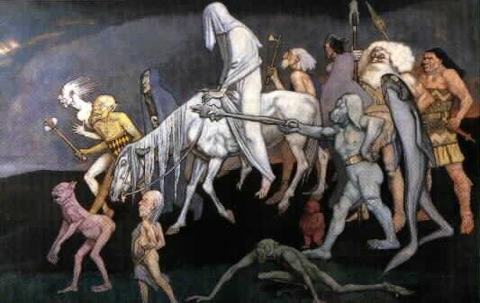
Ireland's monstrous sea-people — raiders, tribute-takers and kin to the gods they fight, led by Balor of the destroying eye.
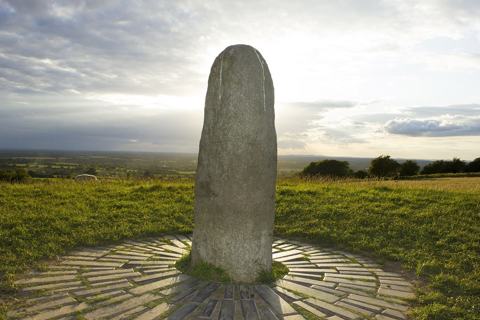
Four wonder-objects the Tuatha De Danann brought to Ireland: a screaming stone, an unstoppable spear, an inescapable sword, and a cauldron that never runs dry.
The mother goddess of the Tuatha De Danann — and the most famous Irish deity who may never have existed under that name.
Ireland's race of gods — arriving with four treasures from four lost cities, winning Ireland twice, then losing it once and withdrawing into the mounds.
Sources & Further Reading
- 1.Cath Maige Tuired: The Second Battle of Mag Tuired, ed. and trans. Elizabeth A. Gray. Irish Texts Society vol. 52, 1982 (CELT edition).
- 2.Lebor Gabala Erenn (The Book of the Taking of Ireland), ed. R. A. S. Macalister. Irish Texts Society, 1938-1956.
- 3.Wheeler, R. E. M. and T. V. Wheeler, with Appendix I, 'The Name Nodens' by J. R. R. Tolkien. Report on the Excavation of the Prehistoric, Roman and Post-Roman Site in Lydney Park, Gloucestershire. Society of Antiquaries of London Research Report No. 9, 1932.
- 4.MacKillop, James. Dictionary of Celtic Mythology. Oxford University Press, 1998.
- 5.Koch, John T. (ed.). Celtic Culture: A Historical Encyclopedia. ABC-CLIO, 2006.
- 6.Green, Miranda J. Dictionary of Celtic Myth and Legend. Thames & Hudson, 1992.
Spot an error or have a source to suggest? Write to info@viseterna.com. We cite primary sources and modern scholarship, and we correct fast.