
Tain Bo Cuailnge (The Cattle Raid of Cooley)
Ireland's longest medieval saga: Queen Medb invades Ulster for a bull, and Cu Chulainn holds the fords alone against her army.
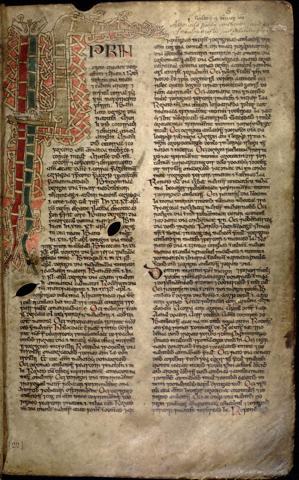
Facsimile page, Book of Leinster, 12th century (used in Joseph Dunn's 1914 translation of the Tain Bo Cuailnge) · Public domain · source
What the Tain Is
Tain Bo Cuailnge, "The Cattle Raid of Cooley," is the centrepiece of the Ulster Cycle, the body of medieval Irish saga built around King Conchobar mac Nessa and the warriors of Emain Macha 7. It is the longest surviving tale of the cycle by a wide margin, and it has been called Ireland's national epic often enough that the label now sticks, though the saga itself is prose broken by verse, episodic in structure, and closer to a chronicle of raids and single combats than to Homer 3,4. Its subject is a war fought over livestock: Queen Medb of Connacht, unwilling to be poorer than her husband Ailill, invades Ulster to seize the Donn Cuailnge, the great brown bull of Cooley, and the boy-warrior Cu Chulainn is left to hold the border alone, drawing on the strength his reputed divine father Lugh is said to have passed him 1,2.
Two Recensions, One Uncertain Original
No single Tain exists. Scholars distinguish two principal recensions. Recension I survives complete only by combining two related twelfth-century manuscripts, Lebor na hUidre (the Book of the Dun Cow) and the fragmentary Yellow Book of Lecan, and reads as a text stitched from at least two older versions that do not always agree, occasionally narrating the same episode twice 1,5. Recension II is the smoother, more literary version copied into the Book of Leinster around 1160, generally judged a deliberate twelfth-century reworking of material close to Recension I rather than an independent witness 2,5. A later, more elaborate Recension III survives only in fragments and has drawn far less scholarly attention 5.
Lebor na hUidre itself is a landmark independent of the Tain: it is the oldest manuscript written substantially in Irish to survive, compiled at the monastery of Clonmacnoise around 1100, and it is damaged, missing leaves, and reworked by at least three scribes across roughly two centuries. One of them, the redactor known only as H, adds a marginal note apologising for splicing material from a second exemplar into the text he was copying, which is often cited as the earliest piece of Irish textual criticism 5.
The Raid Itself
The invasion succeeds only because the Ulstermen lie helpless under the ces noinden, a birth-pang curse laid on the province generations earlier by the goddess Macha; Cu Chulainn, exempt because of his youth, holds the fords by invoking the right of single combat and kills Medb's champions one at a time while her army waits its turn 1,6. The saga's best-known set piece is his duel with his foster-brother Ferdiad, fought across several days at a ford, the two men exchanging food and healing herbs each night before Cu Chulainn kills him with the barbed spear gae bulga and carries the body across the river to lament over it 1,2. The Morrigan intervenes against him in animal shapes and is rebuffed; the Ulstermen finally rouse from the curse and rout Medb's army, and the story ends with the two bulls, Donn Cuailnge and Ailill's white-horned Finnbennach, fighting each other to the death once the human war is already over 1,6.
Reading a Monastic Text
Earlier scholarship tended to read the Tain as a more or less intact window onto pre-Christian Iron Age warrior society, chariots, weapons, and taboos included. That confidence has eroded considerably. The surviving Tain is the work of Christian monastic scribes compiling, translating narrative conventions, and in places visibly editorialising inherited material centuries after any Iron Age setting, so a claim that a given passage preserves genuinely archaic practice now has to be argued rather than assumed 5,7. The saga's own internal evidence for dating is mixed: parts of Recension I are linguistically Old Irish, plausibly composed by the eighth or ninth century, while other passages and the framing material are unmistakably later additions 5.
Survival, Rediscovery, and Translation
The Tain was never physically lost, but it was effectively inaccessible outside a small circle of specialists until the nineteenth-century Celtic Revival turned Old and Middle Irish into an object of sustained philological attention. Standish Hayes O'Grady and other Victorian scholars produced early partial translations, and the modern scholarly base texts are Cecile O'Rahilly's parallel editions of Recension I (1976) and the Book of Leinster version (1967), still the standard for citation 1,2. For general readers, Thomas Kinsella's 1969 translation, illustrated by Louis le Brocquy, defined the saga for a generation; Ciaran Carson's 2007 version, sparer and more colloquial, is the most-read recent rendering 3,4.
Why It Matters to the Cycle
Tain Bo Cuailnge functions less as a stand-alone story than as a hub. A set of shorter tales, the remscela or "fore-tales," exist mainly to explain how its characters arrived at the positions the Tain finds them in, and later texts such as Cu Chulainn's own death-tale assume a reader who already knows this saga 6,7. It is also a large part of the reason the Ulster Cycle survives at all: because monastic scribes judged the Tain worth the vellum and the labour of repeated copying, most of what is known about Conchobar's court, Medb, and Cu Chulainn comes down through this one contested, composite text 5,7.
Continue Exploring
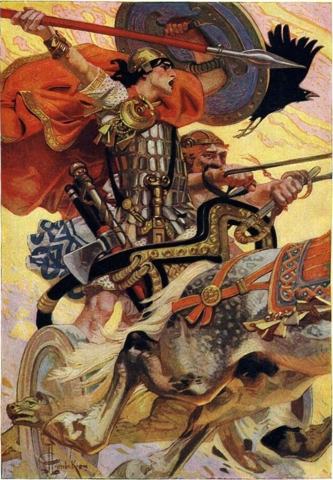
The Hound of Ulster — a boy-hero who holds an entire army at a ford, warps into a monster when he fights, and dies standing up, tied to a stone.
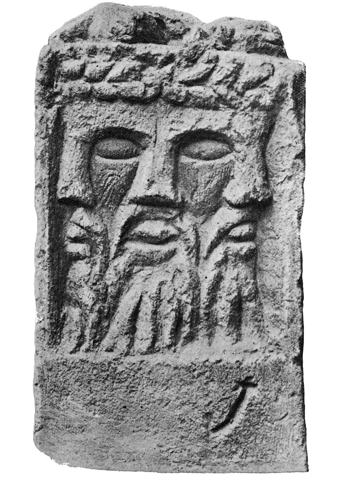
Master of every skill — the young god admitted to Tara because he alone could do all the crafts at once, and who killed his own grandfather Balor.
The great queen of war and fate — a shape-shifting Irish goddess who takes crow form above the battlefield and decides its outcome before it is fought.
A medieval synthetic history of Ireland: six waves of settlers, the Tuatha De Danann, and the Gaelic Milesians, engineered to answer to the Bible.
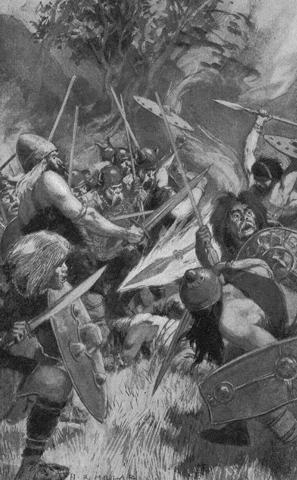
Ireland's race of gods — arriving with four treasures from four lost cities, winning Ireland twice, then losing it once and withdrawing into the mounds.
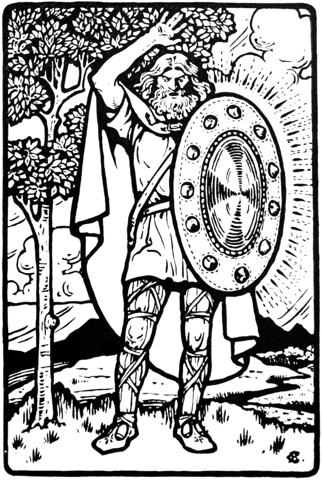
The Irish sea god — ferryman between worlds, master of illusion and the mist of invisibility, and the presiding figure of the Otherworld voyages.
Sources & Further Reading
- 1.O'Rahilly, Cecile (ed. and trans.). Tain Bo Cuailnge, Recension I. Dublin Institute for Advanced Studies, 1976.
- 2.O'Rahilly, Cecile (ed. and trans.). Tain Bo Cuailnge from the Book of Leinster. Dublin Institute for Advanced Studies, 1967.
- 3.Kinsella, Thomas (trans.). The Tain. Dolmen Press / Oxford University Press, 1969.
- 4.Carson, Ciaran (trans.). The Tain: A New Translation of the Tain Bo Cuailnge. Penguin Classics, 2007.
- 5.Best, R. I. and Osborn Bergin (eds.). Lebor na hUidre: Book of the Dun Cow. Royal Irish Academy, 1929.
- 6.Mallory, J. P. (ed.). Aspects of the Tain. December Publications, 1992.
- 7.MacKillop, James. Dictionary of Celtic Mythology. Oxford University Press, 1998.
Spot an error or have a source to suggest? Write to info@viseterna.com. We cite primary sources and modern scholarship, and we correct fast.