
The Hill of Tara
A low Meath hilltop layered with 5,000 years of earthworks, remembered as the seat of Ireland's High Kings — a title the archaeology alone cannot confirm.
The Hill of Tara seen from a hot-air balloon, County Meath, Ireland, 2016 · CC BY-SA 4.0 · source
A Hill Layered with Time
The Hill of Tara is an unremarkable-looking rise above the Meath plain, roughly 155 metres high, that carries one of Ireland's densest concentrations of archaeological monuments: some thirty visible earthworks spanning the Neolithic through the early medieval period, packed into a ridge less than a kilometre long 2. Nothing built there is monumental in the way Newgrange or Stonehenge are; what makes Tara remarkable is duration — people kept building, burying, and gathering on the same hill for roughly five thousand years, and medieval Irish tradition then wrapped the whole accumulation into a single story about kingship 1,2.
The Mound of the Hostages
The oldest structure on the hill is the Mound of the Hostages, a small passage tomb built around 3200 BC, contemporary with Newgrange on the Boyne twenty kilometres away 2. Excavation found the cremated and unburned remains of upwards of a hundred individuals, deposited over more than a thousand years, along with Beaker-period grave goods added long after the tomb's original construction 2. The passage is short and low, but it is aligned so that the rising sun enters it around Samhain and Imbolc, the old November and February quarter days, rather than at either solstice — a different solar target from Newgrange's midwinter alignment, and a reminder that Irish passage tombs were not all built to the same calendar 2.
Seat of the High Kings
Medieval Irish literature calls Tara the seat of the Ard Rí, the High King of Ireland, and stages the Feis Temro, a kingship-confirming assembly, there 4,5. Lebor Gabála Érenn and the Dindshenchas place-poems weave the hill into the story of every incoming people, from the Fir Bolg to the Tuatha Dé Danann, and Tara is where Lugh talks his way past the porter and into the hall in Cath Maige Tuired 3,5. Historians are now cautious about how literally to take any of this: the idea of Tara as the single seat of a unified national kingship looks less like an unbroken ancient institution and more like a political claim, developed and promoted especially by the Uí Néill dynasty from the seventh and eighth centuries onward, that retrofitted the hill's genuine antiquity into a charter for their own authority 1. The archaeology shows intense activity at Tara across many periods; it does not by itself show a single line of "High Kings" ruling from it 1,2.
The Lia Fail
On the summit stands the Lia Fáil, the "Stone of Destiny," a plain standing stone that later legend says roared aloud when the rightful king of Ireland touched it 4,5. The stone now on view was moved to its present position on the mound called the Forradh in the nineteenth century, where local tradition holds it also marks the burial place of United Irishmen killed nearby during the rebellion of 1798 — a genuinely modern layer added to an already ancient object 5. As with most standing stones connected to kingship legends, there is no way to test the older story archaeologically; what survives is the stone and the tradition, not proof that any king was ever inaugurated beside it 1.
Digging Up Tara
Tara's afterlife includes one notorious episode of pseudo-archaeology. Between 1899 and 1902 a group of British Israelites, led by the retired judge Edward Wheeler Bird and convinced the Ark of the Covenant lay buried beneath the hill, paid off the landowner and dug into the Rath of the Synods with no scientific method, damaging the earthworks before public protest — led by cultural figures including W. B. Yeats, Douglas Hyde, and Arthur Griffith — forced the excavation to stop 1. A century later, the hill again became a flashpoint when the M3 motorway was routed through the wider Tara–Skryne landscape despite sustained opposition; the roadworks turned up previously unknown monuments, including a large henge at nearby Lismullin, even as campaigners argued the road itself compromised the setting of the site 1,2.
Tara Today
Tara carries no reconstructed buildings and no standing walls; what a visitor sees is grass-covered earthworks, low banks, and the Lia Fáil on an open hilltop in State care, managed jointly with the Church of Ireland, which still owns the churchyard on the site 1. Reference surveys of Celtic culture now treat Tara primarily as a case study in how a real, long-used landscape and a political myth of unified kingship became inseparable in the medieval and modern imagination 6. That bareness is part of the point: almost everything substantial that can be said about Tara comes from reading the ground and the manuscripts against each other, carefully, and admitting where they disagree 1,2.
Continue Exploring
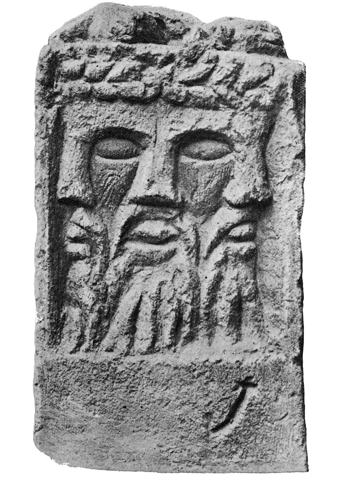
Master of every skill — the young god admitted to Tara because he alone could do all the crafts at once, and who killed his own grandfather Balor.
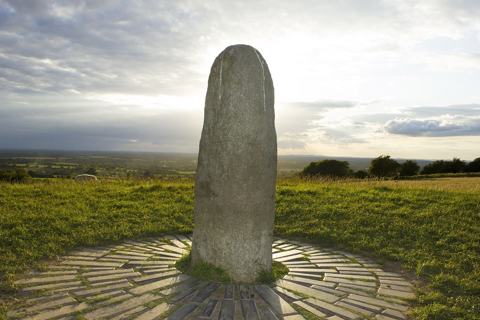
A standing stone on the Hill of Tara said to roar beneath Ireland's rightful king; the rival Scottish claim on it is a much later legend, not medieval fact.
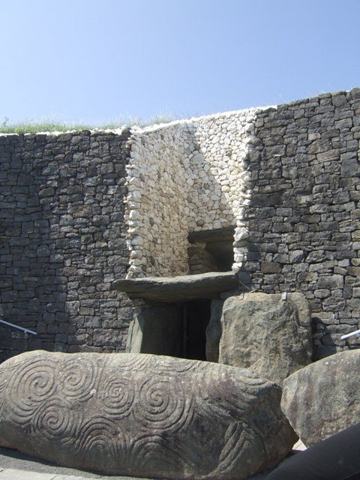
A 5,000-year-old passage tomb on the Boyne, built for the winter solstice centuries before the Celts arrived — later remembered as the Dagda's own hall.
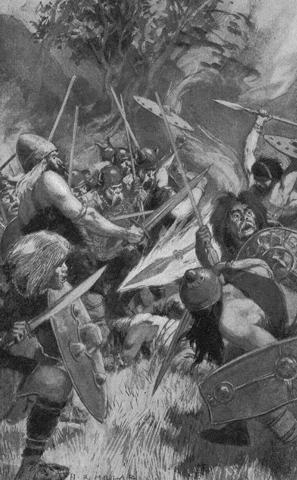
Ireland's race of gods — arriving with four treasures from four lost cities, winning Ireland twice, then losing it once and withdrawing into the mounds.
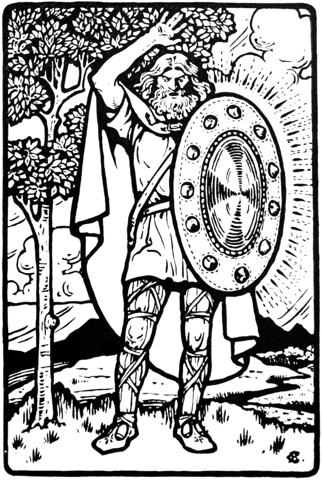
The Irish sea god — ferryman between worlds, master of illusion and the mist of invisibility, and the presiding figure of the Otherworld voyages.
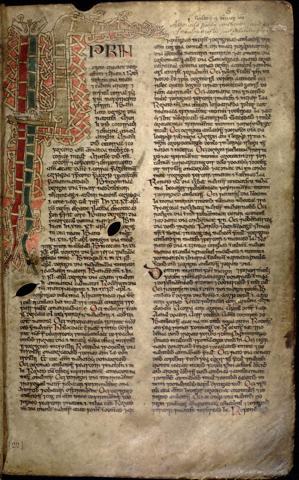
A medieval synthetic history of Ireland: six waves of settlers, the Tuatha De Danann, and the Gaelic Milesians, engineered to answer to the Bible.
Sources & Further Reading
- 1.Bhreathnach, Edel (ed). The Kingship and Landscape of Tara. Four Courts Press, 2005.
- 2.Newman, Conor. Tara: An Archaeological Survey. Royal Irish Academy, 1997.
- 3.The Metrical Dindshenchas, ed. and trans. Edward Gwynn. Royal Irish Academy, 1903-1935.
- 4.Lebor Gabala Erenn (The Book of the Taking of Ireland), ed. R. A. S. Macalister. Irish Texts Society, 1938-1956.
- 5.MacKillop, James. Dictionary of Celtic Mythology. Oxford University Press, 1998.
- 6.Koch, John T. (ed.). Celtic Culture: A Historical Encyclopedia. ABC-CLIO, 2006.
Spot an error or have a source to suggest? Write to info@viseterna.com. We cite primary sources and modern scholarship, and we correct fast.