
Balor of the Evil Eye
The Fomorian king whose single destroying eye must be lifted open by four men — and who dies exactly as prophesied, by his own grandson's hand.
Dun Balair Fort area, Tory Island, Colin Park, 2008 (geograph.org.uk) · CC BY-SA 2.0 · source
The Eye That Cannot Be Opened Alone
Balor, called in the oldest texts Balor Birugderc, "Balor of the piercing eye," is the Fomorian king whose single destructive eye is the central weapon of Irish myth's founding war. Cath Maige Tuired explains its power as an accident: as a boy, Balor looks in on his father's druids brewing a poison, and the fumes blind and blast the eye so that whatever it looks upon afterward is destroyed 1. The eye is kept shut because its own owner cannot control it. Opening it requires a team of men to lift the lid on a hook or handle driven through it, and only in that moment, on a battlefield, is it used at all 1,5.
A Prophecy and a Locked Tower
Woven around the eye is the tradition's best-known prophecy plot: Balor learns he is fated to die at the hand of his own grandson, and moves to prevent any grandson from existing by shutting his only daughter, Ethniu, away from men. The medieval saga material states the outcome economically, without much of the machinery later tradition builds around it — Ethniu bears a son to Cian of the Tuatha De Danann, and that son is Lugh 1. The fuller version usually told today — a tower on an island, a druidess who smuggles Cian in, Balor's fury at the birth, a failed attempt to drown the infant — is folklore accretion, collected from oral storytellers centuries after the sagas were written down. It is worth being honest that the early literary Balor is a sparer figure than the one most retellings describe 1,4.
King of the Fomorians, Kin of His Enemies
In Cath Maige Tuired Balor leads the Fomorians against the Tuatha De Danann at the Second Battle of Mag Tuired, but the saga is explicit that the two sides are related by blood and marriage at nearly every level: Balor's own daughter has borne a child to a Tuatha De man, and that child is the one who will kill him 1. Reading the Fomorians as an alien race invading from outside does not survive contact with the text; Balor is as much an in-law as an enemy, and the war he leads is closer to a succession dispute than an invasion 1,6.
The Sling-Stone at Mag Tuired
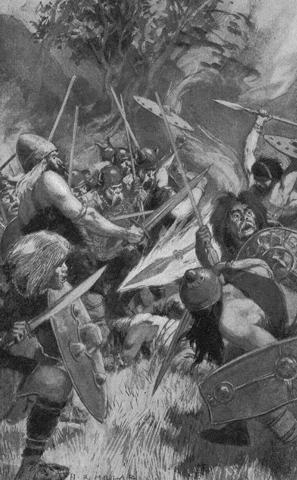
Balor's death is one of the set-piece scenes of early Irish literature. As his eye is hauled open on the battlefield, Lugh — his own grandson, fighting for the opposing side — puts a sling-stone through it with enough force to drive the eye out the back of his skull, so that its destructive gaze falls backward onto the Fomorian ranks rather than onto the Tuatha De 1. Nuada, the Tuatha De king, dies to that same eye earlier in the same battle, which makes Lugh's shot both a revenge and the fulfilment of the prophecy that shaped Balor's whole life 1,5.
Tory Island's Balor
Balor's afterlife is largely a folklore afterlife. Modern oral tradition, collected across Donegal and the Irish-speaking west into the twentieth century, fixes his stronghold on Tory Island, off the Donegal coast, and localises the tower, the daughter, and the birth of Lugh to specific points on that small island's landscape 4. O'Rahilly's study of early Irish mythology treats this geographic anchoring as a late development layered onto a figure whose medieval literary role had nothing to do with any specific island, and cautions against reading the folk topography back into the saga material as though it were original to it 3. The durability of the Tory Island setting in living storytelling is worth noting on its own terms: Balor is one of the clearer cases in the Codex of a figure now better known through nineteenth- and twentieth-century oral collection than through the medieval manuscript that actually created him 3,4.
What the Saga Says, and What It Doesn't
Balor's core role — the destroying eye, the doomed grandson, the death at Mag Tuired — is securely medieval and securely central to Cath Maige Tuired 1,2. Almost everything else commonly said about him — the precise mechanics of Ethniu's imprisonment, a one-legged or goat-headed appearance sometimes attached to Fomorians generally, his standing as a giant — belongs to later retellings, folklore collection, or modern popular writing rather than to the earliest surviving text. The honest position is to keep those two layers visibly separate rather than flatten a thousand years of retelling into a single "the myth says" 1,4,6,7.
Continue Exploring
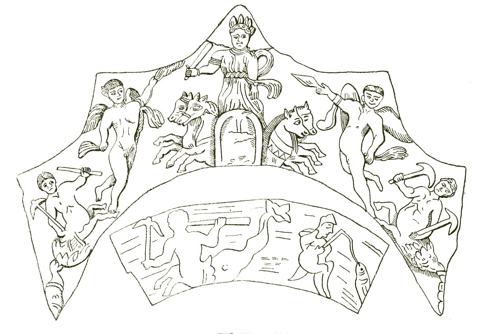
Ireland's disqualified king — the Tuatha De Danann's first ruler, who loses an arm, loses the throne, and wins both back with a physician's graft.
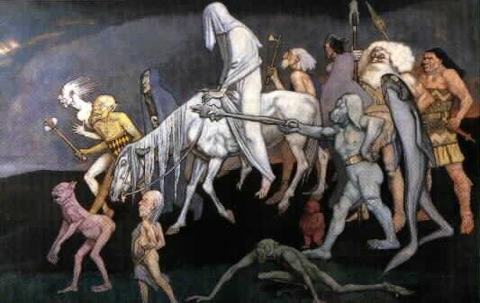
Ireland's monstrous sea-people — raiders, tribute-takers and kin to the gods they fight, led by Balor of the destroying eye.

Four wonder-objects the Tuatha De Danann brought to Ireland: a screaming stone, an unstoppable spear, an inescapable sword, and a cauldron that never runs dry.
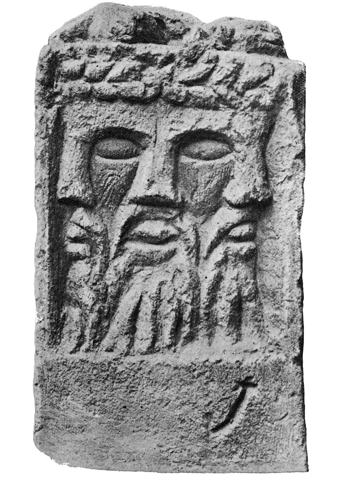
Master of every skill — the young god admitted to Tara because he alone could do all the crafts at once, and who killed his own grandfather Balor.
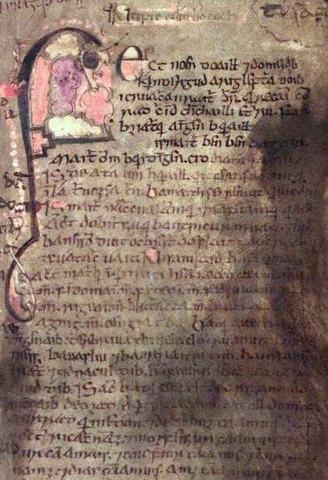
The mother goddess of the Tuatha De Danann — and the most famous Irish deity who may never have existed under that name.
Ireland's race of gods — arriving with four treasures from four lost cities, winning Ireland twice, then losing it once and withdrawing into the mounds.
Sources & Further Reading
- 1.Cath Maige Tuired: The Second Battle of Mag Tuired, ed. and trans. Elizabeth A. Gray. Irish Texts Society vol. 52, 1982 (CELT edition).
- 2.Lebor Gabala Erenn (The Book of the Taking of Ireland), ed. R. A. S. Macalister. Irish Texts Society, 1938-1956.
- 3.O'Rahilly, Thomas F. Early Irish History and Mythology. Dublin Institute for Advanced Studies, 1946.
- 4.O hOgain, Daithi. Myth, Legend and Romance: An Encyclopaedia of the Irish Folk Tradition. Ryan Publishing, 1990.
- 5.MacKillop, James. Dictionary of Celtic Mythology. Oxford University Press, 1998.
- 6.Koch, John T. (ed.). Celtic Culture: A Historical Encyclopedia. ABC-CLIO, 2006.
- 7.Green, Miranda J. Dictionary of Celtic Myth and Legend. Thames & Hudson, 1992.
Spot an error or have a source to suggest? Write to info@viseterna.com. We cite primary sources and modern scholarship, and we correct fast.