
Jade Emperor
Sovereign of Heaven and head of the celestial bureaucracy — the emperor of the gods, who governs the cosmos the way a dynasty governs a realm.
The Jade Emperor, Chinese hanging scroll, Ming dynasty · Public domain · source
Who the Jade Emperor Is
The Jade Emperor — Yuhuang Dadi (玉皇大帝), often shortened to Yudi, and known in Hokkien-speaking communities as Tian Gong, the Lord of Heaven — is the sovereign of heaven in Chinese popular religion and the presiding authority over gods, spirits, and the fate of the human world 4,6. He is imagined in imperial terms: enthroned, robed in the ceremonial dress of an emperor, holding a flat jade tablet, surrounded by ministers and record-keepers 4.
Two clarifications are worth making immediately. First, Chinese religion is living practice for very large numbers of people in China, Taiwan, and the diaspora, and the Jade Emperor is worshipped in active temples today, not only narrated in old books 5,6. Second, in formal Daoist theology he is not the highest being: the Three Pure Ones rank above him as embodiments of the Dao itself, while the Jade Emperor holds executive sovereignty 4,5. He administers; they simply are.
A God with a Datable Rise
Unlike Pangu or Nuwa, the Jade Emperor is not an ancient figure. He does not appear in the early mythological corpus at all. He emerges in Daoist and popular texts of the Tang and, decisively, the Song 4,5.
The turning point is imperial patronage. In the early eleventh century the Song emperor Zhenzong, in the course of a campaign of heavenly revelations meant to shore up a humiliated dynasty, conferred grand titles on the Jade Emperor and gave him state backing; a century later Huizong's court raised him further and identified him with Haotian Shangdi, the august high deity of the classical state sacrifices 4,5. Goossaert's work on revealed scriptures traces how texts attributed to the Jade Emperor were produced and circulated in this and later periods, and how such revelation shaped the god's authority over time 5.
The result is a deity assembled at the intersection of Daoist ritual, imperial politics, and popular devotion — and one whose supremacy was official before it was universally felt 4,5.
The Scripture and the Prince
The Song-era Scripture of the Deeds of the Exalted Jade Emperor supplies him with a biography that most worshippers know in outline 1. He was born a prince in a kingdom called Radiant Wonderful Majesty, to a king and queen who had prayed long for a child. As heir he governed with compassion, then abdicated to cultivate the Way in the mountains, and across an immense span of ages — reckoned in kalpas — he perfected himself, saved beings without number, and only then attained the throne of heaven 1,4.
The shape of that hagiography is significant. It makes the ruler of the gods a self-made sage rather than a primordial power: authority earned through cultivation and merit, exactly the logic by which the celestial bureaucracy is supposed to operate 1,5.
The Celestial Bureaucracy
The Jade Emperor presides over a heaven organised like a government 4,6. There are ministries — thunder, epidemics, waters, wealth, literature, and more — staffed by gods with jurisdictions and ranks. Deities are appointed, promoted for merit, and demoted or punished for failure. Petitions from below are submitted as memorials in proper form, often literally, since Daoist ritual documents addressed to heaven are written as official paperwork and burned to deliver them 4,6. The city god of each locality and the earth god of each neighbourhood sit at the bottom of the same chain of command, with the courts of Diyu handling the dead 4,6.
Scholars caution against taking the metaphor as the whole picture. Von Glahn argues that Chinese religious culture also sustained a very different register — demonic, capricious, transactional powers that had to be bargained with or exorcised rather than petitioned through channels — and that the tidy bureaucratic model describes the official and Daoist framing better than it describes everything people actually did 6.
The Kitchen God's Report
The most domestic point of contact with the Jade Emperor is the Kitchen God, Zaojun, whose paper image sits above the stove and who watches the household all year 4. Shortly before the lunar New Year he ascends to report on the family's conduct. The customary response is to smear his lips with malt sugar or sticky sweets before sending him off — so that he speaks sweetly, or cannot speak clearly at all — then burn the image and paste up a new one 4.
It is a small ritual carrying the whole theology: heaven keeps records, conduct is audited, and ordinary people negotiate with the audit 4,6.
In Fiction and in Temples
The Jade Emperor's best-known literary appearances are unflattering. In Journey to the West, Sun Wukong is bought off with a meaningless stable-keeper's post, discovers the insult, wrecks the peach banquet, and routs the celestial armies — until the exasperated court has to send for the Buddha 2. The novel plays heaven as a vast, rank-obsessed civil service, and the joke lands precisely because readers recognised the institution 2,4. Fengshen Yanyi likewise stages the Jade Emperor's court as the apex of a divine appointment system, distributing godhood to the dead of a dynastic war 3.
In practice he is revered rather than mocked. His birthday on the ninth day of the first lunar month is a major festival, celebrated with elaborate offerings, tall sugarcane stalks, and temple ceremonies, especially in Taiwan and among Hokkien communities in Southeast Asia 4. Many households still address heaven itself through him — the highest authority, reached through the correct forms 4,6.
Continue Exploring
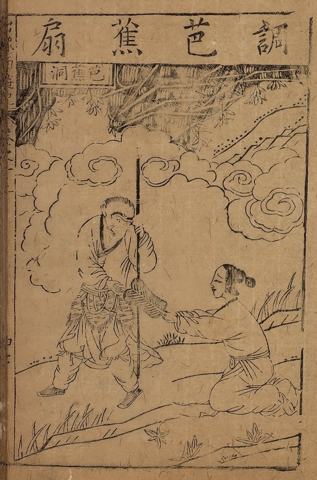
The Monkey King — a stone-born immortal with seventy-two transformations who fought heaven to a standstill, then walked to India as a monk's disciple.
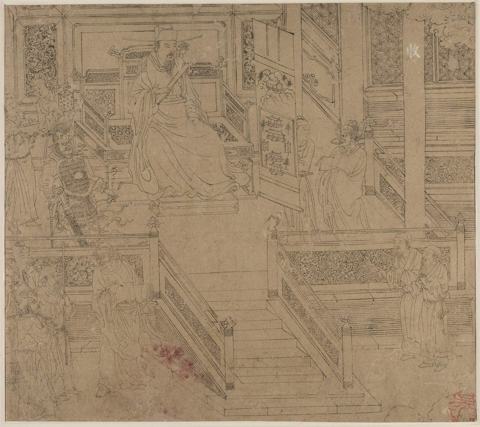
The Chinese underworld — a bureaucracy of ten courts where the dead are tried, serve sentences for what they did, and are then sent back into rebirth.
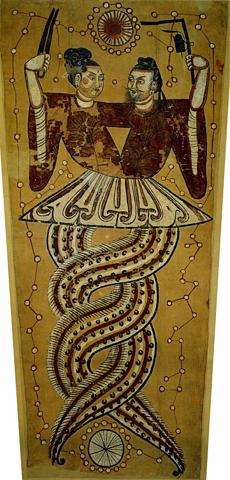
The serpent-bodied creator goddess who shaped the first humans out of yellow earth and patched the broken sky with five-coloured stone.
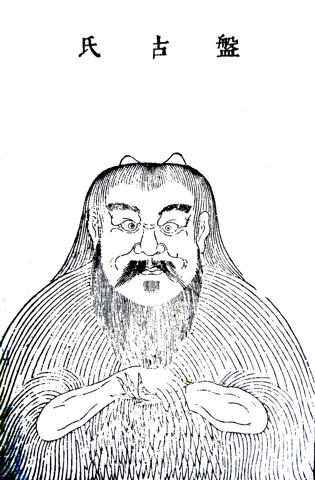
The primordial giant who split chaos into heaven and earth, and whose body at death became the mountains, rivers, winds, and stars of the world.
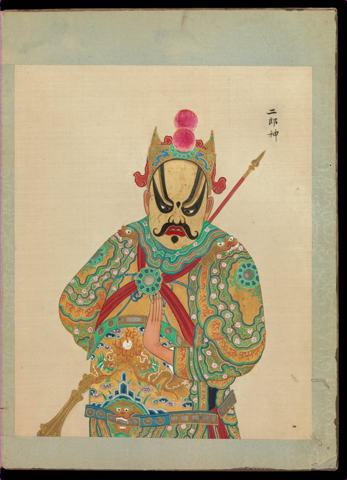
The three-eyed god of Guankou who tamed the floods and was the only celestial general able to beat the Monkey King in a fair fight.
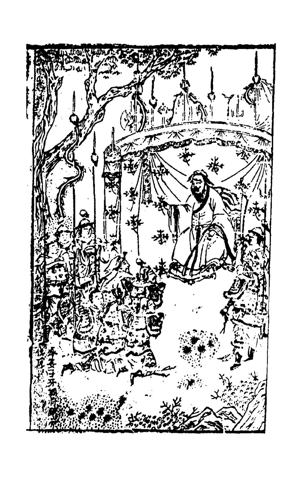
The Ming novel that restaged the fall of the Shang dynasty as heaven's founding war, promoting 365 of its dead into a brand-new celestial bureaucracy.
Also mentioned inGuan Yu (Guan Di)Huli Jing (Chinese Fox Spirit)Journey to the WestMazuNezhaThe Eight ImmortalsThe Peaches of ImmortalityXiwangmu (Queen Mother of the West)Zao Jun (the Kitchen God)
Sources & Further Reading
- 1.Gaoshang Yuhuang benxing jijing — Scripture of the Deeds of the Exalted Jade Emperor (Song dynasty, 11th–12th c.).
- 2.Wu Cheng'en (attrib.), Journey to the West — Xiyouji (16th c.).
- 3.Investiture of the Gods — Fengshen Yanyi (16th c.).
- 4.Yang, Lihui & Deming An. Handbook of Chinese Mythology. ABC-CLIO, 2005.
- 5.Goossaert, Vincent. Making the Gods Speak: The Ritual Production of Revelation in Chinese Religious History. Harvard University Asia Center, 2022.
- 6.von Glahn, Richard. The Sinister Way: The Divine and the Demonic in Chinese Religious Culture. University of California Press, 2004.
Spot an error or have a source to suggest? Write to info@viseterna.com. We cite primary sources and modern scholarship, and we correct fast.