
Huli Jing (Chinese Fox Spirit)
China's shapeshifting fox spirits, who gain power and human form through age — feared as seducers and omens of ruin, and the root of Japan's kitsune.
Nine-tailed fox, woodblock illustration from the Shan Hai Jing (Classic of Mountains and Seas), Chongzhen-era edition, 1628-1644 · Public domain · source
What a Huli Jing Is
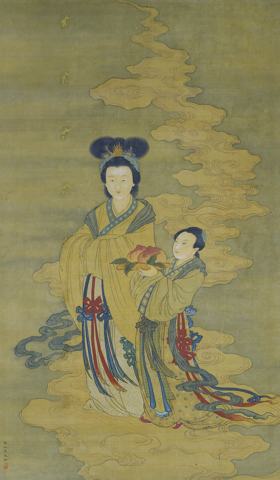
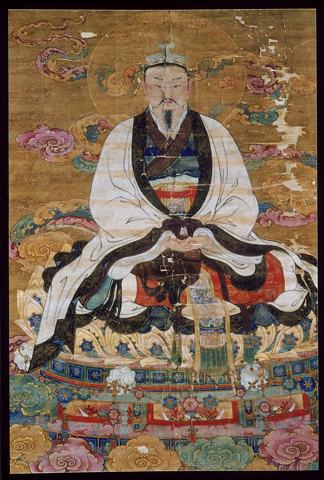
Huli jing (狐狸精), "fox spirit," is the general Chinese term for a fox that has lived long enough, or cultivated enough spiritual discipline, to gain supernatural power — the ability to take human shape, to work illusions, and to draw vital essence from the people it seduces 4,6. Age is the usual measure of strength: popular belief holds that a fox of fifty years can transform into a woman, one of a hundred into a beautiful woman or a sorcerer, and one of a thousand becomes a tianhu, a celestial fox admitted to the court of Heaven presided over by the Jade Emperor 4,6. That path of cultivation toward immortality parallels the elixirs and disciplines kept by Xiwangmu, the Queen Mother of the West, though the fox pursues transcendence on its own, animal terms rather than by petitioning a goddess for it 4. The tradition is old, regionally varied, and morally ambiguous throughout — the same fox spirit that ruins one household's fortune may be the ancestor another family worships for its own 4.
The Oldest Fox Tales
Fox stories are already a fixed genre by the fourth century. Gan Bao's Soushen Ji, a collection of anomaly accounts compiled under the Eastern Jin, records foxes that take the shape of scholars, old men, and young women to test, trick, or seduce the people they meet, and treats a fox's capacity for transformation as a simple, agreed fact about the natural world rather than as something requiring explanation 1. That unremarked-upon quality is itself informative: unlike ghosts or gods, who required a cosmological reason for existing, the fox's uncanniness was folded into ordinary belief about what a long-lived animal could become 1,4.
Liaozhai's Fox Women
The genre reaches its height in Pu Songling's Liaozhai Zhiyi, "Strange Tales from a Chinese Studio," compiled in the early eighteenth century. Fox women appear throughout as scholars' lovers, wives, and rescuers as often as they appear as predators, and Pu Songling gives many of them wit, loyalty, and grievances of their own — a fox who marries a poor student and quietly manages his household is as characteristic of the collection as a fox who drains a young man to death 2. Huntington reads this ambiguity as central rather than incidental: the Liaozhai fox is dangerous specifically because it is sympathetic, blurring the line between the alien and the intimate in a way ghost stories rarely attempt 5. Kang traces the same duality into the broader folk record, where a household's poverty or prosperity might equally be blamed on, or credited to, an attached fox spirit 4.
The Cult of the Fox
Fox belief was not confined to literature. Kang's study of fox worship in north China documents a genuine popular cult, hu xian or "fox immortal" worship, centered on small roadside shrines, attested from the Tang dynasty onward and still active in the twentieth century — one Tang-era writer, cited in her study, complained that there was scarcely a village left without its own fox shrine 4. Chinese popular religion places the fox spirit within a wider cast of liminal, folk-classified beings rather than a formal pantheon — closer in that sense to the reanimated dead of the jiangshi tradition than to a temple god with fixed rites 4. Officials periodically tried to suppress the cult as superstition, with little lasting success; Kang argues that its persistence owes less to organized religion than to the fox's usefulness as an explanation for the unpredictable swings of household fortune, illness, and desire that other deities did not address as directly 4.
Daji and the Downfall of a Dynasty
The most consequential fox in Chinese fiction is Daji, the favorite consort of the last king of Shang in the Ming-dynasty novel Fengshen Yanyi, "Investiture of the Gods." In the novel a thousand-year fox spirit kills and impersonates the real Daji, then uses her position to drive the king into cruelty and excess that brings down his dynasty — a fox spirit not merely dangerous to an individual household but blamed, in fiction, for the collapse of a state 3. The story draws on a much older historical tradition that faulted King Zhou's real consort for the fall of Shang; the novel's innovation is to explain her cruelty as literally inhuman 3,4.
The Fox and the Kitsune
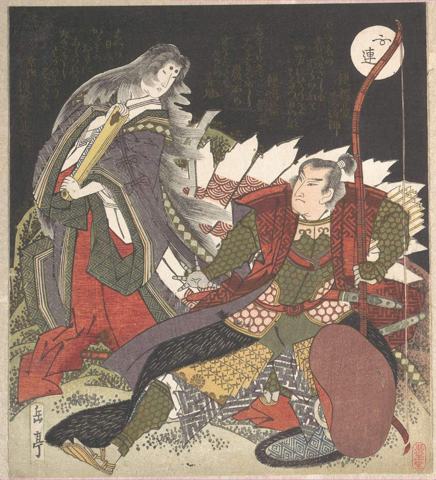
The Chinese fox tradition is also the acknowledged ancestor of Japan's kitsune. Medieval Japanese versions of the Tamamo-no-Mae legend explicitly trace their nine-tailed fox demon back through a career in China and India before her arrival in Japan, a transmission story that openly credits the huli jing tradition as the source 6. The Chinese and Japanese fox share their central grammar — long life as the source of power, tails as its measure, transformation into a beautiful woman as its favorite disguise — even where local custom diverges, and the parallel is close enough that scholars of one tradition routinely cite the other for comparison 5,6.
The fox spirit remains current in Chinese popular culture, where huli jing now also serves as a common, only half-joking, slang term for a seductive or predatory woman — a modern echo of a belief that official China spent well over a thousand years trying, unsuccessfully, to legislate out of existence 4.
Continue Exploring
China's reanimated corpse — stiff-limbed, hopping, driven by a soul that failed to leave the body — a Qing folk terror turned horror-comedy icon.
Japan's fox spirits — shapeshifters who gain tails and power with age, feared as deceivers and revered as the messengers of the rice kami Inari.
A tiger-toothed mountain spirit who became China's greatest goddess of immortality, keeper of the peaches that ripen once in three thousand years.
Sovereign of Heaven and head of the celestial bureaucracy — the emperor of the gods, who governs the cosmos the way a dynasty governs a realm.
The Ming novel that sent a monk and three monster disciples across demon country for Buddhist scripture — and gave Sun Wukong to the world.
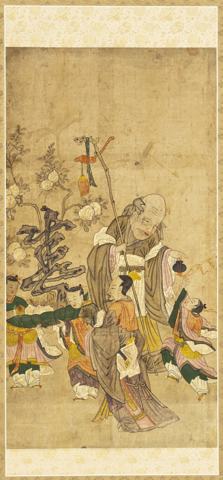
The fruit that ripens once every three thousand years in the Queen Mother's orchard — eaten by the wrong guest, it triggered heaven's most famous brawl.
Sources & Further Reading
- 1.Gan Bao, Soushen Ji — In Search of the Supernatural: The Written Record (c. 4th c. CE); trans. Kenneth J. DeWoskin & J.I. Crump. Stanford University Press, 1996.
- 2.Pu Songling, Liaozhai Zhiyi — Strange Tales from a Chinese Studio (c. 1740); trans. John Minford. Penguin Classics, 2006.
- 3.Xu Zhonglin (attrib.), Fengshen Yanyi — Investiture of the Gods (16th c.).
- 4.Kang, Xiaofei. The Cult of the Fox: Power, Gender, and Popular Religion in Late Imperial and Modern China. Columbia University Press, 2006.
- 5.Huntington, Rania. Alien Kind: Foxes and Late Imperial Chinese Narrative. Harvard University Asia Center, 2004.
- 6.Yang, Lihui & Deming An. Handbook of Chinese Mythology. ABC-CLIO, 2005.
Spot an error or have a source to suggest? Write to info@viseterna.com. We cite primary sources and modern scholarship, and we correct fast.