
Erlang Shen
The three-eyed god of Guankou who tamed the floods and was the only celestial general able to beat the Monkey King in a fair fight.
Erlang Shen, leaf from 'One Hundred Portraits of Peking Opera Characters', unsigned, late Qing dynasty (The Metropolitan Museum of Art) · CC0 · source
Who Erlang Shen Is
Erlang Shen (二郎神), the "Second Son Divinity", is a warrior god of rivers, flood control, and demon-hunting, worshipped above all in Sichuan and carried from there across the Chinese world 3,4. His name in cult is usually Guankou Erlang — Erlang of Guankou, the gorge above Chengdu where the Dujiangyan irrigation works divide the Min River — and his Daoist title is True Lord of the Clear Source and Wondrous Way (清源妙道真君) 4,7.
He is instantly recognisable: a vertical third eye in the middle of his forehead that sees through any disguise, a three-pointed double-edged blade, and a lean celestial hound, Xiaotianquan, that runs down whatever he is hunting 1,4. Like Sun Wukong he commands seventy-two transformations, which is precisely why the two are matched against each other 1.
The Duel with the Monkey King
Erlang's most famous appearance is chapter 6 of Journey to the West. When every general of heaven has failed against the rebel Monkey King, the Jade Emperor's sister proposes her son, who holds a fief at Guanjiangkou and who — in the novel's memorable phrase — answers summons but does not answer to the court 1. Erlang arrives with his six sworn brothers and fights Monkey through a shapeshifting duel: hawk against sparrow, cormorant against cormorant, fish against fish-hawk, until Monkey turns himself into a roadside shrine and forgets to hide his tail, which he leaves standing behind the building as a flagpole 1. Erlang recognises it instantly. Even then the capture is not clean — it takes Laozi's diamond snare dropped from above, and Erlang's hound biting Monkey's leg, to finish it 1.
The novel's Erlang is the Jade Emperor's nephew: son of a heavenly princess who married a mortal named Yang, and by implication a god with a grievance against the celestial family 1. Vernacular tradition develops this into the story of a mother imprisoned under a mountain and a son who splits the mountain to free her, though the details differ sharply between drama, chantefable, and modern retellings, and are sometimes transferred to his nephew instead 6,7.
Where the God Came From
The cult has several roots and the sources do not agree on which is primary 6,7.
The oldest strand is Li Bing, the Qin-dynasty governor of Shu who built the Dujiangyan waterworks in the third century BCE. The Huayang guozhi and related early records already treat him as more than an engineer: he confronts the river god, transforms into a bull to fight it, and subdues the water by force 3. A "second son" — Li Erlang — was attached to Li Bing in later tradition, and the Erwang or "Two Kings" temple at Dujiangyan came to honour father and son together as the tamers of the Min 3,4.
A second strand identifies Erlang with Zhao Yu, a Sui-dynasty official of Jiazhou remembered for killing a flood-dragon in the river; several Daoist sources apply the Clear Source title to him rather than to Li Bing's son 4,7. A third, dominant in later fiction, calls him Yang Jian (楊戩), the name he carries in the Fengshen yanyi, where he is a disciple of the immortal Yuding Zhenren and one of the most capable warriors on the Zhou side of the war against Shang 2.
Modern scholarship generally treats these as accretions onto a regional water-taming deity rather than as competing reports of one historical man 6,7. Meulenbeld's broader argument applies well here: gods of this type are the demon-quelling marshals of Daoist exorcistic ritual, whose biographies were assembled from local legend and then fixed in print by Ming novels and hagiographies 7. Dudbridge, tracing the antecedents of Journey to the West, shows that Erlang was already the standard opponent for a rebellious ape in Yuan drama, well before the novel gave the encounter its classic form 6.
The Demon-Hunter in Drama and Print
Yuan zaju put Erlang on stage as a hunter of monsters — one surviving play has him shoot the demon-binding mirror while drunk and then clean up the demons he has released, which is a fair summary of his dramatic personality 5,6. Ming illustrated compendia standardise the iconography: armoured, third eye open, hound at heel, sometimes with a hawk 4.
The other great image of him is the handscroll subject known as Erlang's Search of the Mountain (二郎搜山圖), in which the god and his troops drive shapeshifting animal-demons out of the hills. Surviving Ming versions of the composition read as a systematic sweep, and the scene is closely tied to the exorcistic function of the cult rather than to any single narrative 7.
Relations and Cult Today
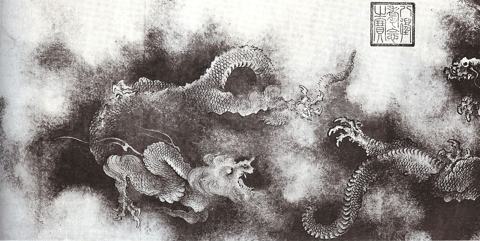
Erlang stands in the same rank of celestial marshals as Nezha — both are divine sons, both are sent against rebels, and both serve the Jade Emperor without much warmth 1,2. His special adversaries are dragons and river spirits, which places him permanently opposite the Chinese dragon in its destructive-flood aspect 3,4.
Temples to Erlang remain active in Sichuan, Fujian, Taiwan, and among overseas Chinese communities, and the Erwang temple complex at Dujiangyan is still a working pilgrimage site as well as a monument to the irrigation system that made the Chengdu plain fertile 3,4. He is also a fixture of opera, where the third eye is painted on the mask, and of modern Chinese animation and games, which tend to keep the hound and the blade and drop the waterworks 6,7.
Continue Exploring
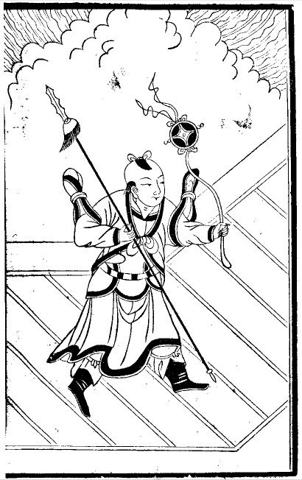
The child god who killed a dragon prince, returned his flesh to his parents, and was rebuilt out of lotus — China's most rebellious divine infant.
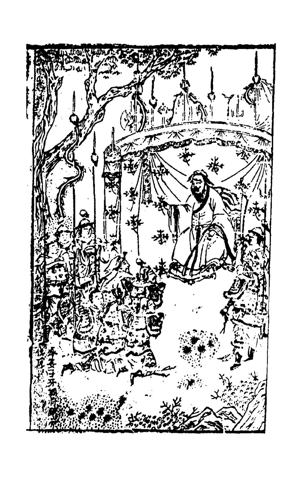
The Ming novel that restaged the fall of the Shang dynasty as heaven's founding war, promoting 365 of its dead into a brand-new celestial bureaucracy.
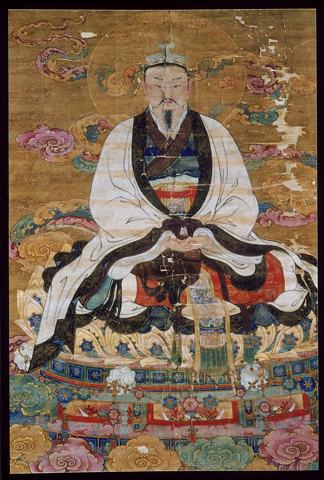
Sovereign of Heaven and head of the celestial bureaucracy — the emperor of the gods, who governs the cosmos the way a dynasty governs a realm.
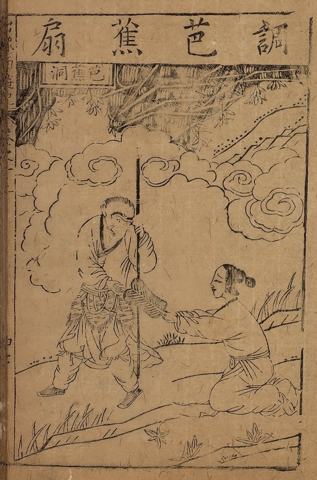
The Monkey King — a stone-born immortal with seventy-two transformations who fought heaven to a standstill, then walked to India as a monk's disciple.
China's dragon — a benevolent, scaled power of rain, river, and sea, emblem of imperial authority and the only mythical beast in the zodiac.
The Ming novel that sent a monk and three monster disciples across demon country for Buddhist scripture — and gave Sun Wukong to the world.
Also mentioned inRuyi Jingu Bang (Sun Wukong's Staff)
Sources & Further Reading
- 1.Wu Cheng'en (attrib.), Xiyouji — Journey to the West (16th century), esp. chapter 6; trans. Anthony C. Yu, The Journey to the West, revised edition, University of Chicago Press, 2012.
- 2.Xu Zhonglin (attrib.), Fengshen yanyi — The Investiture of the Gods (late 16th century); trans. Gu Zhizhong, Creation of the Gods, New World Press, 1992.
- 3.Chang Qu, Huayang guozhi — Chronicles of the Land South of Mount Hua (c. 355 CE), on Li Bing and the waterworks at Guankou.
- 4.Xinke chuxiang zengbu soushenji and Sanjiao yuanliu soushen daquan — illustrated Ming hagiographic compendia of the gods.
- 5.Anonymous, Erlang Shen zui she suomo jing — 'Erlang Shen Drunkenly Shoots the Demon-Binding Mirror' (Yuan-dynasty zaju drama).
- 6.Dudbridge, Glen. The Hsi-yu chi: A Study of Antecedents to the Sixteenth-Century Chinese Novel. Cambridge University Press, 1970.
- 7.Meulenbeld, Mark R. E. Demonic Warfare: Daoism, Territorial Networks, and the History of a Ming Novel. University of Hawai'i Press, 2015.
Spot an error or have a source to suggest? Write to info@viseterna.com. We cite primary sources and modern scholarship, and we correct fast.