
Sun Wukong
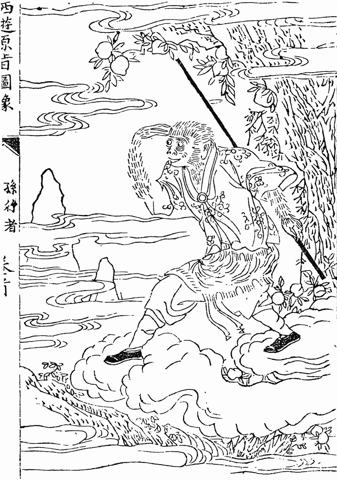
The Monkey King — a stone-born immortal with seventy-two transformations who fought heaven to a standstill, then walked to India as a monk's disciple.
Journey to the West, Shidetang edition, Jinling, 1592 (woodblock illustration) · Public domain · source
Who Sun Wukong Is
Sun Wukong (孫悟空), the Monkey King, is the breakout character of Xiyouji — Journey to the West — the sixteenth-century novel conventionally attributed to Wu Cheng'en and one of the four great classical novels of Chinese literature 1. He is a stone-born immortal, a shapeshifter, a thief of heaven's treasures, an unrepentant braggart, and eventually a Buddha. Very few mythic figures anywhere combine that much comedy with that much cosmic threat 1,3.
His name is given to him by his teacher and means roughly "awakened to emptiness" — a Buddhist joke at the expense of the least contemplative creature imaginable 1.
Stone Birth and the Search for Immortality
He is born from a stone egg on the Mountain of Flowers and Fruit, a rock nourished by heaven and earth since creation. The light of his birth reaches the palace of the Jade Emperor 1. He wins the kingship of his monkey troop by daring to leap through a waterfall and finding the Water Curtain Cave behind it, and rules there happily for centuries — until the thought of death spoils it 1.
So he builds a raft, crosses two oceans, and finds the Daoist patriarch Subhuti, who teaches him the Way, the seventy-two transformations, and the cloud-somersault that carries him 108,000 li in a single jump 1. He then equips himself by intimidation: he bullies the Dragon King of the Eastern Sea out of the iron pillar that steadies the ocean depths — the Ruyi Jingu Bang, a 13,500-jin cudgel that shrinks to a needle he tucks behind his ear 1. Hauled down to the underworld when his allotted lifespan ends, he simply crosses his name and every monkey's name out of the ledgers of life and death and walks back out of Diyu 1.
Havoc in Heaven
Heaven's first response is bureaucratic: co-opt him with a job. He is made Bimawen, keeper of the celestial horses, and revolts on discovering it is the lowest post in the sky 1. He proclaims himself Qitian Dasheng, the Great Sage Equal to Heaven, and the Jade Emperor — after his armies fail — grants the title as an empty sinecure, putting him in charge of the Peach Garden of Immortality 1.
Predictably, he eats the peaches. Then he crashes the Queen Mother's Peach Banquet, drinks the imperial wine, swallows Laozi's elixir pills like snacks, and fights off the massed hosts of heaven until Erlang Shen and Laozi together bring him down 1. Nothing executes him — blades blunt, fire and lightning do nothing — and forty-nine days in Laozi's Eight Trigrams furnace only leaves him with fiery golden eyes that see through disguise 1.
It takes the Buddha to end it, and he does it with a bet rather than a battle: if Monkey can somersault out of Buddha's palm, heaven is his. He travels to the ends of the world, marks the five pillars he finds there, and returns — to discover the pillars were fingers 1. Buddha closes his hand and pins him under the Mountain of Five Elements for five hundred years 1.
The Pilgrimage
He is released to serve the monk Tang Sanzang (the historical pilgrim Xuanzang, heavily fictionalised) on the journey west to fetch Buddhist scriptures from India 1,3. Guanyin supplies the leash: a golden fillet locked around Monkey's head that constricts agonisingly whenever Sanzang recites a certain spell 1. Alongside the pig-demon Zhu Bajie, the reformed ogre Sha Wujing, and a dragon prince serving as the horse, he fights through eighty-one ordeals — demon kings, false Buddhas, a fan that quenches the Flaming Mountains, and rather too many monsters who want to eat the monk 1.
The pilgrimage is the novel's spiritual argument. Monkey's power was never the problem; his self-will was. At the end he is enlightened, the fillet vanishes of its own accord, and he is enthroned as the Victorious Fighting Buddha 1.
Where He Came From
Sun Wukong is older than the novel. The Song-dynasty Da Tang Sanzang qufa shihua, a much shorter narrative of the same pilgrimage, already gives Xuanzang a supernatural monkey acolyte, a "monkey pilgrim in white robes" who does most of the fighting 2,3. Dudbridge traced the story cycle through centuries of prose, drama, and temple art before the sixteenth-century text fixed it 3.
The question of ultimate origins is genuinely open. An old proposal derives Monkey from the Hindu Hanuman, transmitted with Buddhism; others argue for native antecedents such as the chained water-demon Wuzhiqi of Chinese flood legend 3. Shahar makes a further case for a Song-period Hangzhou legend of monkey disciples at the Lingyin monastery, a story combining monkeys, Buddhist piety, magic caves, and a fantastic journey 4. Dudbridge's own conclusion is that the figure is composite, assembled over centuries rather than borrowed whole 3.
A God, Not Only a Character
It matters that Sun Wukong is worshipped. As Qitian Dasheng, the Great Sage, he has temples and spirit-medium traditions across Fujian, Taiwan, Hong Kong, and the Chinese diaspora in Southeast Asia; Elliott's 1950s fieldwork in Singapore documented Great Sage mediums as a live and prominent cult 5. Devotees petition him for protection, healing, and the driving off of malign influence — the same qualities the novel gives him, taken seriously 5.
He is also, by a wide margin, the most adapted figure in Chinese popular culture: opera, the landmark animated film Havoc in Heaven, television, comics, and video games have all re-staged the assault on the Peach Banquet. The Japanese manga hero Son Goku takes his name from the Japanese reading of Sun Wukong 1,3.
Continue Exploring
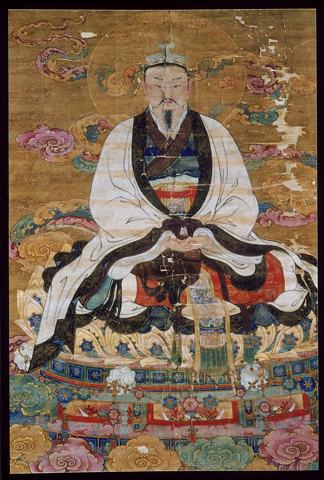
Sovereign of Heaven and head of the celestial bureaucracy — the emperor of the gods, who governs the cosmos the way a dynasty governs a realm.
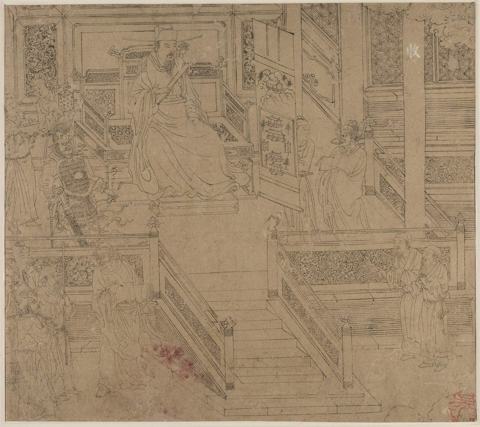
The Chinese underworld — a bureaucracy of ten courts where the dead are tried, serve sentences for what they did, and are then sent back into rebirth.
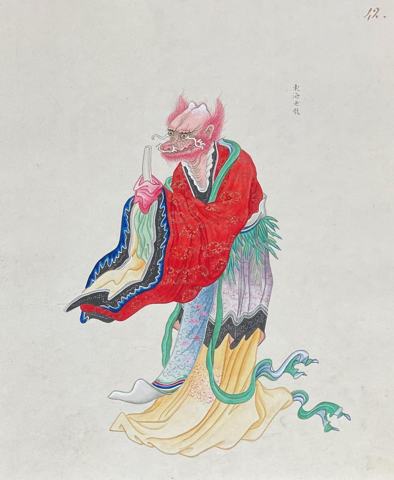
Four bureaucrat-dragons who rule the seas from undersea palaces, command rain and flood, and get bullied by mortal heroes in China's best-loved novels.
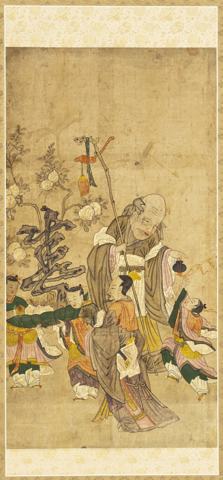
The fruit that ripens once every three thousand years in the Queen Mother's orchard — eaten by the wrong guest, it triggered heaven's most famous brawl.
The 13,500-catty iron pillar that once measured the ocean floor — bullied out of a dragon king and shrunk to a needle behind Sun Wukong's ear.
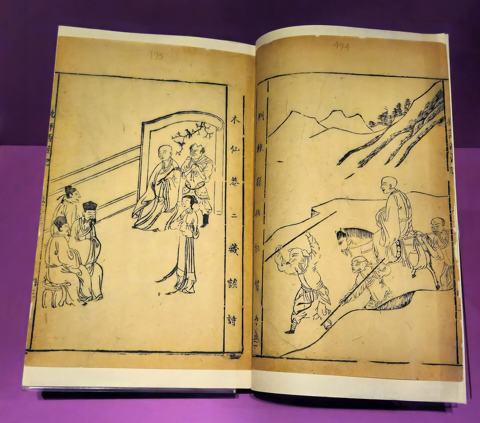
The Ming novel that sent a monk and three monster disciples across demon country for Buddhist scripture — and gave Sun Wukong to the world.
Also mentioned inErlang ShenGuanyinLong, the Chinese DragonNezhaThe Eight ImmortalsXiwangmu (Queen Mother of the West)Yanluo (King Yan)Yu the Great
Sources & Further Reading
- 1.Wu Cheng'en (attrib.), Xiyouji — Journey to the West (16th century); trans. Anthony C. Yu, The Journey to the West, revised edition, 4 vols., University of Chicago Press, 2012.
- 2.Da Tang Sanzang qufa shihua — The Story of How Tripitaka of the Great Tang Procured the Scriptures (Song dynasty).
- 3.Dudbridge, Glen. The Hsi-yu chi: A Study of Antecedents to the Sixteenth-Century Chinese Novel. Cambridge University Press, 1970.
- 4.Shahar, Meir. 'The Lingyin Si Monkey Disciples and the Origins of Sun Wukong.' Harvard Journal of Asiatic Studies 52.1 (1992), 193–224.
- 5.Elliott, Alan J. A. Chinese Spirit-Medium Cults in Singapore. LSE Monographs on Social Anthropology 14, 1955.
Spot an error or have a source to suggest? Write to info@viseterna.com. We cite primary sources and modern scholarship, and we correct fast.