
Journey to the West
The Ming novel that sent a monk and three monster disciples across demon country for Buddhist scripture — and gave Sun Wukong to the world.
Illustrated edition of Journey to the West, 18th century · Public domain · source
A Story Centuries Older Than Its Novel
By the time Journey to the West reached print in the sixteenth century, the journey it tells had already been public property for the better part of a thousand years. The historical monk Xuanzang really did walk from Chang'an to India and back between 629 and 645 CE to bring Buddhist texts to China, and his own travel record and a disciple's biography of him were being reworked into legend within a few centuries of his death 1,2. The Song-dynasty Da Tang Sanzang qufa shihua — "The Story of How Tripitaka of the Great Tang Procured the Scriptures" — is the earliest surviving fictionalised version, and it already gives the monk a supernatural companion: a "monkey pilgrim in white robes" who does most of the fighting and none of the praying 2,4. Yuan-dynasty stage plays kept the pilgrimage in front of audiences for two more centuries, and a fragment of the story was copied into the imperial Yongle Encyclopedia in 1408, proof that a monkey-and-monk version of the tale was standard well before any novel existed 4. One further scholarly proposal traces part of the monkey companion to a Song-period Hangzhou legend of monkey disciples at the Lingyin monastery, a strand of local Buddhist folklore that may have fed into the character alongside the pilgrimage material 6.
The Shidetang Edition and an Unsettled Author
The hundred-chapter novel took its now-classic shape sometime in the sixteenth century. Two earlier printed editions, probably from between 1522 and 1566, are recorded but no copies survive; the oldest surviving complete edition is the 1592 printing from the Shidetang Hall in Jinling, modern Nanjing 1. That edition carries no author's name — the attribution to Wu Cheng'en, a minor Huai'an official and poet, rests on a seventeenth-century local gazetteer that lists a book of this title among his works, not on any claim inside the novel itself 1. Scholars have argued over the attribution for the better part of a century: the gazetteer entry may record only that Wu wrote something called Journey to the West, not necessarily this sprawling vernacular novel, and no surviving edition of the text names an author at all 1,4. This Codex follows convention in crediting him, while flagging the honest position, which is that authorship remains unresolved 1,4.
A Hundred Chapters, Three Monsters, Eighty-One Ordeals
The finished novel has a distinct architecture. Its first seven chapters are effectively a self-contained biography of Sun Wukong, from his stone birth to his defeat by the Buddha, material so complete it is often excerpted on its own 1. Chapters eight through twelve frame the mission proper: Guanyin selects the monk Tang Sanzang to carry scripture back from India, and chapters thirteen to a hundred cover the road itself, organised around a running count of eighty-one ordeals the pilgrims must survive before they are allowed to return 1. Sun Wukong is joined by the disgraced pig-spirit Zhu Bajie, the river-demon-turned-disciple Sha Wujing, and a dragon prince who serves as the horse — a company assembled, chapter by chapter, out of monsters heaven has already half-forgiven 1.
Comedy With a Spiritual Argument Underneath
Read quickly, the novel is a monster-of-the-week adventure carried by a very funny protagonist. Read closely, it is also a work of religious synthesis, braiding Buddhist doctrine, Daoist alchemical vocabulary, and Confucian social order into one continuous joke and one continuous path toward enlightenment 5. Plaks reads the four great Ming novels, this one included, as a coordinated literary achievement in which vernacular fiction first carried the weight of serious philosophical argument, treating the pilgrims' external monsters as figures for internal obstacles — appetite, pride, doubt — that anyone on a spiritual path has to survive 5. The novel never insists on the allegory; it is equally happy read simply as adventure, and both readings sit in the text without much friction 1,5.
Translating the Untranslatable Monkey
English readers have met the novel through very different doors. Arthur Waley's 1942 Monkey: A Folk-Tale of China selected roughly a third of the chapters, dropped nearly all of the verse, and became for decades the only Journey to the West most Western readers knew 3. Anthony C. Yu's complete four-volume translation, published 1977-1983 and revised in 2012, was the first to render every poem and song along with the prose, restoring the novel's constant switching between comic narration and formal verse that Waley had simply cut 1. The gap between the two is really the gap between a story about a monkey and the novel: one built on wordplay, register-shifting, and interpolated poetry that resists translation as much as any classical Chinese text does 1,3.
The Book Behind Half the Codex
Few single texts anchor this Codex as thoroughly as this one. Sun Wukong, the Ruyi Jingu Bang he wields, Erlang Shen's duel with him, Nezha's service under the Jade Emperor, Guanyin's role as the mission's quiet architect, the courts of Diyu that Sun Wukong raids, and the peaches of immortality he steals from Xiwangmu's orchard all either originate in this novel or receive their most famous telling here 1. Dudbridge's study of the pre-novel material makes the same point from the other direction: nearly every element modern readers assume the novel invented was already circulating in some form, and the achievement of Wu Cheng'en, or whoever actually wrote it, was less invention than the disciplined assembly of centuries of accumulated story into one continuous shape 4.
Continue Exploring
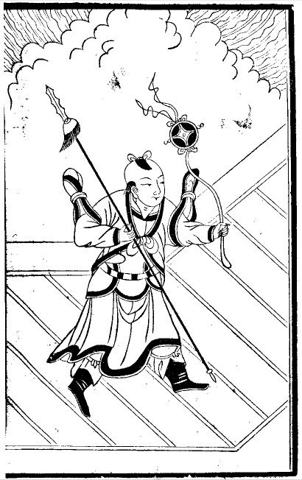
The child god who killed a dragon prince, returned his flesh to his parents, and was rebuilt out of lotus — China's most rebellious divine infant.
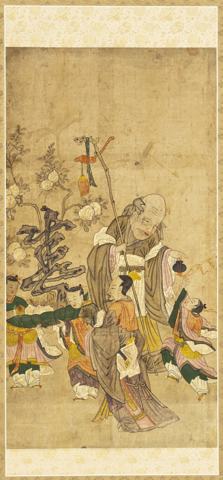
The fruit that ripens once every three thousand years in the Queen Mother's orchard — eaten by the wrong guest, it triggered heaven's most famous brawl.
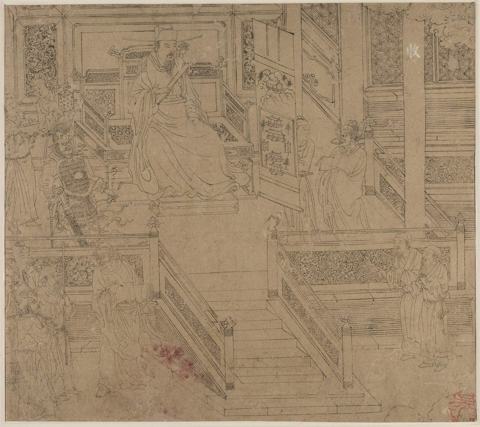
The Chinese underworld — a bureaucracy of ten courts where the dead are tried, serve sentences for what they did, and are then sent back into rebirth.
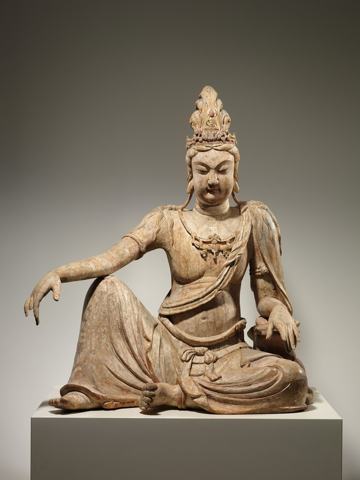
The bodhisattva who hears the cries of the world — an Indian Buddhist figure who became, in China, the most beloved of all female deities.
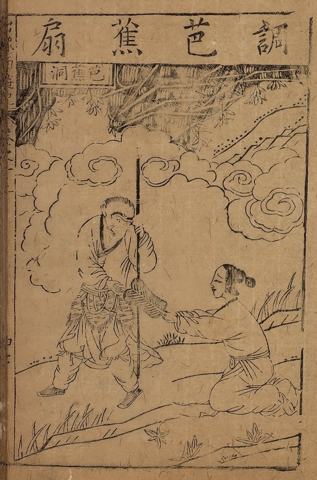
The Monkey King — a stone-born immortal with seventy-two transformations who fought heaven to a standstill, then walked to India as a monk's disciple.
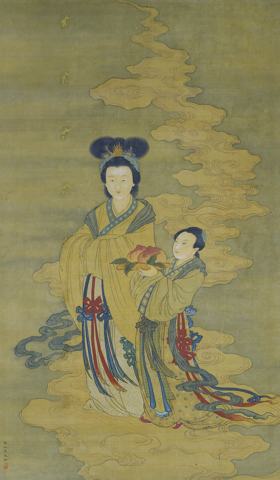
A tiger-toothed mountain spirit who became China's greatest goddess of immortality, keeper of the peaches that ripen once in three thousand years.
Also mentioned inMount KunlunShanhaijing (Classic of Mountains and Seas)
Sources & Further Reading
- 1.Wu Cheng'en (attrib.), Xiyouji — Journey to the West (16th century); trans. Anthony C. Yu, The Journey to the West, revised edition, 4 vols., University of Chicago Press, 2012.
- 2.Da Tang Sanzang qufa shihua — The Story of How Tripitaka of the Great Tang Procured the Scriptures (Song dynasty).
- 3.Waley, Arthur (trans.). Monkey: A Folk-Tale of China. George Allen & Unwin, 1942.
- 4.Dudbridge, Glen. The Hsi-yu chi: A Study of Antecedents to the Sixteenth-Century Chinese Novel. Cambridge University Press, 1970.
- 5.Plaks, Andrew H. The Four Masterworks of the Ming Novel: Ssu Ta Ch'i-Shu. Princeton University Press, 1987.
- 6.Shahar, Meir. 'The Lingyin Si Monkey Disciples and the Origins of Sun Wukong.' Harvard Journal of Asiatic Studies 52.1 (1992), 193-224.
Spot an error or have a source to suggest? Write to info@viseterna.com. We cite primary sources and modern scholarship, and we correct fast.