
Diyu
The Chinese underworld — a bureaucracy of ten courts where the dead are tried, serve sentences for what they did, and are then sent back into rebirth.
Album of Daoist and Buddhist Themes: Kings of Hells, Leaf 29, Southern Song dynasty (Cleveland Museum of Art) · CC0 · source
What Diyu Is
Diyu (地獄) means "earth prison," and prison is the right word. It is the Chinese underworld: not a place of eternal damnation but a vast judicial and penal system through which the dead pass, are tried, serve determinate sentences proportionate to their offences, and are then released into rebirth 5,7.
This is the single most important thing to understand about it. Diyu is purgatorial, not final. Terms end. Records are kept, merit is counted, sentences can be commuted by the actions of the living, and every soul is on its way somewhere else 5,6. Chinese death ritual is still organised around that assumption in many communities today, and what follows describes a living practice as much as a mythology 5,7.
Before Buddhism: Yellow Springs and Mount Tai
China had an afterlife before it had hells. Early texts speak of the Yellow Springs, Huangquan, a shadowy subterranean destination reached by all the dead without regard to conduct 6,7. By the Han dynasty a more administrative picture had formed, centred on Mount Tai in Shandong, whose lord kept the registers of human lifespans and received the dead; Han tomb documents are addressed to underworld officials in the language of court paperwork, complete with the equivalent of case numbers 6,7.
Von Glahn emphasises that this bureaucratic idiom coexisted from the start with a darker one, in which the dead were dangerous, aggrieved, and capable of afflicting the living — a demonic register that no amount of celestial filing ever fully replaced 6.
The Ten Kings
The Diyu that most people picture — ten courts, ten judges, a fixed sequence — is a medieval Chinese creation, and its formation can be dated with unusual precision. Buddhism brought the naraka, the hells of Indian cosmology, and their overseer Yama, who became Yanluo Wang in Chinese 5. What Chinese Buddhism then built out of that material was something new.
The Scripture on the Ten Kings, an apocryphon composed in Chinese around the ninth or tenth century and preserved in the Dunhuang manuscripts, sets out a sequence of ten magistrates through whose courts the deceased must pass in order 1,5. Teiser's study shows how exactly the scheme maps onto Chinese mortuary practice: the soul appears before a new king at each of the seven weekly memorial services in the first forty-nine days after death, then at the hundredth day, the first anniversary, and the third — ten rites, ten kings 5.
That is the mechanism's real genius. The dead person's progress through the courts is synchronised with the family's own ritual calendar, so that every offering, recitation, and burnt document arrives as evidence in an ongoing case 5. Yanluo Wang presides over the fifth court in the standard arrangement; the tenth handles allocation to the next life 1,5.
The Courts and Their Punishments
Later popular literature filled the system in with grim specificity. The Qing-dynasty morality tract known as the Jade Record and its many illustrated descendants assign particular hells to particular sins: the mountain of knives, the forest of blades, cauldrons of boiling oil, hells of ice, of grinding, of tongue-extraction for slander and false speech 3,7. Ox-Head and Horse-Face, the underworld's guards, escort prisoners between courts 7.
In the first court stands the Mirror of Retribution, in which the newly dead see their own lives replayed and can dispute nothing 3,7. Such texts were explicitly didactic, printed cheaply and distributed as merit; their function is closer to a public information campaign than to a metaphysical treatise, and Teiser cautions against treating vivid hell imagery as systematic theology 3,5,6.
Getting Out
Release is the point of the system, and there are several routes to it. Sentences expire. Merit accumulated in life shortens them. And the living can intervene on behalf of the dead — by commissioning rites, reciting scripture, giving to monastic communities, and transferring the merit generated 1,5.
The presiding figure of that hope is Dizang — Ksitigarbha — the bodhisattva who vowed not to become a buddha while any hell remains occupied, and who walks the underworld with a staff to open its gates and a wish-fulfilling jewel to light it 5,7. His scriptural companion piece is the story of the monk Mulian, who finds his mother reborn among the hungry ghosts and cannot free her by his own power alone; on the Buddha's instruction he makes offerings to the assembled monastic community, and her release follows 2,5.
At the exit stands Meng Po, the old woman at the end of the tenth court, who serves each soul a broth that erases the memory of everything before it crosses the bridge into a new life 7.
The Ghost Festival and Living Practice
The Mulian story is the charter for the Ghost Festival, the Yulanpen or Zhongyuan observance on the fifteenth day of the seventh lunar month, when — in popular belief — the gates of the underworld open and the dead return for a month 2,5,7.
Its practices are among the most visible in Chinese religion: offerings of food set out for wandering hungry ghosts with no family to feed them, incense at roadsides, and the burning of paper goods — spirit money, "hell bank notes," paper houses, cars, and appliances — dispatched to the dead for use in the courts below 6,7. The underworld runs on remittances, and popular accounts are frank about bribery, connections, and clerical error 6.
Diyu in Fiction and on Site
Chinese fiction uses the underworld freely. In Journey to the West, Sun Wukong is dragged below, demands the register of the dead, and strikes out his own name and every monkey's — after which the Ten Kings send a formal complaint up to the Jade Emperor; the same novel sends the emperor Taizong on a guided tour of the courts, from which he returns a religious reformer 4.
The system is also built. Fengdu on the Yangtze has been identified for centuries as an entrance to the underworld and is now a temple-and-tourism complex; the Ten Courts of Hell dioramas at Haw Par Villa in Singapore, opened in the 1930s, remain among the most visited depictions of Diyu anywhere 7.
The consistent theme through all of it is accountability rather than terror. Diyu is frightening in its details, but its architecture says that conduct is recorded, that the record is auditable, and that no sentence is forever 5,6.
Continue Exploring
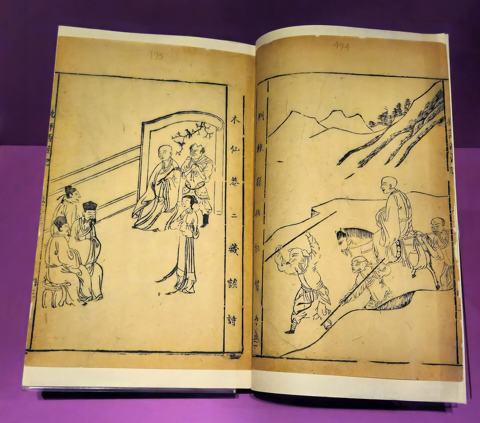
The Ming novel that sent a monk and three monster disciples across demon country for Buddhist scripture — and gave Sun Wukong to the world.
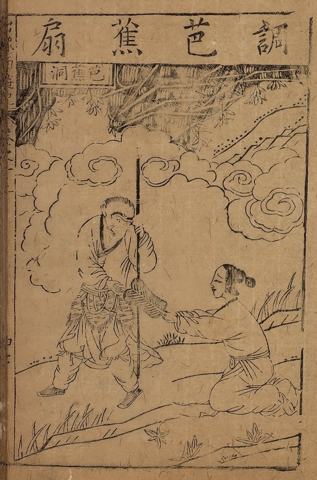
The Monkey King — a stone-born immortal with seventy-two transformations who fought heaven to a standstill, then walked to India as a monk's disciple.
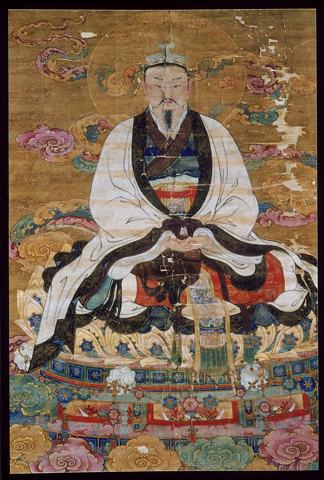
Sovereign of Heaven and head of the celestial bureaucracy — the emperor of the gods, who governs the cosmos the way a dynasty governs a realm.
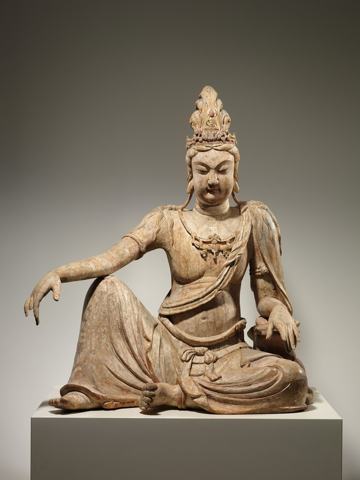
The bodhisattva who hears the cries of the world — an Indian Buddhist figure who became, in China, the most beloved of all female deities.
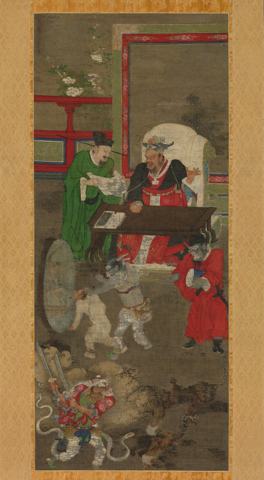
The magistrate-king of the Chinese underworld, who tries every soul against a written record and a mirror that shows what they actually did.
The ugly failed scholar who killed himself on the palace steps and came back as heaven's demon-catcher — hung on doors at New Year to eat what haunts the house.
Also mentioned inJiangshi (Hopping Vampire)Mount Tai (Taishan)
Sources & Further Reading
- 1.Shiwang jing — The Scripture on the Ten Kings (c. 9th–10th c. CE), Dunhuang manuscripts.
- 2.Yulanpen jing — The Ullambana Sutra (Chinese, by the 6th c. CE).
- 3.Yuli baochao — The Jade Record (Qing dynasty morality tract).
- 4.Wu Cheng'en (attrib.), Journey to the West — Xiyouji (16th c.).
- 5.Teiser, Stephen F. The Scripture on the Ten Kings and the Making of Purgatory in Medieval Chinese Buddhism. University of Hawai'i Press, 1994.
- 6.von Glahn, Richard. The Sinister Way: The Divine and the Demonic in Chinese Religious Culture. University of California Press, 2004.
- 7.Yang, Lihui & Deming An. Handbook of Chinese Mythology. ABC-CLIO, 2005.
Spot an error or have a source to suggest? Write to info@viseterna.com. We cite primary sources and modern scholarship, and we correct fast.