
Zao Jun (the Kitchen God)
The household god who watches every family from above the stove all year, then ascends before New Year to report their conduct to the Jade Emperor.
Zao Jun, the Kitchen God, illustration from E.T.C. Werner, Myths and Legends of China, 1922 · Public domain · source
The God in the Kitchen
Zao Jun (灶君), "the Lord of the Stove," or Zao Shen, "the Stove God," is one of the most universally installed deities in Chinese popular religion — a small paper or woodblock print pasted above or beside the kitchen stove in ordinary households, rather than a figure with grand temples of his own 5,7. His job is domestic surveillance: he watches everything a family does for the entire year, then travels to heaven shortly before the New Year to report on it 5,7. Chard describes the cult as unusually well attested precisely because it required no priesthood and no temple, only an image, a household, and a fixed date — which meant it survived in some form through periods when more institutional religion came under pressure 5.
Earliest Attestations
A spirit specifically located in the stove is one of the older domestic beliefs on record. The Zhuangzi, in a passage listing the various spirits said to inhabit different parts of a house and its surroundings, names one that lives in the stove — among the oldest surviving hints that the hearth itself, as distinct from ancestors or the house generally, was treated as inhabited 1. By the Han dynasty the stove had been formally absorbed into state ritual: the Liji, the Book of Rites, lists the stove among the "Five Sacrifices" (wusi), the minor household and seasonal spirits — door, stove, the central room, gate, and the road — owed regular offerings alongside the greater sacrifices to ancestors and to heaven 2. Wang Chong, writing around 80 CE, took popular stove-worship seriously enough to argue against exaggerated folk claims about the god's power, itself indirect evidence that the cult was already widespread and taken for granted in ordinary households of his own time 3.
The Legend of Zhang Lang
Popular explanation eventually gave the god a human backstory. The best-known version names him Zhang Lang: a man who abandoned his virtuous wife for a younger woman, was reduced to blindness and beggary as a consequence, and was fed by his former wife without recognizing her; when he finally realized who had shown him kindness, he was so ashamed that he threw himself into the kitchen stove, and the Jade Emperor, moved by the sincerity of his remorse, made him the household's permanent watcher instead of destroying him outright 7. Yang and An treat the tale as a moral fable grafted onto an older, nameless stove spirit rather than the god's original identity — a folk etiology explaining, after the fact, why the household's harshest witness lives in the one room where food is both wasted and shared 7.
The Yearly Report
Zao Jun's defining ritual moment falls on the twenty-third or twenty-fourth day of the twelfth lunar month, shortly before the New Year, when his image is understood to leave the stove and ascend to heaven to render an account of the household's conduct over the past year directly to the Jade Emperor 5,7. Ahern's study of the bureaucratic metaphor in Chinese popular religion places this ritual squarely within a larger pattern: household and local gods are imagined as the lowest tier of an administrative hierarchy that mirrors the imperial civil service, filing reports upward and receiving instructions, rewards, or punishments downward in turn 6. Zao Jun is, in that scheme, the household's own resident clerk — the deity with the least dignity and the most intimate knowledge of what actually happens in a family 5,6.
Sweetening the Report
Because the report determines whether the coming year brings fortune or misfortune, households have long tried to manage what it contains. The standard practice, recorded across regional variation, is to smear the paper image's mouth with honey, malt sugar, or other sticky sweets before he departs — read either as buttering him up so he speaks favorably, or more bluntly as gumming his lips shut so he cannot report anything damaging at all 7. The old image is then burned so the god can travel, and a new one pasted up to welcome him back after the New Year, a small annual cycle of dismissal and reinstallation that keeps the household's most-watched witness formally as good as new every twelve months 5,7.
A God Without a Temple
Zao Jun's cult has no equivalent of the pilgrimage sites built for gods like Mazu or the Dragon Kings of popular legend; because he belongs to a single house rather than a community, his religious life is entirely domestic, renewed at every stove in the country rather than centralized anywhere 4,5. That structure has made him unusually resistant to erosion — a deity too small and too local to be an obvious target for reform movements, and one who has simply moved, along with the stove itself, from the wood-fired hearths of Wang Chong's era into the gas ranges of the present without much ceremony lost along the way 4,5.
Continue Exploring
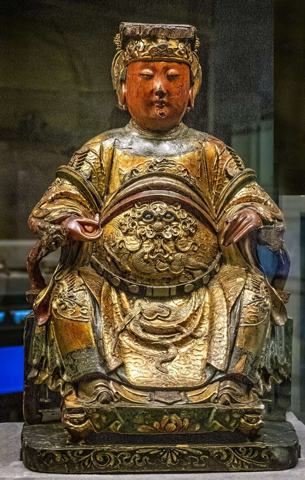
A Fujian fisherman's daughter who died young around 987 and rose, title by imperial title, to become Empress of Heaven and the sea goddess of the Chinese coast.
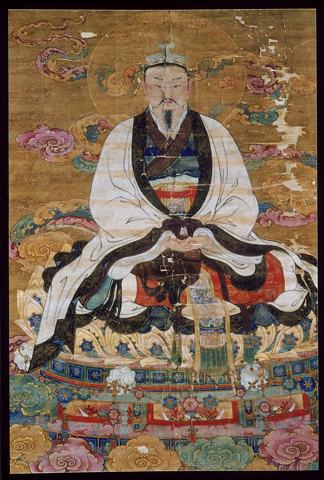
Sovereign of Heaven and head of the celestial bureaucracy — the emperor of the gods, who governs the cosmos the way a dynasty governs a realm.
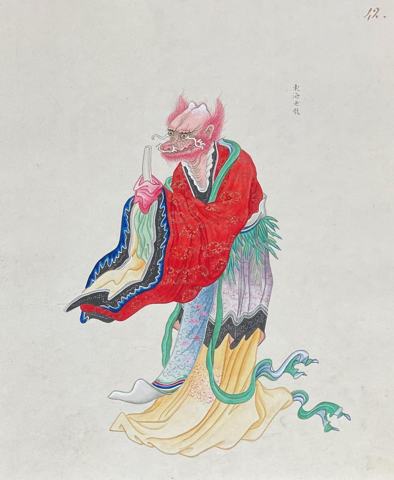
Four bureaucrat-dragons who rule the seas from undersea palaces, command rain and flood, and get bullied by mortal heroes in China's best-loved novels.
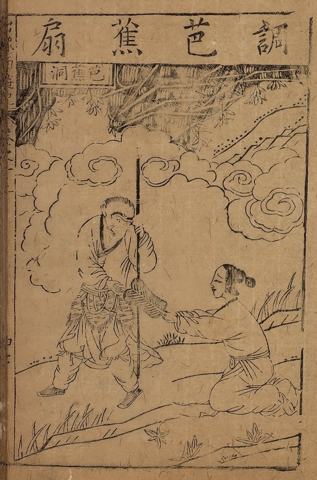
The Monkey King — a stone-born immortal with seventy-two transformations who fought heaven to a standstill, then walked to India as a monk's disciple.
The child god who killed a dragon prince, returned his flesh to his parents, and was rebuilt out of lotus — China's most rebellious divine infant.
The Three Kingdoms general executed in 220 CE who rose, title by title, into a god of war, loyalty, and wealth worshipped across the Chinese-speaking world.
Sources & Further Reading
- 1.Zhuangzi (compiled Warring States period), 'Dasheng' chapter — an early reference to a spirit residing in the stove.
- 2.Liji — Book of Rites, 'Jifa' chapter (ritual canon compiled/edited Han dynasty).
- 3.Wang Chong, Lunheng — Discourses Weighed in the Balance (c. 80 CE).
- 4.Ying Shao, Fengsu tongyi — Comprehensive Meaning of Customs (c. 195 CE).
- 5.Chard, Robert. 'Rituals and Scriptures of the Stove Cult.' In Ritual and Scripture in Chinese Popular Religion: Five Studies, edited by David Johnson. Chinese Popular Culture Project / Institute of East Asian Studies, University of California, Berkeley, 1995.
- 6.Ahern, Emily Martin. Chinese Ritual and Politics. Cambridge University Press, 1981.
- 7.Yang, Lihui and Deming An. Handbook of Chinese Mythology. ABC-CLIO, 2005.
Spot an error or have a source to suggest? Write to info@viseterna.com. We cite primary sources and modern scholarship, and we correct fast.