
Xiwangmu (Queen Mother of the West)
A tiger-toothed mountain spirit who became China's greatest goddess of immortality, keeper of the peaches that ripen once in three thousand years.
Xi Wangmu, unidentified Chinese painter, 19th century, ink and colour on silk, bearing an apocryphal signature of Yu Zhiding · Public domain · source
Who Xiwangmu Is
Xiwangmu (西王母), the Queen Mother of the West, is the most important goddess in the Chinese tradition and one of the very few whose worship can be traced continuously for more than two thousand years 5,7. She rules a mountain paradise in the far west, keeps the drug and the fruit of deathlessness, presides over the ranks of female transcendents, and decides who may cross from mortality into the immortal registers 5.
Her name is a title rather than a personal name — "Western Queen Mother" or "Queen Mother of the West" — and the earliest sources use it for something considerably stranger than the elegant lady of later painting 1,7.
The Tiger-Toothed Original
In the Shanhaijing, the oldest substantial description, she lives on Mount Yu, has a human form but a leopard's tail and tiger's teeth, howls or whistles well, wears her hair loose beneath a sheng headdress, and "presides over the Catastrophes from the Sky and the Five Destructive Forces" 1. That is not a goddess of mercy; it is a spirit of plague, punishment, and cosmic disorder, closer to a tiger deity of the western wilds than to a queen 1,7. Other passages give her three green birds that fetch her food and place her beyond the Flowing Sands 1.
The transformation from that figure to a refined immortal sovereign is the central puzzle of her history, and Cahill's study of the medieval material treats it as a real, traceable development rather than a confusion of two goddesses 5. Something in the tiger-woman's control over death made her the natural custodian of its opposite 5,7.
King Mu and Emperor Wu
Two famous encounters fixed her literary character. In the Mu tianzi zhuan, King Mu of Zhou drives his eight famous horses into the far west and banquets with the Queen Mother beside the Turquoise Pond. They exchange sung poems; she asks whether he will come again, and he promises to return in three years — a promise the story leaves conspicuously unfulfilled 2,7. The scene establishes the pattern of the divine woman receiving a mortal ruler as a near-equal, and of the meeting being fleeting.
In the Han Wudi neizhuan, she descends to Emperor Wu of the Han on the seventh night of the seventh month, appearing not as a monster but as a beautiful woman who looks about thirty. She gives him peaches from a tree that fruits once in three thousand years, and when he tries to save the stones to plant, she tells him the tree will not grow in the mortal world. She then judges him unfit for the teachings he wants, and leaves 3,5. Cahill reads the text as Daoist religious literature rather than court romance: the goddess is a teacher testing a candidate for transcendence, and the emperor fails 5.
Han Cult and the Panic of 3 BCE
The Queen Mother's worship is visible in the archaeological record long before the Daoist canon takes her up. She appears constantly on Han bronze mirrors, tomb tiles, and funerary shrine reliefs, enthroned with a hare pounding the elixir, a nine-tailed fox, a three-legged crow and a toad — an iconography Loewe reads as a map of the paradise the dead hoped to reach 6. In the later Han she is regularly paired with a King Father of the East invented to balance her 6,7.
The most striking evidence is a documented mass movement. The Hanshu records that in the last years of the reign of Emperor Ai, in 3 BCE, a wave of excitement passed through the eastern provinces and on to the capital: crowds of people carried tokens or stalks associated with the Queen Mother from district to district, gathered at night with torches, sang and danced in her honour, and passed on a written message promising that those who wore her talisman would not die 4,6. Court officials treated it as a portent of dynastic failure 4. Whatever its causes, it shows a goddess with genuine popular reach at a moment of drought and political crisis, not merely a literary figure 6.
The Peach Banquet and Later Tradition
By the Tang, Daoist writers had made her the highest goddess of the pantheon, mistress of Mount Kunlun, keeper of the registers of the transcendents, and the giver of scriptures and of divine marriages to worthy adepts; Cahill builds her study on Du Guangting's collection of hagiographies of female transcendents, in which the Queen Mother stands at the head of the whole company 5.
In vernacular fiction she becomes the hostess of the Peach Banquet (蟠桃會), the periodic feast at which the immortals eat her peaches and renew their deathlessness. It is that banquet Sun Wukong wrecks in Journey to the West, having first eaten the peaches he was hired to guard — a comic episode that assumes the audience knows exactly how valuable the fruit is 5,7. Later popular tradition also pairs her with the Jade Emperor as his consort, though this is a late arrangement and not part of her early identity 5,7.
She is also the source of the elixir in the other great immortality story: it is from the Queen Mother that the archer Houyi obtains the drug that his wife Chang'e swallows before rising to the moon 7.
Continue Exploring
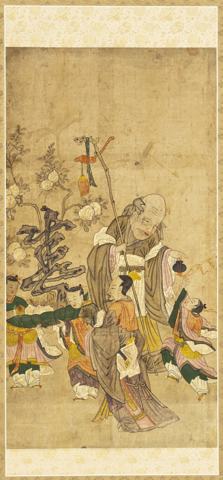
The fruit that ripens once every three thousand years in the Queen Mother's orchard — eaten by the wrong guest, it triggered heaven's most famous brawl.
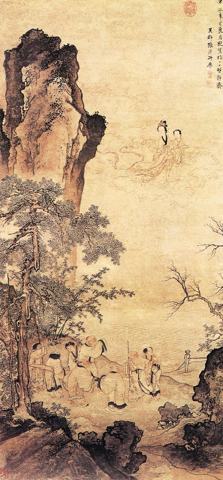
China's cosmic mountain in the far west — the Yellow Emperor's earthly capital, the Queen Mother's paradise, and, confusingly, a real Asian mountain range too.
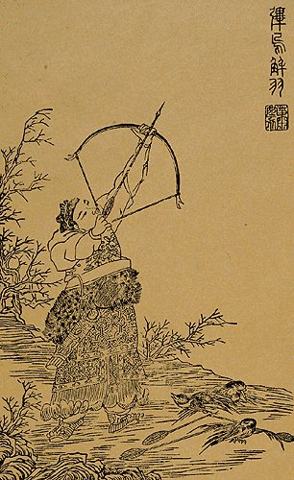
The archer who shot nine of the ten suns out of the sky, won the elixir of immortality, and lost it to his wife Chang'e.
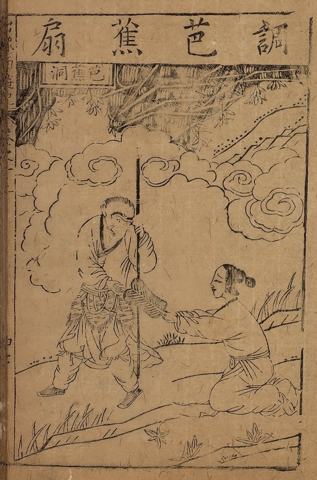
The Monkey King — a stone-born immortal with seventy-two transformations who fought heaven to a standstill, then walked to India as a monk's disciple.
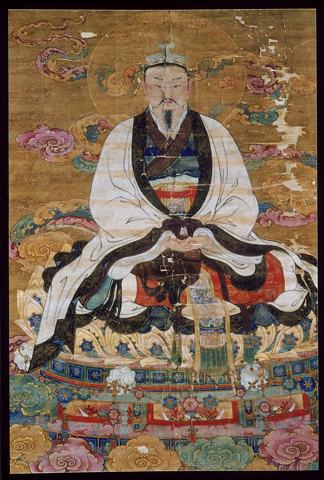
Sovereign of Heaven and head of the celestial bureaucracy — the emperor of the gods, who governs the cosmos the way a dynasty governs a realm.
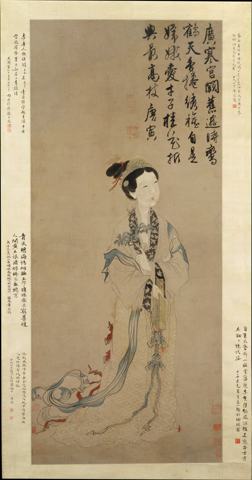
The moon goddess who swallowed the elixir of immortality and rose beyond reach — honoured each Mid-Autumn Festival with mooncakes and lanterns.
Also mentioned inHuli Jing (Chinese Fox Spirit)Journey to the WestShanhaijing (Classic of Mountains and Seas)
Sources & Further Reading
- 1.Shanhaijing — The Classic of Mountains and Seas (compiled c. 4th century BCE – 2nd century CE), esp. the 'Classic of the Western Mountains' and the 'Great Wilderness' chapters; trans. Anne Birrell, Penguin Classics, 1999.
- 2.Mu tianzi zhuan — The Account of Mu, Son of Heaven (recovered from a tomb in 279 CE; text probably 4th–3rd century BCE).
- 3.Han Wudi neizhuan — The Inner Biography of Emperor Wu of the Han (Six Dynasties period).
- 4.Ban Gu, Hanshu — Book of Han (1st century CE), 'Annals of Emperor Ai' and 'Treatise on the Five Phases' (the movement of 3 BCE).
- 5.Cahill, Suzanne E. Transcendence and Divine Passion: The Queen Mother of the West in Medieval China. Stanford University Press, 1993.
- 6.Loewe, Michael. Ways to Paradise: The Chinese Quest for Immortality. George Allen & Unwin, 1979.
- 7.Birrell, Anne. Chinese Mythology: An Introduction. Johns Hopkins University Press, 1993.
Spot an error or have a source to suggest? Write to info@viseterna.com. We cite primary sources and modern scholarship, and we correct fast.