
The Peaches of Immortality
The fruit that ripens once every three thousand years in the Queen Mother's orchard — eaten by the wrong guest, it triggered heaven's most famous brawl.
Shoulao, God of Longevity, Korean, Joseon dynasty, 18th century (Los Angeles County Museum of Art) · Public domain · source
A Tree That Fruits Once in Three Thousand Years
In the mythology of the Queen Mother of the West, immortality is not a state so much as a harvest. Xiwangmu keeps an orchard on Mount Kunlun where a single peach tree, the Pantao, "coiled peach," bears fruit only once every three thousand years, and eating one grants deathlessness to whoever eats it 2,3. The tree is not merely rare; it is functionally singular in the tradition, and its slow, near-geological fruiting cycle is the whole point — this is not a medicine anyone can be given quickly, but a reward measured on a cosmic clock 2.
What the Han Emperor Was Given
The fullest early account of the fruit comes from the Han Wudi neizhuan, a Six Dynasties text describing a visit by Xiwangmu to Emperor Wu of the Han. She gives him peaches from the tree, and when he tries to save the pits to plant an orchard of his own, she tells him plainly that the tree does not grow in the mortal world 2. Cahill reads the scene as Daoist teaching literature rather than court romance: the peaches are a test as much as a gift, and the emperor's attempt to own the source of immortality, rather than simply receive it from a worthy teacher, marks him, in the text's own logic, as not yet ready for what he is asking for 3. He is given the fruit but refused the tree — deathlessness offered once, not held as property 2,3.
Not the Same Immortality as the Elixir
It is worth being precise about which Xiwangmu myth is which, since the tradition preserves at least two distinct routes to deathlessness that later retellings often blur. The peaches are eaten fruit, tied to Kunlun and to the Peach Banquet; separately, Xiwangmu is also keeper of a drug of deathlessness, the elixir she gives the archer Houyi and that his wife Chang'e swallows before rising to the moon 4. Loewe's survey of the Chinese immortality quest treats these as parallel rather than identical traditions — a compounded drug on one hand, a fruit that simply needs to be eaten on the other — both administered by the same goddess but through different material means and different stories 4.
Sun Wukong Robs the Orchard
The fruit's most famous appearance is also its most disastrous. In Journey to the West, the Jade Emperor fobs Sun Wukong off with the empty honorary post of Guardian of the Peach Garden, heaven's least dignified job dressed up as a promotion 1. Wukong promptly eats his way through the orchard by rank: the outer trees fruit every three thousand years and merely extend life, the middle trees every six thousand and grant physical immortality, and the innermost trees every nine thousand years and confer power equal to heaven and earth — a graded system the novel lays out in careful, almost bureaucratic detail before Wukong demolishes it 1. He follows the theft by crashing the Peach Banquet itself and drinking the wine meant for the assembled immortals, setting off the chain of offences that ends in his rebellion against heaven 1.
An Older Symbol Than the Novel
The peach's status as a ward against death and evil predates any of these stories. Peach wood was used in Han-dynasty exorcistic ritual to make charms and door-guardian figures, and the fruit's link to long life appears in Chinese material culture well before Journey to the West gave it a plot 5,6. Birrell traces the peach's protective and longevity associations to beliefs considerably older than the Han court legends about Xiwangmu, suggesting the goddess's orchard is a mythic elaboration built onto a symbol that already carried this meaning in folk practice 5.
Still on the Birthday Table
The mythic fruit survives as a very literal piece of Chinese custom. Shoutao, steamed buns shaped and tinted to look like a peach, often with a painted crease down one side, are a standard birthday gift, especially for elders, and the god of longevity, Shoulao, is conventionally shown holding an oversized peach or standing beside a peach tree, exactly the pairing that later Chinese and Korean court painting repeats 6. The fruit that once needed three thousand years to ripen on Kunlun is now baked fresh for anyone's sixtieth birthday, a piece of myth that never really left the table 6.
Continue Exploring
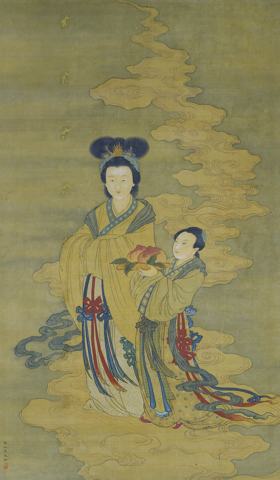
A tiger-toothed mountain spirit who became China's greatest goddess of immortality, keeper of the peaches that ripen once in three thousand years.
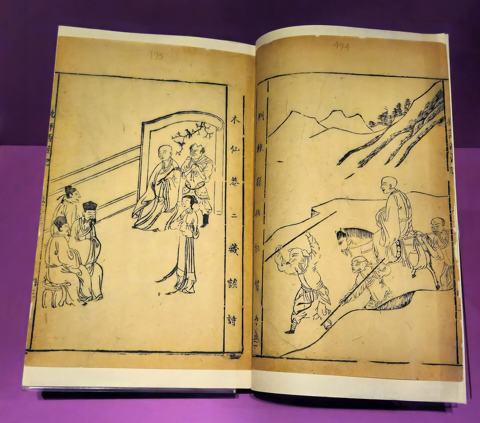
The Ming novel that sent a monk and three monster disciples across demon country for Buddhist scripture — and gave Sun Wukong to the world.
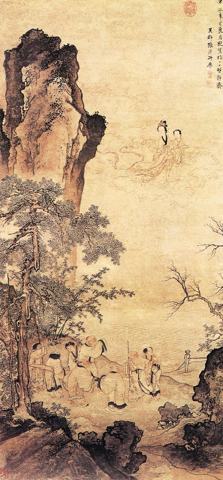
China's cosmic mountain in the far west — the Yellow Emperor's earthly capital, the Queen Mother's paradise, and, confusingly, a real Asian mountain range too.
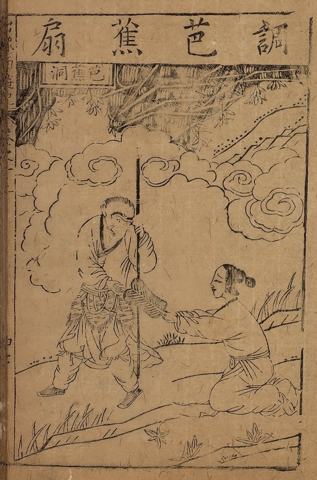
The Monkey King — a stone-born immortal with seventy-two transformations who fought heaven to a standstill, then walked to India as a monk's disciple.
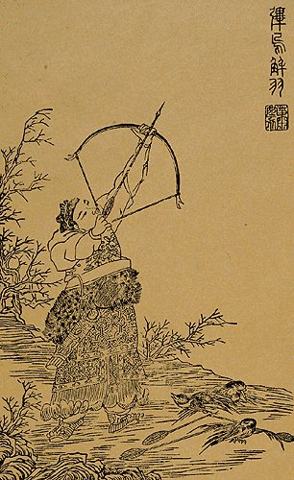
The archer who shot nine of the ten suns out of the sky, won the elixir of immortality, and lost it to his wife Chang'e.
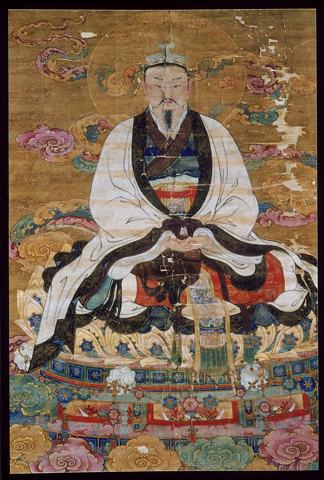
Sovereign of Heaven and head of the celestial bureaucracy — the emperor of the gods, who governs the cosmos the way a dynasty governs a realm.
Sources & Further Reading
- 1.Wu Cheng'en (attrib.), Xiyouji — Journey to the West (16th century); trans. Anthony C. Yu, The Journey to the West, revised edition, 4 vols., University of Chicago Press, 2012.
- 2.Han Wudi neizhuan — The Inner Biography of Emperor Wu of the Han (Six Dynasties period).
- 3.Cahill, Suzanne E. Transcendence and Divine Passion: The Queen Mother of the West in Medieval China. Stanford University Press, 1993.
- 4.Loewe, Michael. Ways to Paradise: The Chinese Quest for Immortality. George Allen & Unwin, 1979.
- 5.Birrell, Anne. Chinese Mythology: An Introduction. Johns Hopkins University Press, 1993.
- 6.Yang, Lihui & Deming An. Handbook of Chinese Mythology. ABC-CLIO, 2005.
Spot an error or have a source to suggest? Write to info@viseterna.com. We cite primary sources and modern scholarship, and we correct fast.