
Guan Yu (Guan Di)
The Three Kingdoms general executed in 220 CE who rose, title by title, into a god of war, loyalty, and wealth worshipped across the Chinese-speaking world.
Guan Yu, Chinese God of War, Katsushika Hokusai, c. 1800-1849 (Metropolitan Museum of Art) · Public domain · source
The General
Guan Yu (關羽, d. January 220 CE) began as a flesh-and-blood soldier, not a myth. Chen Shou's Sanguozhi, the near-contemporary official history of the Three Kingdoms period, records him as one of the earliest followers of the warlord Liu Bei, alongside Zhang Fei, serving through the chaotic final decades of the Han dynasty 1,3. He is remembered for a sharply defined act of loyalty under pressure: captured briefly by the rival warlord Cao Cao in 200 CE, he fought loyally in Cao Cao's service for a time — killing the enemy general Yan Liang at the Battle of Boma — and then, once he learned Liu Bei's whereabouts, left Cao Cao's considerable rewards behind and returned to his original lord 1,3. De Crespigny's biographical dictionary treats this episode as the historical kernel around which the later cult of unbreakable loyalty would eventually be built, an act reported soberly in the third-century sources, long before anyone was praying to him 3.
Death at Maicheng
Guan Yu's later career was less fortunate. Given command of Liu Bei's territory in Jing Province, he won a major victory at the Battle of Fancheng in 219, defeating the general Yu Jin and executing Pang De — but while his forces were committed there, the rival warlord Sun Quan's army seized Jing Province behind him 1,3. Cut off and retreating toward Maicheng, Guan Yu was captured and executed, along with his son Guan Ping, in early 220 1,3. The Sanguozhi records the death plainly, as a military and political failure; ter Haar's study of the later cult takes its title, "the religious afterlife of a failed hero," directly from this fact, arguing that Guan Yu's defeat and betrayal, not an unbroken record of triumph, are what made him usable as a figure onto whom later devotees could project loyalty betrayed and wrongs still to be avenged 5.
From Local Ghost to Imperial God
The transformation from dead general to deity took centuries and moved through several distinct religious registers. Buddhist temple legend, from roughly the Sui dynasty (581-618) onward, cast him as a local spirit near Jingzhou who was converted and became a guardian of the Buddhist faith 5. Daoist and popular cults developed in parallel, and the imperial state took progressively greater notice: successive dynasties from the Song onward raised his posthumous rank from duke to prince to, eventually, emperor, and by the Qing he carried the honorific "Saint of War" (Wusheng), a deliberate pairing with Confucius as "Saint of Culture" (Wensheng) 4,5. Chinese popular religion regularly imagines such promotions as issued from above by the Jade Emperor's celestial court, mirroring the same earthly bureaucracy that granted Guan Yu his mounting list of titles here on earth 6. Duara reads this long sequence of escalating titles not as simple piety but as a contest: the imperial state, local temple communities, and various popular movements each had their own reasons to claim Guandi and inscribe their own meaning onto him, a process he calls "superscription," new meanings layered onto the same symbol without erasing the old ones 4. Guan Yu belongs to a small set of deified mortals in Chinese popular religion, a group that also includes the sea goddess Mazu and the demon-queller Zhong Kui: historical or quasi-historical figures elevated by imperial title and popular devotion into full gods 6.
Guardian, Warrior, Moneylender
By the late imperial period Guan Yu's portfolio had broadened well past his original military role. He is invoked as a protector by soldiers and by police, as a patron of righteousness and sworn brotherhood by secret societies and martial lineages who look back to the oath he swore with Liu Bei and Zhang Fei, and, in a role that would have surprised his own century, as a god of wealth, venerated by merchants and shopkeepers particularly from the eighteenth century onward 5,6. Ter Haar traces this last association partly to the reputation of Shanxi merchants, Guan Yu's home province, and partly to the general logic by which a figure known for scrupulous honesty made an obvious patron for the trust that commercial credit requires 5. He is worshipped across Confucian, Daoist, and Buddhist contexts simultaneously, with no single institution claiming exclusive ownership of him 4,5.
Guan Yu in Fiction
Guan Yu's popular image owes at least as much to fiction as to the official history. The Sanguo yanyi, the Romance of the Three Kingdoms compiled from earlier oral and dramatic material in the fourteenth century, gives him his most durable attributes: the Qinglong Yanyue Dao, the Green Dragon Crescent Blade, a weapon not attested in the third-century record; his red face and magnificent long beard; and set-piece episodes such as riding alone through five passes, killing six generals, to rejoin Liu Bei, and calmly playing a board game while a physician scrapes poison from the bone of his arm 2. These scenes, not the sparer historical record, are what most people who invoke Guan Yu today actually picture, and the novel's Guan Yu — loyal past the point of self-interest, contemptuous of bribery, unshakeable under pain — is the version the religious cult formally venerates 2,5.
Guan Yu Today
Guan Yu, as Guandi or Guan Gong, remains one of the most widely worshipped deities in the Chinese-speaking world, with temples across mainland China, Taiwan, Hong Kong, and the diaspora, and a particularly strong presence in police stations and small businesses that keep a shrine to him for much the same reason ancient soldiers once did: trust in a figure whose myth insists, against a good deal of ordinary human evidence, that loyalty and honesty are rewarded in the end 4,5.
Continue Exploring
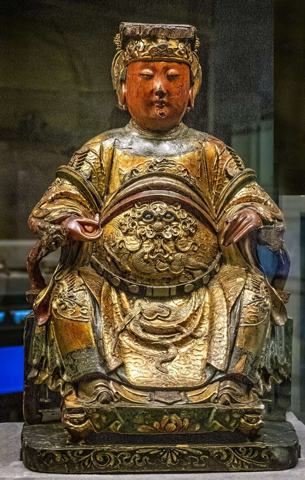
A Fujian fisherman's daughter who died young around 987 and rose, title by imperial title, to become Empress of Heaven and the sea goddess of the Chinese coast.
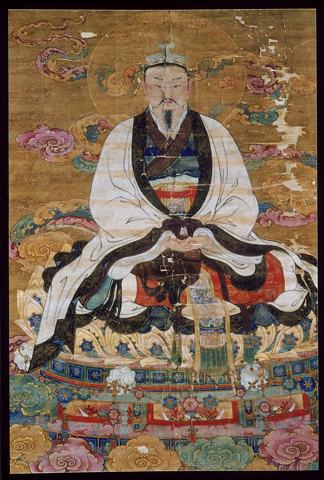
Sovereign of Heaven and head of the celestial bureaucracy — the emperor of the gods, who governs the cosmos the way a dynasty governs a realm.
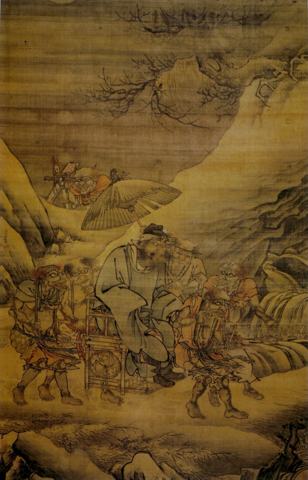
The ugly failed scholar who killed himself on the palace steps and came back as heaven's demon-catcher — hung on doors at New Year to eat what haunts the house.
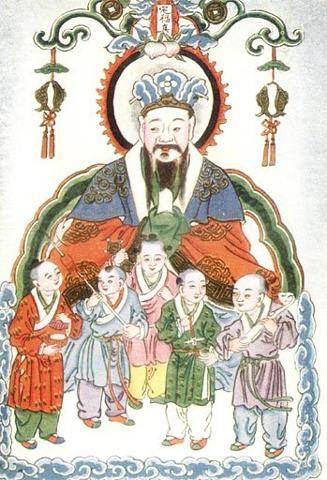
The household god who watches every family from above the stove all year, then ascends before New Year to report their conduct to the Jade Emperor.
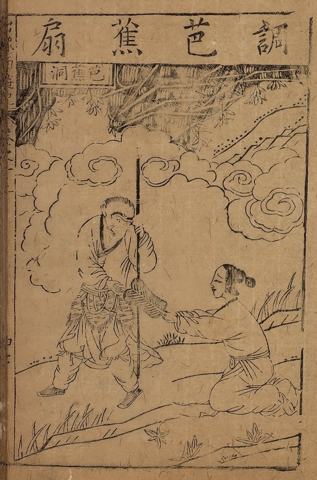
The Monkey King — a stone-born immortal with seventy-two transformations who fought heaven to a standstill, then walked to India as a monk's disciple.
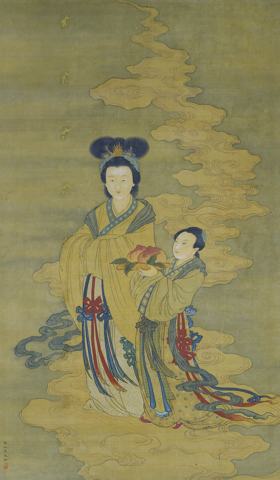
A tiger-toothed mountain spirit who became China's greatest goddess of immortality, keeper of the peaches that ripen once in three thousand years.
Sources & Further Reading
- 1.Chen Shou, Sanguozhi — Records of the Three Kingdoms, 'Shu shu,' Guan Yu's biography (compiled late 3rd century CE).
- 2.Luo Guanzhong (attrib.), Sanguo yanyi — Romance of the Three Kingdoms (14th century); trans. Moss Roberts, Three Kingdoms. University of California Press / Foreign Languages Press, 2001.
- 3.de Crespigny, Rafe. A Biographical Dictionary of Later Han to the Three Kingdoms (23-220 AD). Brill, 2007.
- 4.Duara, Prasenjit. 'Superscribing Symbols: The Myth of Guandi, Chinese God of War.' The Journal of Asian Studies 47, no. 4 (1988): 778-795.
- 5.ter Haar, Barend J. Guan Yu: The Religious Afterlife of a Failed Hero. Oxford University Press, 2017.
- 6.Yang, Lihui and Deming An. Handbook of Chinese Mythology. ABC-CLIO, 2005.
Spot an error or have a source to suggest? Write to info@viseterna.com. We cite primary sources and modern scholarship, and we correct fast.