
The Eight Immortals
Eight Daoist immortals — a beggar, a drunk, a girl, a courtier, a flute player — who cross the sea by their own strange powers instead of by boat.
The Eight Immortals Crossing the Sea, Chinese illustration reproduced in E. T. C. Werner, Myths and Legends of China, 1922 · Public domain · source
Who the Eight Are
The Eight Immortals — Baxian (八仙) — are the most recognisable group in Chinese religious art: eight Daoist adepts of wildly different rank, age, sex and temperament who travel together and are invoked together for long life and good fortune 6. The standard roster is Zhongli Quan, Lü Dongbin, Zhang Guolao, Han Xiangzi, Li Tieguai, Cao Guojiu, He Xianggu and Lan Caihe 1,6.
What makes the set unusual is that it is deliberately unbalanced. It contains a general and a beggar, an imperial in-law and a street busker, an old man and a young woman. Chinese commentators have long read the group as an argument in itself: immortality is available from any station in life, and the Way is not a court appointment 5,6. Their emblems — fan, sword, drum, flute, gourd, castanets, lotus, basket of flowers — became a decorative vocabulary in their own right, the anbaxian or "hidden eight immortals", where the objects stand in for the persons on porcelain, textiles and furniture 6.
The Eight in Brief
Zhongli Quan is usually the senior of the group, a Han-dynasty general who lost a battle, retreated to the mountains, received the elixir teachings, and carries a fan said to revive the dead 1,6. Lü Dongbin is by far the most important historically — a scholar-swordsman of the Tang who failed the examinations, was converted by Zhongli Quan through a dream of an entire illusory career, and became the patron of a real, large and enduring cult 4,5.
Zhang Guolao is an aged recluse who rides a white mule backwards and folds it up like paper when he dismounts; Tang court records mention a Daoist of that name summoned by emperors, so a historical kernel is plausible 1,6. Han Xiangzi, said in legend to be a nephew of the Tang statesman Han Yu, plays a flute and makes flowers bloom out of season; his full-length hagiography by Yang Erzeng is one of the best-preserved immortal narratives 2.
Li Tieguai — "Iron-Crutch Li" — left his body during a spirit journey, found on returning that his disciple had cremated it, and was obliged to enter the corpse of a lame beggar instead 1,6. Cao Guojiu, in court dress and holding a jade tablet, is presented as a Song imperial relative who withdrew from office in shame at a kinsman's crimes 1,6. He Xianggu, the one woman, is a maiden of Guangdong who ate a magic mica or peach and ceased to need food 1,6. Lan Caihe is a ragged singer of unclear sex who wears one shoe, carries a basket of flowers, and is generally the group's holy fool 1,6.
Where the Group Came From
The eight are older individually than they are collectively. Lü Dongbin already draws stories and poetry in the Northern Song, and Baldrian-Hussein's survey of that material shows a figure being assembled out of anecdote and verse well before any fixed set of eight existed 4. Zhongli Quan and Lü Dongbin together become the founding patriarchs claimed by the Quanzhen school, which gave them institutional weight 4,5.
The group takes shape on stage. Yuan-dynasty zaju dramas built around "deliverance" plots — an immortal descends and converts a reluctant mortal — repeatedly bring immortals on in company, and several name eight, though not always the same eight 3,5. The membership stayed fluid for some time; the roster now treated as standard is generally credited to the late-Ming vernacular novel Baxian chuchu dongyou ji, attributed to Wu Yuantai and printed around 1600 1,6. That should be stated as the point of fixing rather than of invention: the novel gathered a set that drama and temple art had been circling for two centuries 3,5.
Crossing the Sea
The single story everyone knows is Baxian guo hai — "the Eight Immortals cross the sea". Returning from a banquet, the eight reach the ocean, and Lü Dongbin proposes that rather than ride a cloud together each should cross by their own means 1. Each throws down an emblem and floats on it. The crossing goes wrong when a son of the Dragon King seizes Lan Caihe, and the resulting brawl escalates until the immortals are heaping mountains into the sea and heaven has to broker a peace 1.
The proverb drawn from it — baxian guo hai, ge xian shen tong, "the Eight Immortals cross the sea, each showing their own divine power" — is still ordinary Chinese for a group in which everyone contributes differently. It is worth noting how closely the anarchic tone matches Sun Wukong's assault on heaven in the roughly contemporary Journey to the West: late-Ming vernacular fiction liked its saints disorderly 1.
Cult and Image
The Eight Immortals are not only literary. Lü Dongbin in particular received large-scale patronage; the Yuan-dynasty Palace of Eternal Joy (Yongle gong) in Shanxi, built at the site claimed as his birthplace, carries some of the finest surviving Chinese wall painting, and Katz's study of that complex traces a cult with genuine political backing behind it 5. Spirit-writing altars across late imperial and modern China have transmitted scriptures under Lü's name, and he remains a widely petitioned deity in Taiwan and Hong Kong 5.
Visually the eight are ubiquitous — on birthday hangings, on porcelain, on temple ridge tiles, and in the extremely common scene where they attend the Queen Mother of the West's peach banquet or offer birthday greetings 6. They keep company in art with other lucky figures, from the Jade Emperor's court above them to Zhong Kui and the moon goddess Chang'e, and the whole ensemble reads less as a theology than as a wish for a long, well-attended, slightly drunken life 6,7.
Their afterlife outside the temple is just as broad. They are stock characters of regional opera and of the New Year print trade, they supply the named postures of the drunken-boxing style zui baxian, and their emblems still circulate as ordinary good-luck decoration on objects whose owners may know the symbols better than the stories 6,7.
Continue Exploring
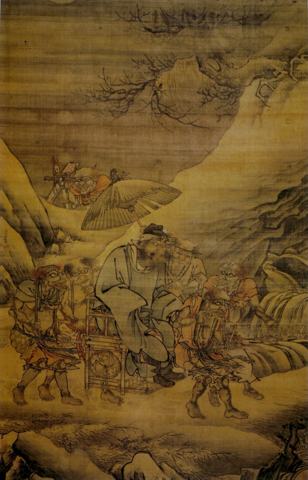
The ugly failed scholar who killed himself on the palace steps and came back as heaven's demon-catcher — hung on doors at New Year to eat what haunts the house.
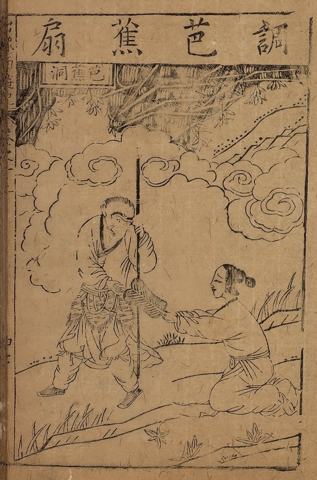
The Monkey King — a stone-born immortal with seventy-two transformations who fought heaven to a standstill, then walked to India as a monk's disciple.
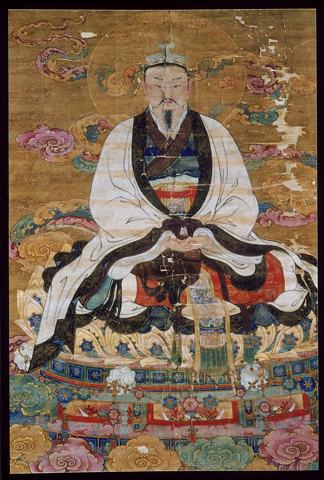
Sovereign of Heaven and head of the celestial bureaucracy — the emperor of the gods, who governs the cosmos the way a dynasty governs a realm.
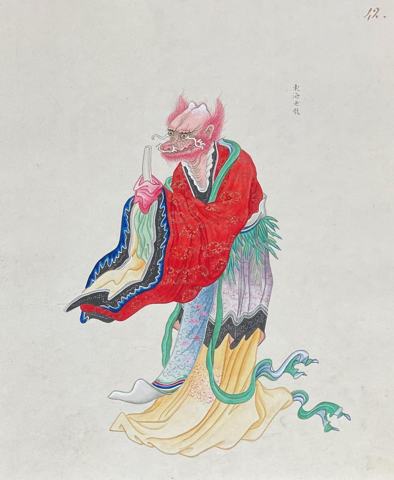
Four bureaucrat-dragons who rule the seas from undersea palaces, command rain and flood, and get bullied by mortal heroes in China's best-loved novels.
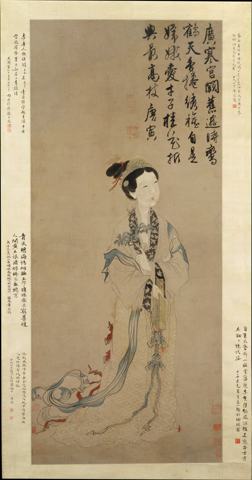
The moon goddess who swallowed the elixir of immortality and rose beyond reach — honoured each Mid-Autumn Festival with mooncakes and lanterns.
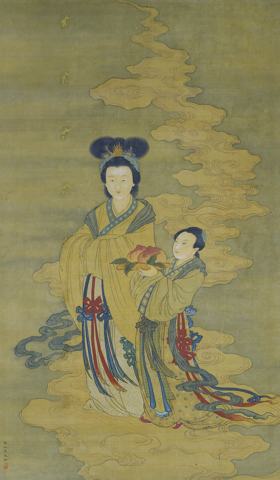
A tiger-toothed mountain spirit who became China's greatest goddess of immortality, keeper of the peaches that ripen once in three thousand years.
Sources & Further Reading
- 1.Wu Yuantai (attrib.), Baxian chuchu dongyou ji — The Eight Immortals' Journey to the East (Ming, c. 1600).
- 2.Yang Erzeng, Han Xiangzi quanzhuan — The Story of Han Xiangzi (1623); trans. Philip Clart, University of Washington Press, 2007.
- 3.Yuan-dynasty zaju dramas of deliverance featuring Zhongli Quan and Lu Dongbin (13th-14th century).
- 4.Baldrian-Hussein, Farzeen. 'Lu Tung-pin in Northern Sung Literature.' Cahiers d'Extreme-Asie 2 (1986), 133-169.
- 5.Katz, Paul R. Images of the Immortal: The Cult of Lu Dongbin at the Palace of Eternal Joy. University of Hawai'i Press, 1999.
- 6.Little, Stephen, with Shawn Eichman. Taoism and the Arts of China. The Art Institute of Chicago / University of California Press, 2000.
- 7.Werner, E. T. C. Myths and Legends of China. George G. Harrap, 1922.
Spot an error or have a source to suggest? Write to info@viseterna.com. We cite primary sources and modern scholarship, and we correct fast.