
Nuwa
The serpent-bodied creator goddess who shaped the first humans out of yellow earth and patched the broken sky with five-coloured stone.
Fuxi and Nuwa, painted silk, Tang dynasty, Astana Tombs, Xinjiang · Public domain · source
Who Nuwa Is
Nuwa (女媧, Nüwa) is the great creating and repairing goddess of Chinese myth — the maker of human beings and the patcher of a shattered heaven 5,6. She is described and depicted with a human head and upper body and the long coiling body of a serpent or dragon, and in Han-dynasty tomb art she most often appears as one of an entwined pair, her tail twisted around that of Fuxi 5,6.
Her mythology is unusual in Chinese tradition for being centred on a female figure with cosmic scope, and Birrell notes that the early sources treat her as a solitary agent — she acts alone, without a court, a consort, or a mandate from anyone 5. Nuwa is also not merely archival: temples to her remain active in northern China, and her myths are still told and performed 6.
The Making of Humankind
The earliest surviving account of Nuwa creating people comes from the Fengsu tongyi, a survey of customs compiled by Ying Shao around the end of the second century CE 2,5. Heaven and earth had opened but there were no people. Nuwa knelt at the riverbank and shaped them one by one out of yellow earth.
The work was slow, and she had no time to finish it. So she dipped a cord into the mud and dragged it up, and the drops that flew off it became human beings too 2,5. The text then draws the conclusion that gives the story its bite: the ones she had modelled by hand became the rich and the noble, and the ones flicked from the cord became the poor and the common 2,5. It is a creation myth that arrives already carrying a social explanation, and Birrell reads it as an unusually frank piece of class etiology 5.
Mending the Sky
Nuwa's most famous act is repair. The Huainanzi, compiled at the Han court of Liu An by 139 BCE, describes a cosmic collapse: the four pillars that hold up the sky gave way, the nine regions of the earth split apart, heaven no longer covered everything and earth no longer supported it, fires burned without going out, waters flooded without receding, beasts ate the people and birds of prey seized the weak 1.
So Nuwa smelted stones of five colours to patch the azure sky. She cut the legs from a giant sea turtle and set them up as the four supports. She killed a black dragon to rescue the province of Ji, and piled the ashes of reeds to dam the flooding waters 1. With the sky mended and the waters stopped, the seasons resumed and the world became habitable again 1,5.
The Huainanzi and the Liezi elsewhere supply a separate account of what broke the sky: the water god Gonggong, defeated in a struggle, rammed his head against Mount Buzhou, the pillar of the northwest, snapping it — which is why in Chinese cosmological explanation the heavens tilt toward the northwest and the rivers of China run southeast into the sea 1,3,5. The two episodes circulate independently in the early texts and were combined into a single narrative later 5,7.
Nuwa and Fuxi
Fuxi is the culture hero credited with the trigrams, with fishing nets, and with the beginnings of civilised order, and by the Han period he and Nuwa are a standard pair 5,6. Stone reliefs and painted tomb banners show them from the waist up as a man and a woman and below as two serpent tails wound together, he holding a carpenter's square and she a pair of compasses — the tools for making the square earth and the round heaven 5,6.
The relationship is described in different sources as consorts, as siblings, or as both, and the sources do not agree on which came first 5,6,7. Where Fuxi institutes culture, Nuwa is credited in later texts with instituting marriage itself and with inventing the reed mouth-organ, the sheng 6.
The Flood and the Sibling Marriage
One of the most widely told Nuwa stories in modern China is not attested in the ancient corpus. In it, a great flood destroys humanity, leaving only Nuwa and Fuxi, a brother and sister, who must repopulate the world and seek heaven's approval to marry — asking for a sign, and receiving it when two columns of smoke join, or two millstones rolled down opposite hills come to rest together 6,7.
This version appears in written form from the Tang period onward and is enormously widespread in oral tradition and among many of China's ethnic groups, collected in hundreds of variants by twentieth-century folklorists 6,7. Lewis's study of early Chinese flood mythology is careful about the gap: the ancient sources describe floods managed by the sage-engineer Yu, not by a surviving sibling pair, and the sibling-marriage story should be understood as a distinct and later tradition rather than as the original form 7.
Nuwa in Later Literature
Two of the great Chinese novels begin with her. Fengshen Yanyi opens with the last Shang king writing a lecherous poem on the wall of Nuwa's temple; the insulted goddess dispatches a fox spirit to take human form and bring his dynasty down, which sets the entire war of the novel in motion 4. And Dream of the Red Chamber opens with a single leftover stone from the sky-mending — rejected, useless, and conscious of it — which becomes the novel's protagonist 6.
Both use her the same way: as the fixed point of cosmic order against which a story of ruin can be measured 4,6.
Worship and Living Tradition
Nuwa is venerated at temples in several provinces, most prominently the Wahuang Gong complex in Shexian, Hebei, where large annual pilgrimages continue 6. Yang and An emphasise that Chinese myth is not confined to classical texts: Nuwa narratives are still transmitted orally, attached to local landscapes and festivals, and recounted by living storytellers who freely differ from the Han sources and from each other 6.
Continue Exploring
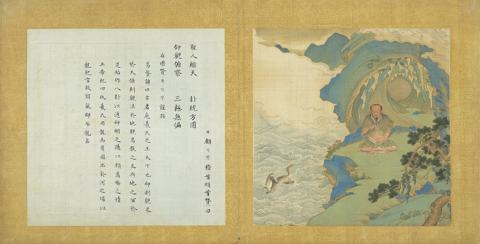
The serpent-tailed sage who read the eight trigrams from a dragon-horse's markings and taught fishing, fire, and marriage — first of China's Three Sovereigns.
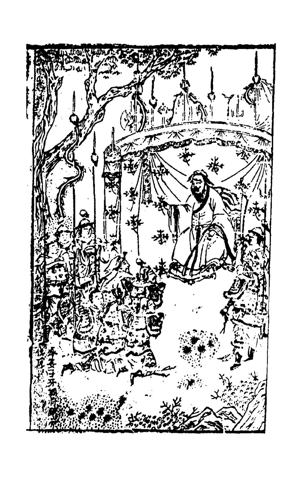
The Ming novel that restaged the fall of the Shang dynasty as heaven's founding war, promoting 365 of its dead into a brand-new celestial bureaucracy.
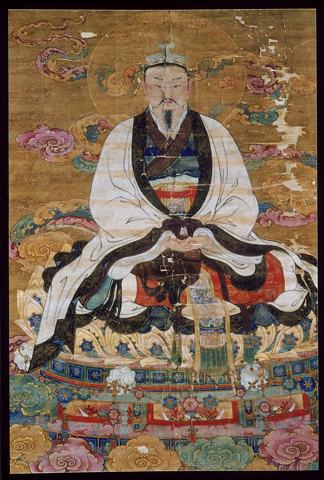
Sovereign of Heaven and head of the celestial bureaucracy — the emperor of the gods, who governs the cosmos the way a dynasty governs a realm.
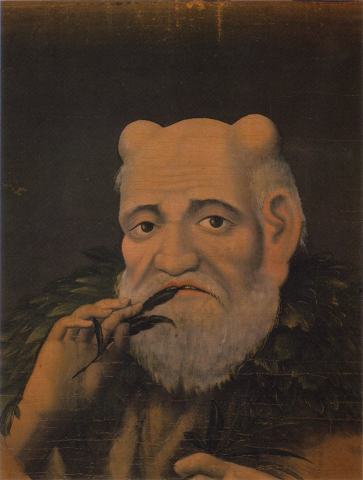
The horned sage who tasted a hundred herbs to found Chinese medicine, invented the plow, and reigns as second of the Three Sovereigns before the Yellow Emperor.
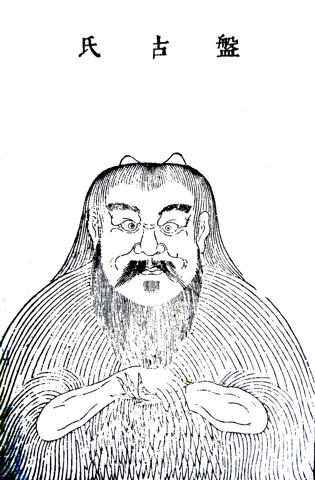
The primordial giant who split chaos into heaven and earth, and whose body at death became the mountains, rivers, winds, and stars of the world.
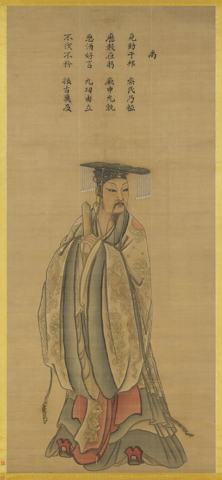
The hero who ended China's great flood by dredging channels instead of damming them, walked the Nine Provinces, and founded the Xia — if he existed at all.
Also mentioned inHouyi (Hou Yi)
Sources & Further Reading
- 1.Huainanzi (139 BCE); trans. John S. Major, Sarah A. Queen, Andrew Seth Meyer & Harold D. Roth. Columbia University Press, 2010.
- 2.Ying Shao, Fengsu tongyi — Comprehensive Meaning of Customs (c. 195 CE).
- 3.Liezi (compiled c. 4th c. CE).
- 4.Investiture of the Gods — Fengshen Yanyi (16th c.).
- 5.Birrell, Anne. Chinese Mythology: An Introduction. Johns Hopkins University Press, 1993.
- 6.Yang, Lihui & Deming An. Handbook of Chinese Mythology. ABC-CLIO, 2005.
- 7.Lewis, Mark Edward. The Flood Myths of Early China. SUNY Press, 2006.
Spot an error or have a source to suggest? Write to info@viseterna.com. We cite primary sources and modern scholarship, and we correct fast.