
Mazu
A Fujian fisherman's daughter who died young around 987 and rose, title by imperial title, to become Empress of Heaven and the sea goddess of the Chinese coast.
Wood statue of Mazu, late 19th century, Qing dynasty, China; photograph by Mary Harrsch · CC BY-SA 4.0 · source
The Goddess of the Chinese Sea
Mazu (媽祖, "Ancestral Mother") is the protector of sailors, fishermen and travellers by water, and the most widely worshipped deity of the Chinese maritime world. Her temples run the length of the southeast coast and out through the diaspora — Taiwan, Hong Kong, Macau, Singapore, Malaysia, Vietnam, Japan, and the port Chinatowns of the Americas 4,7. UNESCO inscribed Mazu belief and customs on its Representative List of Intangible Cultural Heritage in 2009, citing a devotee population then estimated in the hundreds of millions 7.
She is unusual among major Chinese deities in that her human career is comparatively well documented — not the miracles, but the arc by which a local Fujianese spirit was recognised, promoted and eventually made an empress of heaven by the imperial state 4,6.
Lin Mo of Meizhou
Tradition makes her Lin Mo (林默), also called Lin Moniang, "the silent girl", born on Meizhou Island off Putian in Fujian and conventionally dated 960-987 3,6. The name is explained by her not crying at birth. The hagiographies give her a childhood of unusual piety, an ability to read weather and to travel in spirit, and a death in her twenties — variously as an ascension from a mountain top or as a drowning while trying to reach a boat in distress 3.
Her signature miracle exists in several versions: while in a trance at her loom she is out at sea saving her father and brothers from a storm, holding them by mouth and hands; her mother rouses her, she speaks, and one brother is lost 3. After death she was seen in red robes above the waves and began saving ships that called on her 1,3.
How much of this reaches back to a real woman is not knowable. The earliest surviving account of the cult, Liao Pengfei's 1150 inscription for the rebuilding of the Meizhou temple, is written roughly a century and a half after the traditional death date and already describes an established local shrine to a shamaness-figure of the Lin family 1,5. Most scholars accept a genuine local medium or spirit at the origin while treating the detailed biography as later hagiographical growth 4,5.
Promotion by the State
The interesting history is the promotion. Court recognition begins in the Northern Song: a temple plaque bearing the name Shunji ("Smooth Crossing") is recorded as bestowed in the Xuanhe era, conventionally 1123, after her aid was credited in a diplomatic mission to Korea 1,2,6. Personal titles follow under the Southern Song, beginning with furen ("Lady") around the mid-twelfth century and rising to fei ("Consort") 2,6.
The Yuan dynasty, which moved its grain supply north by sea, had a direct state interest in a sea goddess and raised her to Tianfei, Heavenly Consort, in 1281 2,6. The Ming continued the patronage; Zheng He's fleets carried her cult and left inscriptions crediting her with their safe returns 4,6. The Qing made the final promotion to Tianhou, Empress of Heaven, conventionally dated to 1684 and tied to the naval conquest of Taiwan under Shi Lang, whose victory was formally attributed to her intervention 4,6. Titles kept accreting into the nineteenth century until the full style ran to dozens of characters 6.
Watson's classic study reads this sequence as "standardisation": the state did not suppress local cults so much as adopt one, grant it prestige, and let it absorb its neighbours, producing an outward uniformity of name and title over a great deal of surviving local variation in what Mazu actually was to her worshippers 4. Zhang has argued for reading the canonisations alongside the personal, family-model relationship devotees have with her, rather than as a purely top-down political operation 6. Both readings are current; the tension between them is the live question in the field.
Temple, Festival and Pilgrimage
Mazu is shown enthroned in imperial robes and a flat-topped crown with hanging bead strings — the regalia of a Chinese empress, which is precisely the claim the titles make 4. She is flanked by two demon-generals she subdued and took into service: Qianliyan, "Thousand-Mile Eyes", and Shunfeng'er, "Wind-Following Ears", who watch and listen for ships in trouble 3.
Her birthday, the twenty-third day of the third lunar month, is the great festival 7. The Meizhou ancestral temple is the cult's origin point, and the largest modern observance is the Dajia Mazu pilgrimage in Taiwan, a multi-day procession in which a temple's palanquin travels a route of allied temples and hundreds of thousands walk with it 7. Taiwanese temples maintain elaborate genealogies of "division of incense" from parent shrines, and the resulting network is a working map of migration out of Fujian 4,7.
Fishing crews still carry her image aboard, and offerings before a voyage remain ordinary practice in coastal communities 7.
Mazu Among the Gods
Within the Chinese pantheon she sits under the Jade Emperor's celestial bureaucracy, and her career is the clearest available example of how that bureaucracy was understood to work: merit, memorial, promotion, new title 4,6. Where Zhong Kui is a legend given a Tang setting and no verifiable subject, Mazu is the opposite case — a cult whose paperwork survives 5,6.
Buddhist tradition in some regions identifies or associates her with Guanyin, and Daoist liturgy has its own registers for her; the cult has never belonged cleanly to either institution, which is normal for Chinese popular religion rather than exceptional 5. On the water she is functionally the counterpart to the dragon kings of the seas — see the Chinese dragon — with the difference that she is petitioned as a rescuer rather than placated as a power 3,5.
Continue Exploring
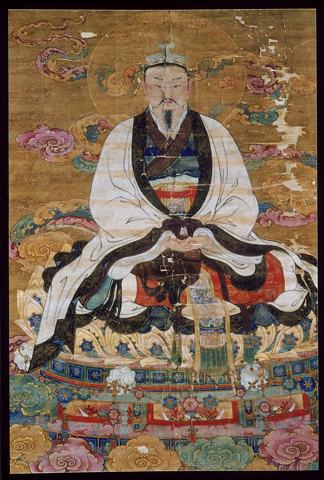
Sovereign of Heaven and head of the celestial bureaucracy — the emperor of the gods, who governs the cosmos the way a dynasty governs a realm.
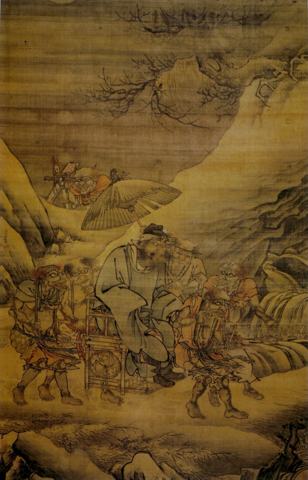
The ugly failed scholar who killed himself on the palace steps and came back as heaven's demon-catcher — hung on doors at New Year to eat what haunts the house.
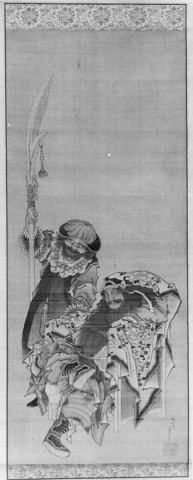
The Three Kingdoms general executed in 220 CE who rose, title by title, into a god of war, loyalty, and wealth worshipped across the Chinese-speaking world.
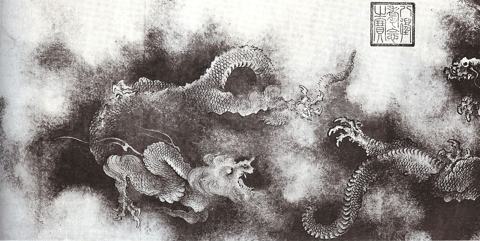
China's dragon — a benevolent, scaled power of rain, river, and sea, emblem of imperial authority and the only mythical beast in the zodiac.
The household god who watches every family from above the stove all year, then ascends before New Year to report their conduct to the Jade Emperor.
The three-eyed god of Guankou who tamed the floods and was the only celestial general able to beat the Monkey King in a fair fight.
Sources & Further Reading
- 1.Liao Pengfei, 'Shengdun zumiao chongjian Shunji miao ji' (1150) — the earliest surviving inscription describing the Meizhou cult.
- 2.Song shi and Song huiyao jigao — court records of temple plaques and title bestowals from the Xuanhe era (1119-1125) onward.
- 3.Tianfei xiansheng lu (Record of the Manifestations of the Heavenly Consort), Ming hagiographical compilation.
- 4.Watson, James L. 'Standardizing the Gods: The Promotion of T'ien Hou along the South China Coast, 960-1960', in Popular Culture in Late Imperial China, ed. Johnson, Nathan and Rawski. University of California Press, 1985.
- 5.Boltz, Judith M. 'In Homage to T'ien-fei.' Journal of the American Oriental Society 106.1 (1986), 211-232.
- 6.Zhang, Yue. 'The State Canonization of Mazu: Bringing the Notion of Imperial Metaphor into Conversation with the Personal Model.' Religions 10.3 (2019), 151.
- 7.UNESCO, 'Mazu belief and customs' — Representative List of the Intangible Cultural Heritage of Humanity, inscribed 2009.
Spot an error or have a source to suggest? Write to info@viseterna.com. We cite primary sources and modern scholarship, and we correct fast.