
Pangu
The primordial giant who split chaos into heaven and earth, and whose body at death became the mountains, rivers, winds, and stars of the world.
Pangu, Chinese woodblock book illustration (Sancai Tuhui tradition, 1609) · Public domain · source
Who Pangu Is
Pangu (盤古) is the first being in the best-known Chinese creation myth: a giant who grows inside primordial chaos, forces heaven and earth apart, and then dissolves into the world itself 1,5. He is the closest thing Chinese tradition has to a single cosmogonic protagonist, and — as this article will show — he is also a surprisingly late arrival in the written record 5,6.
He is usually pictured as a shaggy, horned or tusked giant wrapped in leaves or skins, wielding an axe or a chisel, holding heaven above his head 6. That axe is a later illustrative convention; the earliest texts describe growth and separation, not a blow 1,5.
The Egg of Chaos
The earliest surviving account is attributed to Xu Zheng, a scholar of the third century CE from the southern state of Wu, and survives because Tang encyclopaedists quoted it — chiefly the Yiwen leiju of 624 1,3,5.
Heaven and earth, it says, were mixed together like the inside of a hen's egg, and Pangu was born within that egg-shaped chaos 1,5. After eighteen thousand years the egg opened. What was clear and light rose and became the sky; what was turbid and heavy sank and became the earth — the standard Chinese cosmological vocabulary of yang and yin, applied to a birth 1,5.
Pangu stood between them. The text says he changed nine times in a day, divine in heaven and sagely on earth 1,3.
Eighteen Thousand Years
Then the growth begins, and it is described with an accountant's precision. Each day the sky rose ten feet higher, each day the earth grew ten feet thicker, and each day Pangu grew ten feet taller between them, holding them apart 1,3,5. This continued for another eighteen thousand years, until the sky was extremely high, the earth extremely deep, and Pangu extremely tall 1.
The image is not of a builder but of a spacer — a living wedge whose only work is to keep the two halves of the cosmos from closing again 5. Birrell notes how differently this reads from creation by command or by craft: nothing is designed, and the world simply becomes possible as Pangu grows 5.
The Death That Made the World
The second and more elaborate account, attributed to the same author, describes what happened when he died 2,5.
His breath became the wind and the clouds; his voice became the rolling thunder. His left eye became the sun and his right eye the moon. His four limbs and five extremities became the four quarters of the earth and the great mountains. His blood became the rivers, his sinews the contours of the land, his flesh the fields and soil. The hair of his head and his beard became the stars; the hair on his body became the plants and trees. His teeth and bones became metals and stones, his marrow became pearls and jade, and his sweat became the rain 2,3,5.
Then the last detail, which is the one people remember: the parasites on his body, touched by the wind, became human beings 2,5. There is no dignity in the human origin here at all — we are what was living on the corpse, animated by a draught 5.
Birrell places this among the world's cosmic-body myths, a type with striking parallels in the dismemberment of Purusha in the Rigveda and of the giant Ymir in Norse tradition, and comparative scholars have argued over whether resemblance implies transmission 5. What can be said plainly is that the Chinese version, as we have it, is a late text drawing on an old and widespread idea 5,6.
A Late Arrival
Pangu is absent from the classical corpus. He is not in the Classic of Mountains and Seas, not in the Huainanzi, not in the Warring States philosophers — texts that between them preserve a great deal of Chinese myth, including Nuwa mending the sky 5,6. His first appearances are in the third century CE, more than a thousand years after the earliest Chinese writing 5.
Several explanations have been proposed. One suggests the myth was carried into the Han written tradition from the non-Han peoples of the south, where cognate figures and a similar name are attested; another looks to Indian influence arriving with Buddhism; another argues simply that a long-standing oral cosmogony finally got written down 5,6. None of these has settled the matter, and it is more honest to describe the debate than to pick a winner 5,6.
Chaos Before Pangu
Chinese thought had a cosmogony before it had Pangu, and it was about undifferentiation rather than a person. Hundun, "chaos," names the primordial, unformed condition — and in one of the most quoted passages of the Zhuangzi, Hundun is a kindly emperor with no facial openings, whose grateful friends drill him one hole a day for seven days so he can see, hear, eat, and breathe; on the seventh day he dies 4.
The parable turns the Pangu logic inside out. Distinction and definition make a world possible, and also end the wholeness that preceded them 4,5.
Pangu Today
Pangu was absorbed into Daoist cosmology, where he is at times identified with the primordial celestial worthy at the head of the Daoist pantheon, and he became a fixture of popular cosmological lore 6. Temples and festivals dedicated to him survive, including significant Pangu King observances among Yao communities in southern China, and shrines in Guangdong and Henan 6.
Yang and An stress the general point his case illustrates well: Chinese mythology is not a closed classical canon but a body of living narrative, transmitted orally and locally, in which the date of a text is a poor guide to the age of a story 6.
Continue Exploring
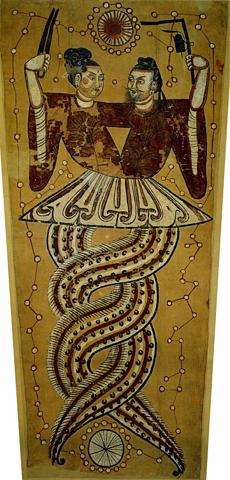
The serpent-bodied creator goddess who shaped the first humans out of yellow earth and patched the broken sky with five-coloured stone.
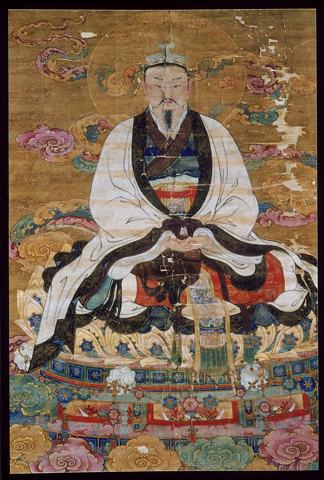
Sovereign of Heaven and head of the celestial bureaucracy — the emperor of the gods, who governs the cosmos the way a dynasty governs a realm.
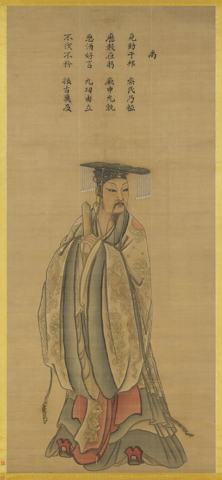
The hero who ended China's great flood by dredging channels instead of damming them, walked the Nine Provinces, and founded the Xia — if he existed at all.
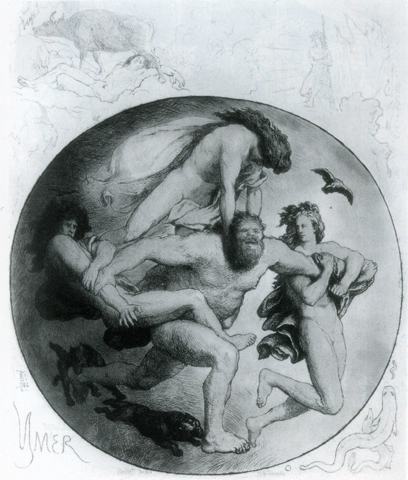
The frost-giant who came first, out of the meeting of fire and ice — killed by Odin and his brothers, his body split apart to build the world.
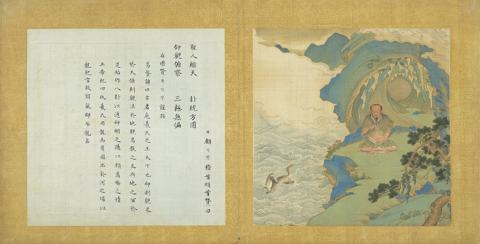
The serpent-tailed sage who read the eight trigrams from a dragon-horse's markings and taught fishing, fire, and marriage — first of China's Three Sovereigns.
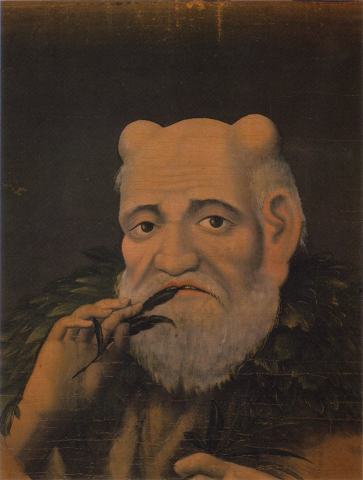
The horned sage who tasted a hundred herbs to found Chinese medicine, invented the plow, and reigns as second of the Three Sovereigns before the Yellow Emperor.
Sources & Further Reading
- 1.Xu Zheng, Sanwu liji — Chronicle of the Three Sovereigns and Five Emperors (3rd c. CE), surviving in later quotation.
- 2.Xu Zheng (attrib.), Wuyun linian ji — Chronicle of the Five Cycles of Time (3rd c. CE), surviving in later quotation.
- 3.Yiwen leiju — Collection of Literature Arranged by Categories, comp. Ouyang Xun (624 CE).
- 4.Zhuangzi (c. 3rd c. BCE).
- 5.Birrell, Anne. Chinese Mythology: An Introduction. Johns Hopkins University Press, 1993.
- 6.Yang, Lihui & Deming An. Handbook of Chinese Mythology. ABC-CLIO, 2005.
Spot an error or have a source to suggest? Write to info@viseterna.com. We cite primary sources and modern scholarship, and we correct fast.