
Bes (Egyptian Household Protector)
The grinning dwarf god who guarded bedrooms rather than temples — a fierce, funny protector of mothers and infants, armed with noise and a terrifying face.
Statue of the god Bes, marble, Roman Egypt, 1st-2nd century AD (Gregorian Egyptian Museum, Vatican Museums) · CC0 · source
A God Built to Be Ugly on Purpose
Bes breaks nearly every rule of Egyptian divine portraiture, and the break is the point. Where most gods are shown in the elegant profile convention that gives Egyptian art its instantly recognisable look, Bes faces the viewer full-on: a bow-legged dwarf with a lion's mane and ears, a protruding tongue, a heavy beard, and a grimace rather than the serene half-smile every other deity wears 5,6. James Romano's study of the type traces its likely origin to the image of a lion rearing up on its hind legs, gradually humanised into a squat figure whose exaggerated, almost comic ferocity was never meant to be attractive — it was meant to be worse than whatever it was warding off 3. Egyptian artists could carve serene beauty without difficulty. With Bes they chose not to, on purpose, for centuries.
Not One God But a Type
"Bes" functions less like a single personal name and more like a category. Romano's research and later scholarship both treat the Bes-image as a shared iconographic form applied to several related protective spirits, male and female, with overlapping functions and no single canonical genealogy — Beset, his female counterpart, appears in some magical texts in her own right, and other dwarf-and-lion hybrids blur into the same visual family 3,5. This looseness was not a defect in Egyptian eyes. A protective power did not need a fixed place in the Ennead to do its job at a bedroom doorway, and Bes-type figures multiplied precisely because they were useful rather than theologically prestigious 4,5.
Guardian of Birth
Bes's most consistent and best-documented role is protecting women in labour and the infants born to them, the single most dangerous ordinary event in ancient Egyptian life. Birth scenes on temple walls, amulets worn by pregnant women, and headrests and furniture from actual households all carry his image standing guard, often shown dancing, brandishing a knife, or shaking a rattle at the threshold a malevolent spirit might use to reach mother or child 4,5. Geraldine Pinch's survey of Egyptian magic places Bes at the centre of the country's domestic magical toolkit for exactly this reason: he appears on the curved hippopotamus-ivory "wands" carried by Middle Kingdom households and on birth-related amulets across every period for which evidence survives, a continuity of use that outlasts most Egyptian religious fashions 4. The same logic shaped the healing stelae called cippi of Horus, thin slabs showing the child Horus gripping snakes and scorpions, which worshippers touched or washed with water believed to carry the spell's power against poison; the largest and best preserved, the fourth-century-BCE Metternich Stela, crowns its whole inscribed surface with a single oversized Bes face glaring out above the scene, standing guard over the very spells invoked below him 1.
A God of the House, Not the Temple
Unlike Amun or Ra, Bes had essentially no major state temple and no priesthood comparable to theirs; his worship happened overwhelmingly in the home, which is precisely why he survives so abundantly in the archaeological record of ordinary life rather than in royal inscriptions 5,6. Bes amulets, furniture fittings, cosmetic containers, and small household shrines turn up across every social class excavated in Egypt, and by the New Kingdom his image decorates the walls of actual bedrooms at sites like Deir el-Medina, the village of the workers who built the royal tombs 4,6. A god this embedded in daily domestic life needed no temple bureaucracy to remain constantly, physically present.
Noise, Music, and Frightening Things Away
Egyptian protective magic worked partly on the logic that evil could be startled off, and Bes is consistently shown as the noisiest god in the pantheon: dancing, playing a tambourine or harp, and pulling faces, all activities understood as apotropaic rather than merely festive 4,5. That same energy connected him to music, drunkenness, and sexuality more broadly — he appears on New Kingdom cosmetic items and in scenes of revelry, a protector who guarded pleasure as readily as he guarded sleep 5,6. By the Late Period this multiplying, syncretic energy produced the striking "Bes Pantheos" amulets, in which his squat body sprouts extra arms, wings, and the heads of other gods, becoming a single condensed image of protective divine power rather than a portrait of one deity — an escalation entirely in keeping with a god whose whole design was already turned up past the point of realism 5,6.
Bes Abroad, and His Quiet Disappearance
Bes travelled with Egyptian influence into the wider Mediterranean world; Phoenician and Punic sites across the region adopted Bes-like amulet figures, and Roman-period Egypt kept carving him in marble as well as the older faience and wood, evidence that his appeal crossed cultural lines even where formal Egyptian religion did not 5,6. His most dramatic late appearance is historical rather than mythological. The Roman historian Ammianus Marcellinus records that a dream-oracle of Bes at Abydos was popular enough in the fourth century CE that written questions sent to it became entangled in a treason investigation under Emperor Constantius II, who ultimately had the oracle shut down 2. It is a strange final scene for a household god who began as a doorway ornament: closed not by theological reform but by imperial paranoia, one of the last acts in a very long career spent making the household, rather than the state, feel safe.
Continue Exploring
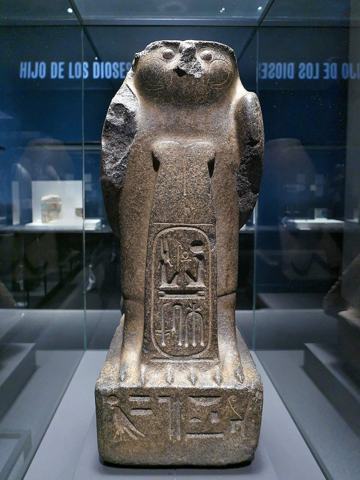
The sun itself as a god — Ra sails the sky by day, fights the serpent of chaos by night, and is reborn on the horizon every dawn.
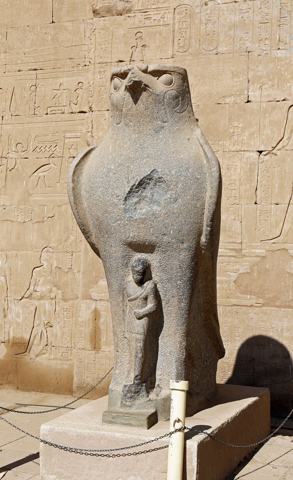
The sky falcon — god of kingship whose torn-out eye became the symbol of healing, and who won Egypt's throne from Set after eighty years of litigation.
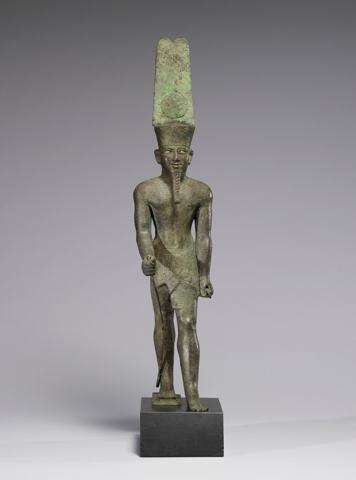
The imperial god of the New Kingdom — a once-minor Theban god whose name means "hidden," fused with Ra until Akhenaten tried to erase him from Egypt.
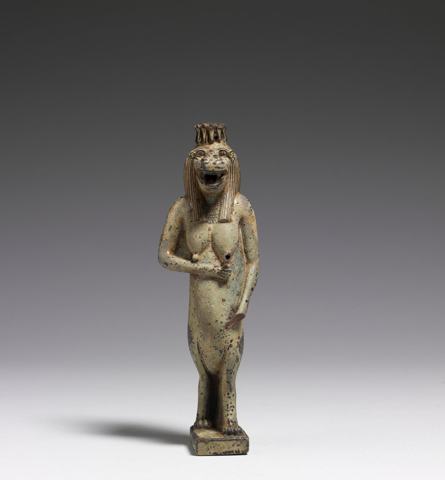
A hippopotamus standing upright on lion's legs with a crocodile down her back — Egypt's oddest goddess, and its most trusted guardian of pregnant women.
Lord of the afterlife — the murdered king remade as the first mummy, whose resurrection promised every Egyptian a life beyond the grave.
Goddess of magic — the widow whose spells restored Osiris, the mother who hid Horus in the marshes, and the one Egyptian deity Rome adopted whole.
Sources & Further Reading
- 1.The Metternich Stela (Thirtieth Dynasty, 4th century BCE).
- 2.Ammianus Marcellinus, Res Gestae, Book XIX (4th century CE).
- 3.Romano, James F. "The Bes-Image in Pharaonic Egypt." PhD dissertation, New York University, 1980.
- 4.Pinch, Geraldine. Magic in Ancient Egypt. British Museum Press, 1994.
- 5.Wilkinson, Richard H. The Complete Gods and Goddesses of Ancient Egypt. Thames & Hudson, 2003.
- 6.Pinch, Geraldine. Egyptian Mythology: A Guide to the Gods, Goddesses, and Traditions of Ancient Egypt. Oxford University Press, 2002.
Spot an error or have a source to suggest? Write to info@viseterna.com. We cite primary sources and modern scholarship, and we correct fast.