
The Great Sphinx of Giza
The colossal lion-bodied guardian of Giza, carved from the living bedrock, worshipped a thousand years later as the sun god Horemakhet.
The Great Sphinx of Giza, with the Pyramid of Khufu behind; photo Daniel Mayer, 2008 · CC BY-SA 4.0 · source
Carved From the Plateau Itself
The Great Sphinx was not built up from blocks like the pyramids beside it; it was carved down, out of a single outcrop of soft Eocene limestone left standing when stone was quarried for the pyramid complex of King Khafre 3,6. The result is enormous and, in engineering terms, irreversible — a lion's body some seventy metres long and twenty metres high, topped with a human head wearing the royal nemes headcloth and, originally, a divine false beard and a cobra at the brow 3. Because it is carved in place rather than assembled, its softer limestone layers have weathered unevenly for forty-five centuries, and most of its present pitted, undulating surface is the record of that long erosion rather than of the sculptors' original tool work 3,4.
Whose Face Is It?
Most Egyptologists attribute the monument to Khafre, reasoning from its position squarely on his pyramid causeway, from a resemblance to surviving statues of him, and from an inscription bearing his name found near the adjoining Sphinx Temple 3,6. No contemporary Old Kingdom text names the Sphinx or explicitly credits its construction to any king, which has left room for a minority of scholars to argue for his father Khufu or half-brother Djedefre instead; the case for Khafre remains the strongest on current evidence, but it is an inference from context, not a signed inscription 5,6.
Horemakhet, Horus in the Horizon
For roughly a thousand years after its carving the Sphinx received no recorded cult of its own — it functioned as a guardian figure within Khafre's funerary complex, not as a god 2,6. That changed in the New Kingdom, when Egyptians began worshipping it directly as a solar deity in its own right, Horemakhet, "Horus in the Horizon," known to the Greeks as Harmachis, and increasingly merged with Ra into a single sun god watching the eastern horizon at dawn 1,2.
The Dream Stele
The clearest evidence for that cult stands between the Sphinx's paws: a granite stele erected by King Thutmose IV around 1401 BCE, recording how, as a young prince out hunting, he fell asleep in the statue's shadow and dreamed that Horemakhet promised him the throne if he cleared away the sand that had buried the Sphinx's body up to its neck 1,2. Thutmose did clear it, and did become king — a story that, whatever really happened, gave a possibly non-eldest prince's claim to the throne a divine endorsement, carved permanently where every later visitor to the Sphinx would read it 1,2.
The Water-Erosion Claim, and Why It Doesn't Hold
Since the 1990s, the geologist Robert Schoch has argued that the deep, rounded fissuring on the walls of the pit surrounding the Sphinx was cut by prolonged heavy rainfall, and that Egypt's arid climate has not supported rainfall on that scale since roughly 7000–5000 BCE — implying the Sphinx predates the Old Kingdom, and Egyptian civilisation itself, by thousands of years 4. Geologists working the same rock reject the conclusion. James Harrell's direct response showed the same weathering pattern is fully explained by a monument buried in wind-blown sand for most of its history, periodically wetted from below by capillary action and rare flash floods, rather than by open-air rain over millennia — no exotic climate history required 4. Hawass and Lehner's fieldwork adds the wider archaeological case: quarry marks, construction technique, and the statue's integration with Khafre's causeway and temples all place it firmly in the Fourth Dynasty, and no trace of any culture capable of this carving exists from a 7000 BCE Egypt 5. The water-erosion hypothesis remains a minority position outside professional Egyptology and geology, not a live dispute within it 4,5.
Restoration and the Missing Nose
Popular legend blames Napoleon's soldiers for the Sphinx's missing nose, but sketches and written accounts from European travellers predate his 1798 expedition and already show the damage, so the nose was lost well before Napoleon set foot in Egypt, by a cause no surviving record settles 2,3. The monument has been excavated from its own sand repeatedly since antiquity — Thutmose IV's clearance was itself a restoration of an already-buried statue — and has undergone modern conservation campaigns since the early twentieth century to stabilise masonry added to its eroding body 2,3. It stands today within the UNESCO World Heritage listing for Memphis and its Necropolis, alongside the pyramid fields it was carved to guard, and remains, with the temple complex at Karnak, one of the most visited relics of pharaonic Egypt 3.
Continue Exploring
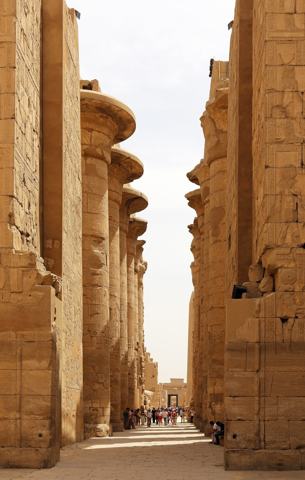
The largest religious complex ever built — fifteen hundred years of continuous construction at Thebes, centred on the state cult of Amun-Re.
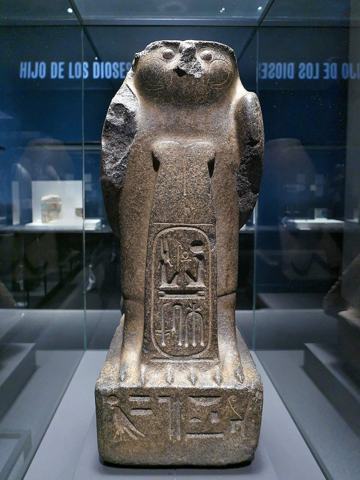
The sun itself as a god — Ra sails the sky by day, fights the serpent of chaos by night, and is reborn on the horizon every dawn.
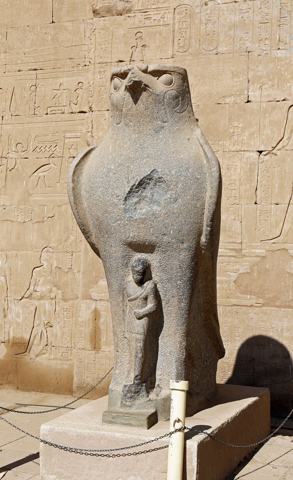
The sky falcon — god of kingship whose torn-out eye became the symbol of healing, and who won Egypt's throne from Set after eighty years of litigation.
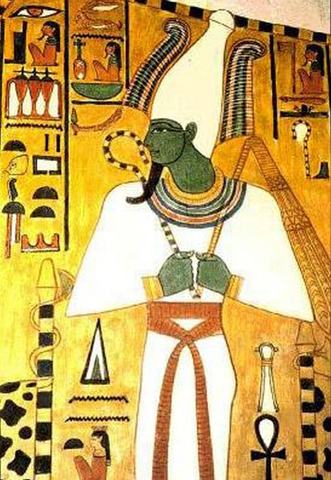
Lord of the afterlife — the murdered king remade as the first mummy, whose resurrection promised every Egyptian a life beyond the grave.
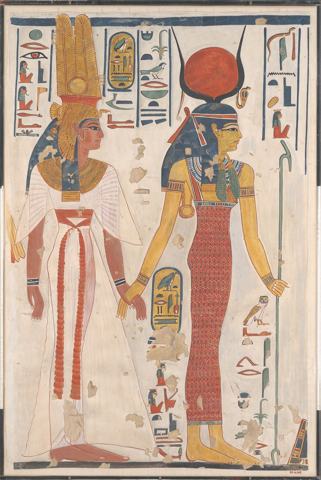
Goddess of magic — the widow whose spells restored Osiris, the mother who hid Horus in the marshes, and the one Egyptian deity Rome adopted whole.
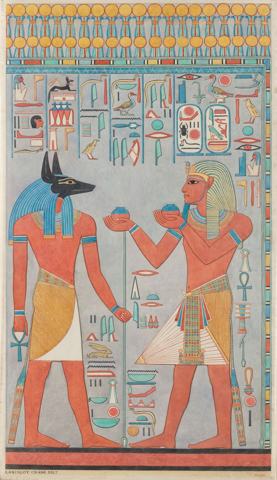
Guardian of the dead — the black jackal god who embalmed Osiris, watched over the necropolis, and weighed the heart against the feather of truth.
Sources & Further Reading
- 1.The Dream Stele (Sphinx Stele) of Thutmose IV, Giza, c. 1401 BCE.
- 2.Zivie-Coche, Christiane. Sphinx: History of a Monument. Trans. David Lorton. Cornell University Press, 2002.
- 3.Lehner, Mark. The Complete Pyramids. Thames & Hudson, 1997.
- 4.Harrell, James A. "The Sphinx Controversy: Another Look at the Geological Evidence." KMT: A Modern Journal of Ancient Egypt 5, no. 2 (1994).
- 5.Hawass, Zahi, and Mark Lehner. "The Sphinx: Who Built It, and Why?" Archaeology 47, no. 5 (1994).
- 6.Wilkinson, Richard H. The Complete Temples of Ancient Egypt. Thames & Hudson, 2000.
Spot an error or have a source to suggest? Write to info@viseterna.com. We cite primary sources and modern scholarship, and we correct fast.