
Karnak Temple Complex
The largest religious complex ever built — fifteen hundred years of continuous construction at Thebes, centred on the state cult of Amun-Re.
Great Hypostyle Hall, Precinct of Amun-Re, Karnak Temple Complex; photo Marc Ryckaert, 2018 · CC BY-SA 4.0 · source
Ipet-Isut, "The Most Select of Places"
Karnak is not one temple but a walled precinct of temples, covering about a hundred hectares on the east bank of the Nile at ancient Thebes, modern Luxor 3,5. Its Egyptian name, Ipet-isut, "the most select of places," marks it as the state's foremost seat of the sun and creator god Amun-Re — a New Kingdom fusion of the hidden god Amun with the sun god Ra — whose wife Mut and son Khonsu completed the Theban triad worshipped alongside him in their own attached precincts 3. An avenue of ram-headed and human-headed sphinxes once connected Karnak directly to Luxor Temple roughly two and a half kilometres south, the route along which Amun's cult statue travelled each year during the Opet Festival 2,3.
Fifteen Hundred Years of Building
Karnak began small: a Middle Kingdom shrine to Amun, probably established under Senusret I in the early second millennium BCE, of which only fragments survive, reused as filler inside later structures 2. Almost every New Kingdom pharaoh added, rebuilt, or usurped something at the site over the next fifteen hundred years, and the result is not a single planned building but a palimpsest — pylons, courts, obelisks, and chapels laid down by roughly thirty successive kings, making Karnak by most measures the largest religious complex ever constructed 2,3.
The Great Hypostyle Hall
The single most reproduced part of the complex is the Great Hypostyle Hall, raised mainly under Seti I and completed by his son Ramesses II: a forest of 134 massive papyrus-capital columns across roughly a fifth of a hectare, with the twelve columns of the central nave taller than the rest to admit clerestory light above the surrounding rows 3,4. Every surface, columns included, was carved and originally painted with relief scenes of kings offering to the gods and with hymns to Amun, and the towering granite obelisks Hatshepsut raised nearby, one of them still the tallest standing obelisk in Egypt, were meant to be seen catching the first and last light of the sun above the hall's roofline 3,4.
Annals of a Conqueror
Near the sixth pylon, Thutmose III had the temple's closest approach to a historical archive carved into the stone: his "Annals," a year-by-year record of his military campaigns in the Levant, including the Battle of Megiddo, listing captured cities, tribute and booty in unusually specific administrative detail for a monument whose main business was praising Amun 1,5. It is one of the few places at Karnak where the temple speaks in something closer to a chronicle than a hymn.
The Cachette Underground
In 1903 the archaeologist Georges Legrain, excavating in the temple's open Court of the Cachette, broke into a vast pit that Karnak's own priests had used across many centuries to clear the courts of surplus votive statues: thousands of bronze figurines and several hundred stone statues of kings, officials and gods, buried rather than destroyed once the temple genuinely ran out of room to display them all 2,6. The find remains one of the largest single caches of Egyptian sculpture ever recovered, and it is a measure of how long, and how continuously, ordinary Egyptians kept bringing offerings to this one site.
A Working Temple
Karnak was never built for public worship in the modern sense. Only the king, understood in ritual as the living Horus, and purifying priests entered the innermost sanctuaries where the gods' cult statues were kept, each one, like any temple image, understood to have first been given working senses by the Opening of the Mouth ceremony before it could house a god at all 3,6. Ordinary Thebans met Amun only at festivals, when his statue left the sanctuary in a portable shrine and was carried out among them — the one occasion each year when a private person's prayer might, briefly, reach as far as the innermost room of the largest temple ever raised 2,3.
Continue Exploring
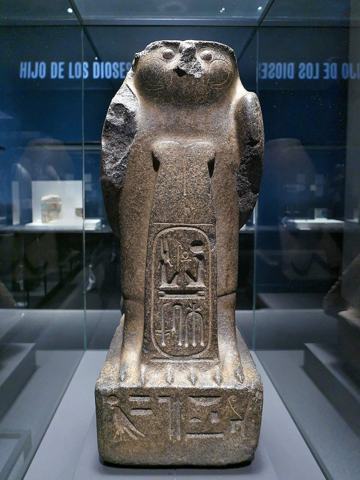
The sun itself as a god — Ra sails the sky by day, fights the serpent of chaos by night, and is reborn on the horizon every dawn.
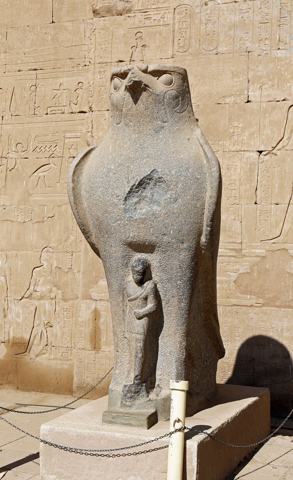
The sky falcon — god of kingship whose torn-out eye became the symbol of healing, and who won Egypt's throne from Set after eighty years of litigation.
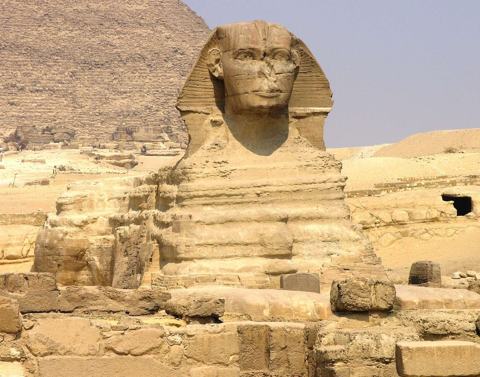
The colossal lion-bodied guardian of Giza, carved from the living bedrock, worshipped a thousand years later as the sun god Horemakhet.
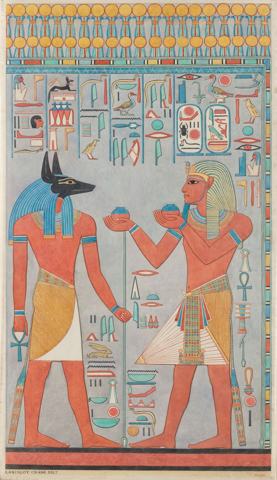
Guardian of the dead — the black jackal god who embalmed Osiris, watched over the necropolis, and weighed the heart against the feather of truth.
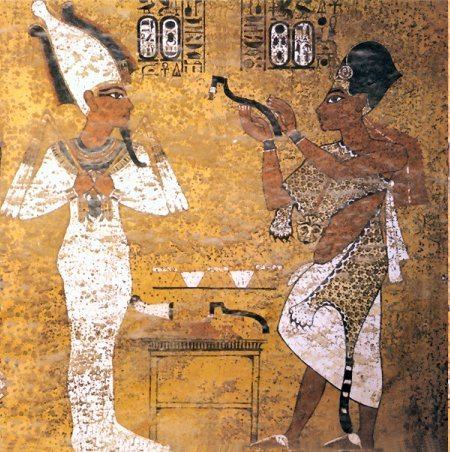
The Egyptian rite that restored a mummy's or statue's senses — touching sacred tools to its face so it could eat, see, and speak again.
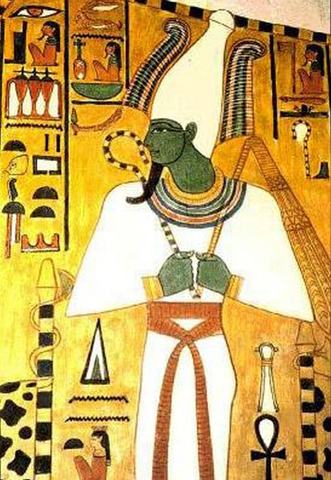
Lord of the afterlife — the murdered king remade as the first mummy, whose resurrection promised every Egyptian a life beyond the grave.
Sources & Further Reading
- 1.Inscriptions and Annals of Thutmose III, Precinct of Amun-Re, Karnak Temple, 18th Dynasty.
- 2.Blyth, Elizabeth. Karnak: Evolution of a Temple. Routledge, 2006.
- 3.Wilkinson, Richard H. The Complete Temples of Ancient Egypt. Thames & Hudson, 2000.
- 4.Strudwick, Nigel and Helen Strudwick. Thebes in Egypt: A Guide to the Tombs and Temples of Ancient Luxor. Cornell University Press, 1999.
- 5.Kemp, Barry J. Ancient Egypt: Anatomy of a Civilization. 2nd ed. Routledge, 2006.
- 6.Shafer, Byron E., ed. Temples of Ancient Egypt. Cornell University Press, 1997.
Spot an error or have a source to suggest? Write to info@viseterna.com. We cite primary sources and modern scholarship, and we correct fast.