
The Nihon Shoki
Japan's first official state history, finished in 720 in formal Chinese for a court that wanted its myths and its chronology to impress foreign readers.
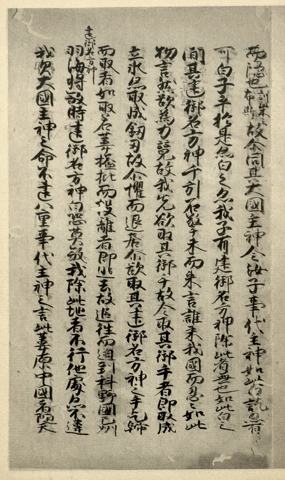
Nihon Shoki, Iwasaki-bon manuscript (National Treasure) · Public domain · source
A State History, Commissioned
The Nihon Shoki, "Chronicles of Japan," was presented to the court in 720, eight years after the Kojiki, and it was built for a different purpose 1,2. Where the Kojiki reads as a court's internal record of its own descent, the Nihon Shoki was compiled as Japan's first official national history, edited under the supervision of Prince Toneri, a son of Emperor Tenmu, with a team of scholars that most sources agree included O no Yasumaro among its contributors 1,3. The project appears to have been commissioned under Tenmu and completed under Empress Genshō, so that its composition spans the same decades of intense institution-building — new law codes, a new fixed capital, a court modeling itself explicitly on Tang China — that also produced the Kojiki 3,4.
That context matters for how the book reads. Piggott's study of early Japanese kingship treats the Nihon Shoki less as a neutral record than as a deliberate instrument of state formation, a history written to show a Chinese-style bureaucratic monarchy that Japan's ruling line had always been legitimate, continuous, and equal in dignity to its continental neighbors 3,4.
Thirty Books in the Chinese Manner
The chronicle runs to thirty books of history plus one of genealogical tables, and unlike the Kojiki's hybrid script it is written throughout in formal classical Chinese, the shared diplomatic and scholarly language of East Asia at the time 1,5. The choice of language was itself a message: a history written in kanbun could be read, in principle, by envoys and scholars from Tang China and the Korean kingdoms, and the text's coverage of diplomatic missions and continental affairs reads as an attempt to place Japan's court inside a shared East Asian frame of reference rather than to speak only to itself 1,4.
The two opening books cover the Age of the Gods, and the remaining twenty-eight follow human reigns from the legendary Emperor Jimmu down to Empress Jitō, whose reign ends the narrative in 697 1,3. That is a longer historical run than the Kojiki attempts, and the later books, covering the sixth and seventh centuries, are detailed enough that historians treat them as genuine, checkable records of court politics, diplomacy, and the introduction of Buddhism, even while the earliest reigns remain legendary 3,4.
The Same Myths, Told More Than One Way
The Nihon Shoki's most distinctive feature as a text is its habit of giving variant versions of a single myth back to back. Where the Kojiki settles on one telling of an episode, the Nihon Shoki will present the main narrative and then add, often several times, "a certain writing says" — an alternative version of the same event, sometimes contradicting the main account in details of names, order, or outcome 1,5. Susanoo's expulsion from heaven, the birth of Amaterasu from Izanagi's purification, and the finding of the sword later called Kusanagi inside the serpent Yamata-no-Orochi all appear in the Nihon Shoki with two, three, or more variant tellings stacked beside the primary one 1.
Scholars read this practice as evidence that Yasumaro's generation was compiling from genuinely divergent regional or clan traditions and chose, for this text, to preserve rather than harmonize them — a very different editorial instinct from the Kojiki's single authoritative line, and one reason the two texts are used together rather than either alone whenever a fuller picture of early Japanese myth is wanted 1,5.
Chronology Built to Impress
The Nihon Shoki dates its early reigns using the Chinese sexagenary calendar and pins Jimmu's accession to a year corresponding to 660 BCE. Almost no modern historian accepts that date, or the improbably long reigns assigned to the earliest emperors, at face value 3,4. The going explanation is that the compilers, working from a Chinese theory that a major political revolution recurs every 1260 years, worked backward from a significant year in living memory to land Jimmu's founding on a suitably auspicious point in that cycle, stretching the intervening reigns to fill the gap 3,4. Piggott treats this stretched chronology as part of the same impulse that chose the Chinese language and the diplomatic framing: a court eager to present a history as old and as orderly as China's own 3.
Aston's Nihongi and Reading the Chronicle Today
The Nihon Shoki reached English readers well before the Kojiki gained a full translation, through William George Aston's 1896 version, titled Nihongi, which remains the standard English text more than a century later 1. Aston's translation, running to Jitō's reign in 697, is the edition most Codex sources for the Age of the Gods material ultimately draw on 1.
Modern scholarship treats the Nihon Shoki and the Kojiki as a linked pair, often called together the Kiki, and reads them against each other rather than in isolation: where they agree, the tradition is older and steadier; where they diverge, the disagreement itself is evidence of competing eighth-century interests 4,5. Both chronicles underlie the imperial-regalia tradition explored in this Codex's Yata no Kagami entry, and both are cited constantly, and cross-checked against each other, wherever an entry here touches the age of the kami 1,2,5.
Continue Exploring
Japan's oldest surviving chronicle, presented to the throne in 712 from one court reciter's memory — the deepest source for the Codex's kami and early emperors.
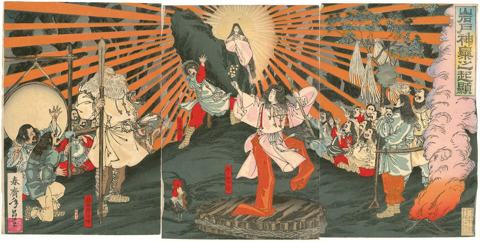
The sun goddess who shines in heaven — ruler of the Plain of High Heaven, ancestor of Japan's imperial line, and the kami enshrined at Ise.
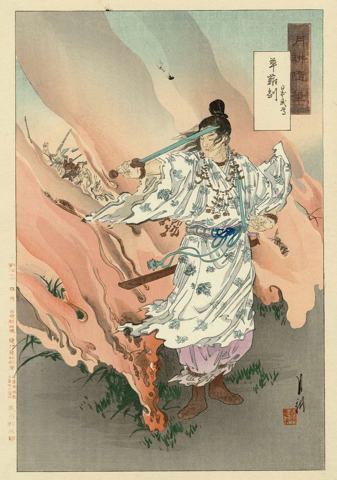
The sword drawn from a serpent's tail and renamed by a burning field — one of Japan's three imperial regalia, kept at Atsuta Jingu and never shown to anyone.
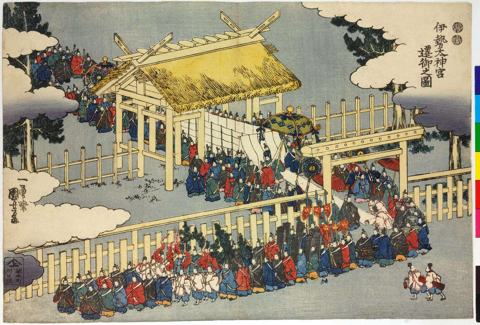
The mirror forged to trick a sun goddess out of hiding, handed down to her earthly heirs, and now kept at Ise, wrapped, unphotographed, and never once unveiled.
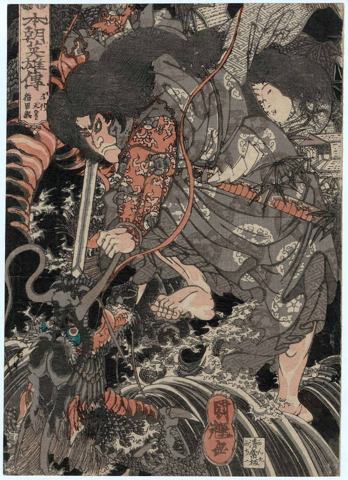
The eight-headed, eight-tailed serpent of Izumo — devourer of maidens, killed drunk by Susanoo, and the source of the imperial sword Kusanagi.
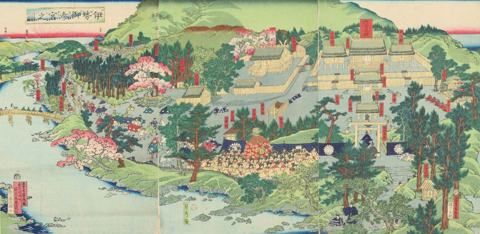
Shinto's holiest site, home to the sun goddess's mirror — rebuilt on an adjacent plot every twenty years so nothing there is ever allowed to age.
Also mentioned inIzumo Taisha
Sources & Further Reading
- 1.Nihon Shoki (Chronicles of Japan, 720), in W.G. Aston, trans., Nihongi: Chronicles of Japan from the Earliest Times to A.D. 697. Kegan Paul, 1896.
- 2.Kojiki (Records of Ancient Matters, 712). Trans. Donald L. Philippi. University of Tokyo Press, 1968.
- 3.Piggott, Joan R. The Emergence of Japanese Kingship. Stanford University Press, 1997.
- 4.Hardacre, Helen. Shinto: A History. Oxford University Press, 2017.
- 5.Breen, John & Mark Teeuwen. A New History of Shinto. Wiley-Blackwell, 2010.
Spot an error or have a source to suggest? Write to info@viseterna.com. We cite primary sources and modern scholarship, and we correct fast.