
Izumo Taisha
The shrine built, myth says, as the price for the land — where every kami in Japan is believed to gather each autumn, beneath a hall once among Japan's tallest.
Hotohoto Festival at Izumo Grand Shrine, Utagawa Hiroshige (Cleveland Museum of Art) · CC0 · source
The Land God's Shrine
Izumo Taisha, on the coast of what is now Shimane Prefecture, is among the oldest and most venerated shrines in Japan, and shrine tradition holds it predates even Ise 4,5. It is dedicated to Okuninushi, the land-building deity of the Izumo cycle, and it is the country's central shrine for en-musubi, the tying of bonds between people — marriages foremost, but by extension all human connection 4. The shrine's great straw shimenawa, woven for the Kagura Hall and among the largest ropes made anywhere in Japan, has become the single most photographed image of the site, though the sacred core lies in the separate, far less visited main hall behind it 4,5.
The Kuniyuzuri: A Transfer of the Land
The shrine's founding myth is a settlement, not a gift freely given. In the Kojiki and Nihon Shoki, Amaterasu sends heavenly messengers to demand that Okuninushi surrender rule of the earthly land he has built. Okuninushi agrees, after his sons are consulted and one of them, Takeminakata, is defeated in a contest of strength, but he sets a condition: a shrine built for him on a scale equal to the heavenly palace itself, with a hall reaching as high into the sky as Amaterasu's own 1,2. That bargain, the kuniyuzuri or "transfer of the land," is presented in both chronicles as the origin of Izumo Taisha, and it makes the shrine unusual among major sites in this Codex: it exists, by its own myth, as the price of a political surrender rather than as a straightforward act of devotion 1,2,4.
A Local Counter-Tradition: The Izumo Fudoki
The kuniyuzuri is the story the national chronicles tell about Izumo from the perspective of the heavenly court. The region's own eighth-century gazetteer, the Izumo no Kuni Fudoki, tells a different and largely separate creation story for the same land: the god Yatsukamizu Omizuno is said to have found the province too small and to have pulled extra land across the sea with a great rope, stitching new coastline onto Izumo from what the text calls Silla and other far shores 3. This "land-pulling" myth shares almost no plot with the kuniyuzuri, and scholars read the difference as evidence that Izumo kept a body of local tradition that the compilers of the Kojiki and Nihon Shoki drew on selectively rather than transcribed whole — the fudoki preserves what a regional priesthood wanted remembered, not necessarily what the Yamato court wanted told 3,5. How much of Izumo's outsized place in the national mythology reflects a real, once-independent regional power, and how much reflects the compilers' own literary needs, remains genuinely debated rather than settled 4,5.
Kamiarizuki: When the Gods Come Home
In the old lunar calendar's tenth month, popular belief holds that every kami in Japan leaves its home shrine and travels to Izumo for a gathering, to discuss, among other things, the coming year's marriages — which is why the shrine calls the month Kamiarizuki, "the month with the gods," while shrines everywhere else in Japan traditionally call the same month Kannazuki, "the month without gods" 4,5. Izumo Taisha still holds a Kamiari-sai festival at the month's start to welcome the visiting kami. The gods-absent etymology is the one repeated at every shrine gift shop, but linguists are not unanimous that it is the term's original sense rather than a folk reading layered onto an older word of uncertain meaning — a caution worth keeping in mind alongside the more famous story 5.
How Tall Was It? The Pillar Question
Medieval sources rank Izumo Taisha's main hall, at various points, as the tallest building in Japan, ahead of the Great Buddha Hall at Todaiji and the imperial palace's own great hall, and some traditional diagrams describe a honden reaching roughly 48 meters on giant triple-bundled pillars — a height that, if accurate, would dwarf the 24-meter hall standing today 4. For centuries this was treated as pious exaggeration. In 2000, excavation at the shrine uncovered the buried bases of three huge cypress logs lashed together into a single post, of a kind matching the old diagrams' description of the main pillars, and dated to a Kamakura-period rebuilding 4,5. The find renewed the debate rather than closing it: it shows the shrine once used pillars built for genuinely massive scale, but it does not by itself prove the full 48-meter figure, and Hardacre treats the discovery as strong support for an unusually tall premodern hall without treating the ancient height claims as fully confirmed 4.
Izumo Today
The current honden, rebuilt in 1744 in the taisha-zukuri style — reckoned the oldest shrine architectural style in Japan — is a National Treasure and undergoes its own cycle of ritual renewal, on a longer and less rigid schedule than Ise's twenty-year Shikinen Sengu 4,5. Pilgrims still come chiefly for en-musubi, clapping the distinctive four-times pattern used only here rather than the usual two, at a shrine whose myth has always insisted that this ground, more than any other, was Okuninushi's rightful price for peace 1,2,4.
Continue Exploring
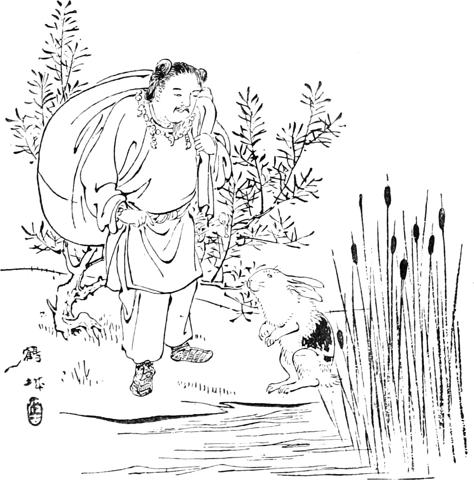
The Izumo kami who healed a skinned hare, survived his own brothers twice, built the land with a tiny god, and ceded it all to Amaterasu's line.
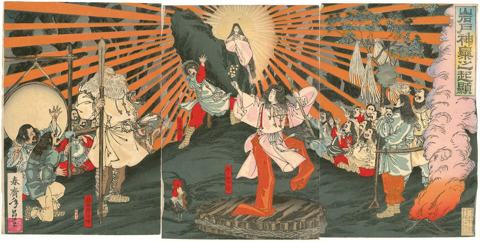
The sun goddess who shines in heaven — ruler of the Plain of High Heaven, ancestor of Japan's imperial line, and the kami enshrined at Ise.
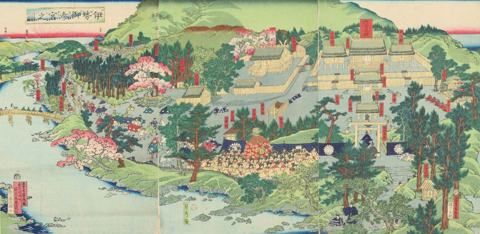
Shinto's holiest site, home to the sun goddess's mirror — rebuilt on an adjacent plot every twenty years so nothing there is ever allowed to age.
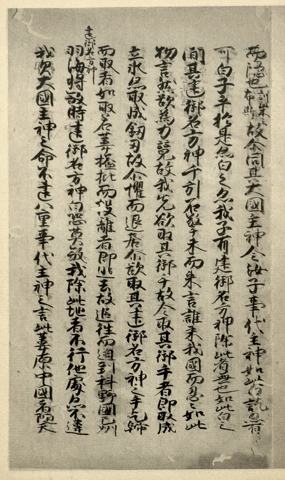
Japan's oldest surviving chronicle, presented to the throne in 712 from one court reciter's memory — the deepest source for the Codex's kami and early emperors.
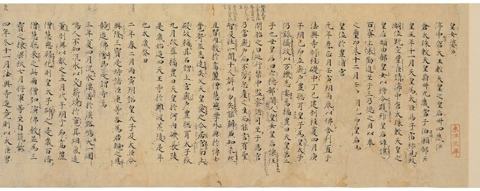
Japan's first official state history, finished in 720 in formal Chinese for a court that wanted its myths and its chronology to impress foreign readers.
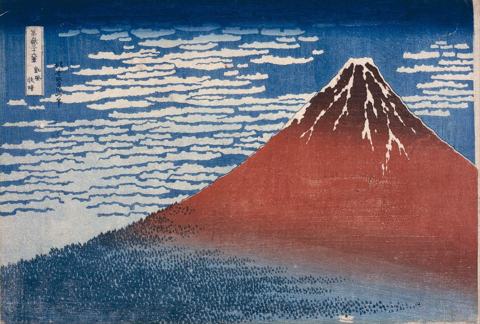
Japan's tallest, most sacred peak, home to a blossom goddess and climbed by pilgrim confraternities for centuries — a UNESCO site for its art, not its geology.
Sources & Further Reading
- 1.Kojiki (Records of Ancient Matters, 712). Trans. Donald L. Philippi. University of Tokyo Press, 1968.
- 2.Nihon Shoki (Chronicles of Japan, 720), in W.G. Aston, trans., Nihongi: Chronicles of Japan from the Earliest Times to A.D. 697. Kegan Paul, 1896.
- 3.Izumo no Kuni Fudoki (Gazetteer of Izumo Province, 733). Trans. Michiko Y. Aoki. Sophia University, 1971.
- 4.Hardacre, Helen. Shinto: A History. Oxford University Press, 2017.
- 5.Breen, John & Mark Teeuwen. A New History of Shinto. Wiley-Blackwell, 2010.
Spot an error or have a source to suggest? Write to info@viseterna.com. We cite primary sources and modern scholarship, and we correct fast.