
Ise Grand Shrine
Shinto's holiest site, home to the sun goddess's mirror — rebuilt on an adjacent plot every twenty years so nothing there is ever allowed to age.
View of the Ise Grand Shrine, Utagawa Sadahide, 1869 · Public domain · source
Two Shrines, One Complex
Ise Jingu, usually called simply "Jingu" by the tradition that considers it the shrine above all others, is not one building but around 125, spread across the city of Ise in Mie Prefecture and centered on two great sanctuaries several kilometers apart 4,5. The Naiku, or Inner Shrine, is dedicated to Amaterasu, ancestral deity of the imperial line and the tradition's supreme kami. The Geku, or Outer Shrine, is dedicated to Toyouke-Omikami, a deity of grain and food said to have been summoned to Ise centuries after Amaterasu specifically to provide her with sacred meals 4,5. The two shrines are administered as a single institution but keep separate precincts, separate rites, and, as later sections cover, a long and occasionally tense rivalry over precedence between the priestly lineages that served each 3.
Yamatohime's Search and the Mirror
The shrine's own founding story is told in the Nihon Shoki: during the reign of Emperor Suinin, the imperial princess Yamatohime-no-mikoto was charged with finding Amaterasu a permanent resting place, after the goddess's symbol had been kept, uneasily, inside the palace itself 1. Yamatohime carried the sacred mirror through several provinces before receiving, by tradition, a sign that Ise was the goddess's chosen site, and the Nihon Shoki and later shrine chronicles place the mirror's arrival there in this period 1. That mirror is identified with the Yata no Kagami, one of the three regalia of the imperial house, and it is still said to rest at the heart of the Naiku, wrapped and never viewed, even by the priests who tend it 1,4.
Before Ise, the mirror was kept beside the sword now called Kusanagi inside the palace, and its removal to a shrine of its own marks the moment the cult of Amaterasu became something distinct from the person of the reigning emperor, however closely the two remained bound afterward 1,4. The Kojiki keeps Yamatohime attached to Ise a generation later as well: it is from her, serving as priestess there, that her nephew Yamato Takeru receives Kusanagi and a fire-striking pouch before his campaign in the eastern provinces, arming him with treasures drawn straight from the shrine she had founded 2.
The Shikinen Sengu: A Shrine Rebuilt Forever
Ise's defining practice is the Shikinen Sengu, the periodic transfer of both main shrines to an identical building freshly constructed on an adjacent plot, after which the old structure is dismantled. Shrine tradition dates the custom to the reign of Empress Jitō at the end of the seventh century, and the Nihon Shoki records ritual and construction activity at Ise from this period consistent with an early Sengu 1,5. The interval has settled at twenty years, and the cycle has been repeated, with some interruptions during the long civil wars of the fifteenth and sixteenth centuries, into the present; the most recent rebuilding was completed in 2013 4,5.
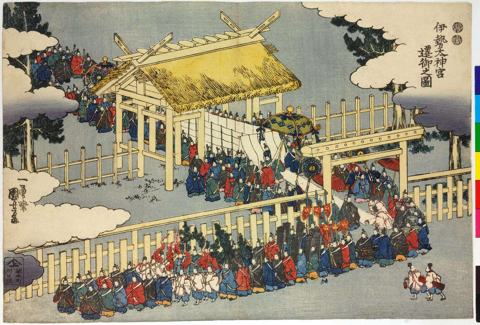
Each Naiku and Geku precinct holds two adjoining plots of equal size. One holds the current shrine buildings, built in the unpainted cypress shinmei-zukuri style with thatched roofs, crossed roof-finials (chigi), and short log weights (katsuogi) along the ridge; the other lies empty, waiting for the next cycle, marked only by a small central post-hole shelter 4,5. When the new buildings are finished, the sacred objects are moved across in a nighttime procession, and the old halls come down soon after, their timber redistributed to Ise's subordinate shrines rather than discarded 4,5.
What Rebuilding Means, and What It Hides
The Shikinen Sengu creates an odd situation for anyone trying to read the site archaeologically: because no Ise building is ever more than twenty years old, there is no ancient physical fabric to excavate in the way there is at a fixed stone monument. What survives instead is a continuously renewed technique — carpentry, thatching, weaving, and metalwork skills transmitted through the rebuilding itself, which functions as a kind of living archive of Nara-period construction methods even though no single plank is Nara-period wood 4,5. Scholars generally treat this as the deliberate point of the custom rather than an accident of it: renewal, not preservation, is what keeps the site sacred and the craft traditions unbroken 4,5.
The Outer Shrine's Own Claim
Ise's history is not only one of harmony between its two halves. From the medieval period onward, priests of the Geku developed Watarai Shinto, a body of theology that argued for Toyouke's own cosmic importance and, at times, pressed claims of near-equality with the Naiku that the Inner Shrine's own priesthood did not welcome 3. Teeuwen's study of Watarai Shinto reads this theological movement as a serious intellectual tradition in its own right, produced by an institution that needed doctrine to defend its standing precisely because it played permanent second precedence to its more famous neighbor 3.
Ise Today
Ise remains the closest thing Shinto has to a national high shrine, and its highest offices are still held by members or appointees of the imperial family, who alone, along with specially designated priests, may enter its innermost fences 4,5. Ordinary worshippers, arriving in the millions each year, approach only as far as an outer gate and never see the buildings that the Sengu keeps eternally new. That contradiction — a site defined by openness to endless pilgrimage and by an interior nobody outside a small circle is ever shown — is, more than any single building, what the shrine has represented for over a thousand years 4,5.
Continue Exploring
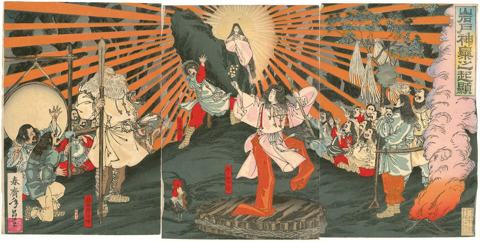
The sun goddess who shines in heaven — ruler of the Plain of High Heaven, ancestor of Japan's imperial line, and the kami enshrined at Ise.
The mirror forged to trick a sun goddess out of hiding, handed down to her earthly heirs, and now kept at Ise, wrapped, unphotographed, and never once unveiled.
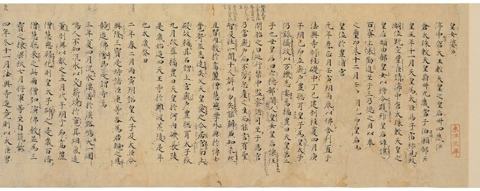
Japan's first official state history, finished in 720 in formal Chinese for a court that wanted its myths and its chronology to impress foreign readers.
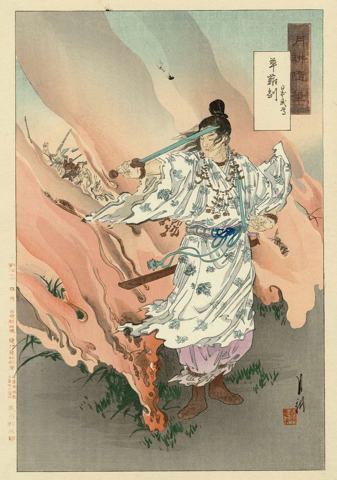
The sword drawn from a serpent's tail and renamed by a burning field — one of Japan's three imperial regalia, kept at Atsuta Jingu and never shown to anyone.
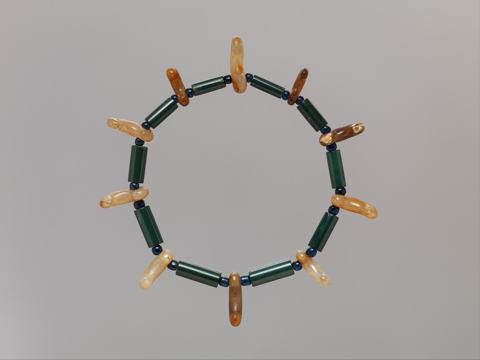
One of Japan's three imperial regalia: a string of curved jewels born at the heavenly rock cave, handed down from Amaterasu, and kept with the emperor unseen.
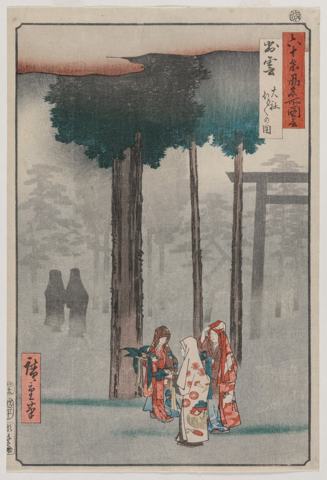
The shrine built, myth says, as the price for the land — where every kami in Japan is believed to gather each autumn, beneath a hall once among Japan's tallest.
Also mentioned inInari (Inari Okami)Mount Fuji (Sacred Mountain)
Sources & Further Reading
- 1.Nihon Shoki (Chronicles of Japan, 720), in W.G. Aston, trans., Nihongi: Chronicles of Japan from the Earliest Times to A.D. 697. Kegan Paul, 1896.
- 2.Kojiki (Records of Ancient Matters, 712). Trans. Donald L. Philippi. University of Tokyo Press, 1968.
- 3.Teeuwen, Mark. Watarai Shinto: An Intellectual History of the Outer Shrine in Ise. CNWS Publications, Leiden, 1996.
- 4.Hardacre, Helen. Shinto: A History. Oxford University Press, 2017.
- 5.Breen, John & Mark Teeuwen. A New History of Shinto. Wiley-Blackwell, 2010.
Spot an error or have a source to suggest? Write to info@viseterna.com. We cite primary sources and modern scholarship, and we correct fast.