
Ruyi Jingu Bang (Sun Wukong's Staff)
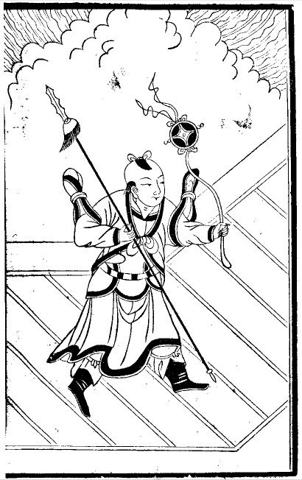
The 13,500-catty iron pillar that once measured the ocean floor — bullied out of a dragon king and shrunk to a needle behind Sun Wukong's ear.
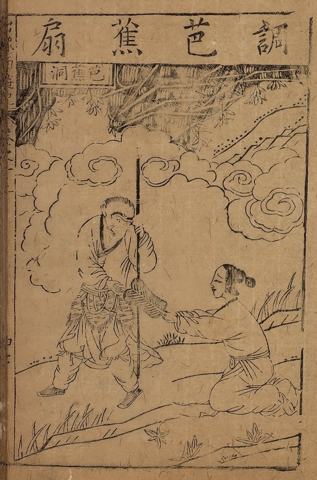
Sun Wukong with his staff, woodblock illustration from Xiyou Yuanzhi Tuxiang, 19th century · Public domain · source
Bullied Out of the Dragon King's Vault
The weapon enters the novel as a theft. Newly returned from Daoist training and unhappy with the rusty weapons his monkey troop can scrape together, Sun Wukong descends to the undersea palace of Ao Guang, the Dragon King of the Eastern Sea, and demands something better 1. The court produces weapon after weapon, a nine-pronged rake, a trident of colossal weight, and Wukong rejects each as too light, until the queen suggests the one piece of treasure nobody wants moved: a shaft of black iron banded in gold that has lately been glowing at the bottom of the palace's inner courtyard 1. Wukong takes this as an invitation rather than a warning, walks over, and claims it on the spot 1.
Yu the Great's Forgotten Measuring Rod
The novel gives the iron a pedigree reaching back past the Dragon King's own tenure. It identifies the shaft as the tool Yu the Great used to gauge the depths of the rivers and seas while draining the primordial flood, the mythic counterpart to the dredging campaign the Shiji credits him with in the founding legend of the Xia 1,2. Once the flood receded, the story goes, the measuring iron was left at the bottom of the Eastern Sea and forgotten, decorative rather than useful, until a demanding new owner arrived who could actually lift it 1. The detail is the novel's own invention rather than an older attested tradition, but it does real work: it ties Wukong's signature weapon to the single most respected labour in Chinese myth, engineering rather than conquest, before handing it to the least disciplined character in the book 1.
Thirteen Thousand Five Hundred Catties, and Shrinking
The shaft is inscribed along its length: Ruyi Jingu Bang, "As-You-Will Gold-Banded Staff," weight thirteen thousand five hundred catties 1. It answers to Wukong's will as much as to his hands: he can swell it to a battering ram or a bridge between mountains, or shrink it to the size of an embroidery needle small enough to tuck behind his ear, where he carries it for most of the novel between fights 1. Plaks reads this shrink-and-grow property as characteristic of the whole novel's method, in which physical objects carry Daoist inner-alchemy vocabulary without ever pausing to explain it — a staff that expands and contracts on command is also, in the language of internal cultivation, a fair description of how the undisciplined mind is supposed to behave before it is brought under control 3.
The Mind Monkey's Weapon
That reading fits the character carrying it. Sun Wukong is repeatedly called, in the novel's own recurring epithets, the "mind monkey," a stock figure in Ming vernacular Buddhism and Daoism for the restless, hard-to-govern human mind, and Plaks treats the cudgel's obedience to Wukong's will, for better and worse, as a physical staging of that idea: a tool of limitless power that is exactly as disciplined as the person wielding it, no more 3. Dudbridge's study of the pre-novel material is more cautious, noting that the cudgel itself has no clear antecedent in the earlier story cycle he traces, which suggests it may be a Ming-novel invention layered onto an already-old monkey-hero tradition rather than an inherited piece of folklore 4.
In Every Fight of the Pilgrimage
Once the pilgrimage begins, the staff is the pilgrims' one reliably lethal resource. It kills the White Bone Demon in three separate disguises, it is the weapon Wukong swings against Erlang Shen during the failed defence of heaven, and it proves useless, notably, against the one opponent the novel says outright cannot be beaten by force — the Buddha's open palm, which simply outlasts the whole confrontation without needing to block a single blow 1. Between fights it disappears behind Wukong's ear so completely that other characters frequently forget he is armed at all, a joke the novel returns to more than once 1.
The Cudgel Since
Shahar's study of Sun Wukong's origins situates the character among the most continuously adapted figures in Chinese popular religion and performance, and the staff has followed him into every medium: opera, the animated Havoc in Heaven, and a large modern industry of games and toys that reach for the glowing gold-banded pole as instant shorthand for the character before any monkey face is even drawn 5. Of all the treasures carried by any hero in this Codex, few have kept their exact original measurements, thirteen thousand five hundred catties, still, through four centuries of retelling 1,5.
Continue Exploring
The Monkey King — a stone-born immortal with seventy-two transformations who fought heaven to a standstill, then walked to India as a monk's disciple.
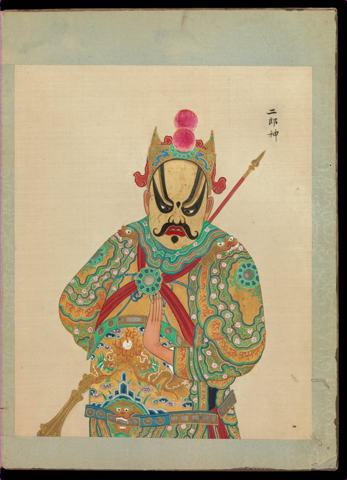
The three-eyed god of Guankou who tamed the floods and was the only celestial general able to beat the Monkey King in a fair fight.
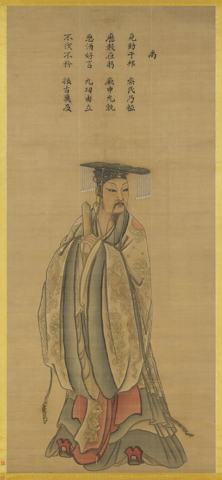
The hero who ended China's great flood by dredging channels instead of damming them, walked the Nine Provinces, and founded the Xia — if he existed at all.
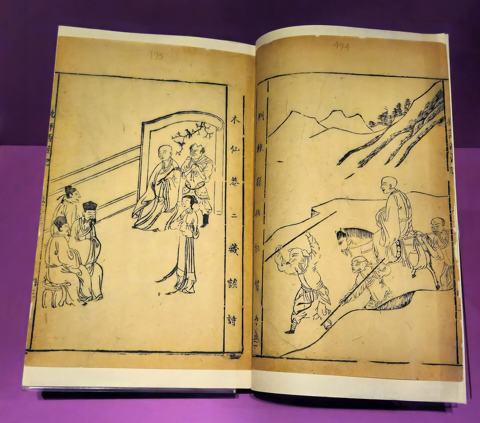
The Ming novel that sent a monk and three monster disciples across demon country for Buddhist scripture — and gave Sun Wukong to the world.
The child god who killed a dragon prince, returned his flesh to his parents, and was rebuilt out of lotus — China's most rebellious divine infant.
The fruit that ripens once every three thousand years in the Queen Mother's orchard — eaten by the wrong guest, it triggered heaven's most famous brawl.
Sources & Further Reading
- 1.Wu Cheng'en (attrib.), Xiyouji — Journey to the West (16th century); trans. Anthony C. Yu, The Journey to the West, revised edition, 4 vols., University of Chicago Press, 2012.
- 2.Sima Qian, Shiji, chapter 2, 'Xia benji' (Annals of the Xia), c. 91 BC.
- 3.Plaks, Andrew H. The Four Masterworks of the Ming Novel: Ssu Ta Ch'i-Shu. Princeton University Press, 1987.
- 4.Dudbridge, Glen. The Hsi-yu chi: A Study of Antecedents to the Sixteenth-Century Chinese Novel. Cambridge University Press, 1970.
- 5.Shahar, Meir. 'The Lingyin Si Monkey Disciples and the Origins of Sun Wukong.' Harvard Journal of Asiatic Studies 52.1 (1992), 193-224.
Spot an error or have a source to suggest? Write to info@viseterna.com. We cite primary sources and modern scholarship, and we correct fast.