
Yanluo (King Yan)
The magistrate-king of the Chinese underworld, who tries every soul against a written record and a mirror that shows what they actually did.
Yama, the Fifth King of Hell, Jin Chushi, late 12th century (The Metropolitan Museum of Art) · Public domain · source
Who Yanluo Is
Yanluo (閻羅), usually Yanluo Wang (閻羅王) or simply Yanwang — King Yan — is the judge of the dead in Chinese religion and the best-known ruler of Diyu, the earth-prison 2,6. He is not a devil and not an enemy of the living. He is a magistrate: robed in the court dress of an imperial official, seated behind a desk, working from written records, surrounded by clerks who keep the ledgers of every life 2,6.
That image is the whole point. The Chinese afterlife was imagined as a bureaucracy, with courts, dockets, warrants, terms of sentence, and the possibility of appeal or clerical error — an underworld built on the model of the government the living already knew 2,5.
From Yama to Yanluo
The name is Indian. Yama appears in the Vedas as the first mortal to die and therefore the king of the dead, and Buddhism carried him into China, where his name was transliterated as Yanmoluo and abbreviated to Yanluo 2. What arrived in China was already a Buddhist Yama, presiding over hells of punishment rather than a shadowy realm of ancestors.
The naturalisation was thorough. Chinese sources gave him Chinese officials, Chinese paperwork, and a Chinese chain of command, and by the medieval period he was operating alongside indigenous underworld figures such as the Lord of Mount Tai 2,5. Teiser's work on the medieval material argues that the resulting system — a period after death in which the spirit undergoes retribution for past deeds while surviving relatives can intervene on its behalf — is close enough to the medieval European idea to justify calling it a purgatory rather than a hell 2.
Fifth of the Ten Kings
The single most influential text about him is the Scripture on the Ten Kings, known from Dunhuang manuscripts of the ninth and tenth centuries and often copied as an illustrated scroll 1,2. It sets out a fixed itinerary: the soul of the dead passes before ten kings in turn, at seven-day intervals for the first seven weeks, then at one hundred days, one year, and three years 1,2. At each court the record is examined and the case advanced.
In that scheme Yanluo is the fifth king, not the first, and the Scripture is explicit about it — a striking demotion for a figure who had been the ruler of the dead outright 1,2. Teiser reads the ten-king system as an assimilation of Buddhist judgement to Chinese mourning practice, since the intervals match the memorial services families were already performing 2. The demotion never took hold in popular speech: "Yanluo Wang" continued to mean the king of the underworld in general, and in most temples and folk usage he outranks the other nine in fame if not in the official order 2,6.
Late imperial morality tracts, above all the widely reprinted Yuli baochao, spread a standardised tour of the ten courts with the specific punishments assigned to each sin, and it is largely from this literature that the familiar imagery of Chinese hell comes 3,6. Yanluo's fifth court is where the Terrace of the Mirror of Retribution stands: the dead who deny their offences are shown their own lives reflected back at them 3,6.
His Court and Its Officers
Yanluo does not work alone. The standing cast includes the judge Cui Jue, who keeps the registers of lifespans; the demon-runners Ox-Head and Horse-Face, who make the arrests; and the pale and dark messengers Heibai Wuchang, who fetch the dying 4,6. Popular tradition from the Song onwards also identified the incorruptible Northern Song official Bao Zheng with one of the underworld kings, on the reasoning that a judge that honest could only be doing the same work after death — a widespread belief, though the details of which court he holds vary between sources 6.
Temples of the city gods and dedicated hell-halls displayed the whole apparatus in painted or sculpted form for public instruction. Goodrich's survey of the Peking temple of the eighteen hells records the arrangement as it survived into the twentieth century, court by court 6.
Yanluo in Fiction
Journey to the West gives Yanluo two of his most famous appearances, and both turn on the fallibility of his bureaucracy. In chapter 3, Sun Wukong is dragged below when his allotted span ends, demands to see the ledgers, and simply crosses his own name and every monkey's name out of the register of life and death before walking back out; the Ten Kings can only file a complaint with heaven 4. In chapters 10 and 11, Emperor Taizong of the Tang is summoned to the underworld, meets the ten kings courteously, and is sent back after the judge Cui Jue quietly alters a numeral in the register to extend his lifespan 4. The joke in both episodes is a serious one: a world run on paperwork can be beaten by tampering with the paperwork 4.
What He Represents
Yanluo's function is moral accounting made explicit. Nothing is forgotten, everything is written down, rank and wealth carry no weight in his court, and the sentence fits the offence with an exactness the living world rarely manages 2,6. That is why he was preached to laypeople rather than kept for specialists, and why his courts were painted on temple walls where anyone could see them.
The system also allows mercy. Merit transferred by the living — sutras copied, feasts offered at the ghost festival, prayers to Guanyin or to the bodhisattva Dizang, who vowed to empty the hells — can shorten a sentence, and the Scripture on the Ten Kings assumes that families will act on behalf of the dead at every one of the ten stages 1,2,5.
Continue Exploring
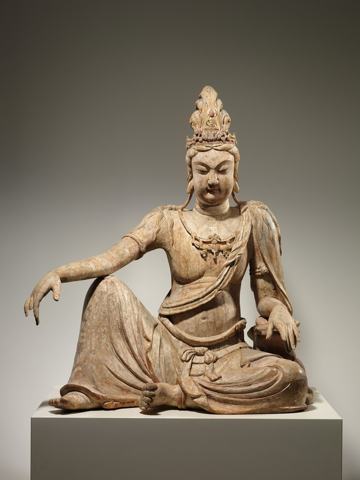
The bodhisattva who hears the cries of the world — an Indian Buddhist figure who became, in China, the most beloved of all female deities.
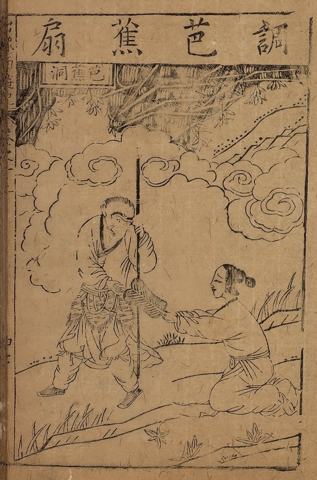
The Monkey King — a stone-born immortal with seventy-two transformations who fought heaven to a standstill, then walked to India as a monk's disciple.
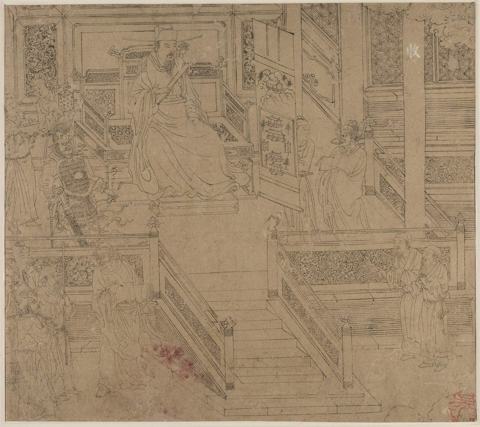
The Chinese underworld — a bureaucracy of ten courts where the dead are tried, serve sentences for what they did, and are then sent back into rebirth.
China's reanimated corpse — stiff-limbed, hopping, driven by a soul that failed to leave the body — a Qing folk terror turned horror-comedy icon.
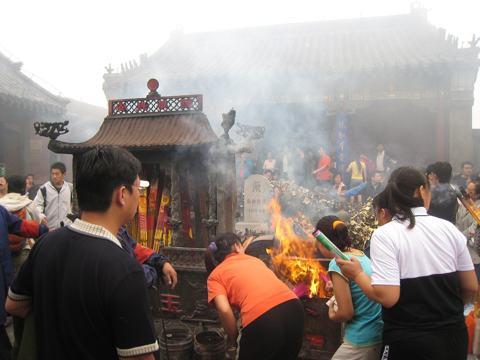
China's most sacred mountain, climbed by emperors seeking Heaven's mandate and by pilgrims for three millennia — seat of a goddess and an underworld judge.
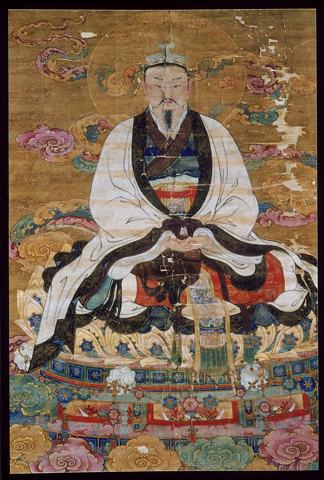
Sovereign of Heaven and head of the celestial bureaucracy — the emperor of the gods, who governs the cosmos the way a dynasty governs a realm.
Sources & Further Reading
- 1.Fo shuo shiwang jing — The Scripture on the Ten Kings (9th–10th century; Dunhuang manuscripts), text, translation and study in Teiser (below).
- 2.Teiser, Stephen F. The Scripture on the Ten Kings and the Making of Purgatory in Medieval Chinese Buddhism. University of Hawai'i Press, 1994.
- 3.Yuli baochao — The Precious Records of the Jade Calendar (late imperial morality tract describing the ten courts of the underworld).
- 4.Wu Cheng'en (attrib.), Xiyouji — Journey to the West (16th century), esp. chapters 3 and 10–11; trans. Anthony C. Yu, The Journey to the West, revised edition, University of Chicago Press, 2012.
- 5.Teiser, Stephen F. The Ghost Festival in Medieval China. Princeton University Press, 1988.
- 6.Goodrich, Anne Swann. Chinese Hells: The Peking Temple of Eighteen Hells and Chinese Conceptions of Hell. Monumenta Serica, 1981.
Spot an error or have a source to suggest? Write to info@viseterna.com. We cite primary sources and modern scholarship, and we correct fast.