
Yu the Great
The hero who ended China's great flood by dredging channels instead of damming them, walked the Nine Provinces, and founded the Xia — if he existed at all.
Standing Portrait of King Yu of Xia, attributed to Ma Lin, Southern Song dynasty (National Palace Museum, Taipei) · Public domain · source
The Man Who Fixed the Flood
Yu (禹), called Da Yu, Yu the Great, is the culture hero at the join between Chinese myth and Chinese history. He is the last of the sage rulers, the engineer who drained the great flood, the surveyor who divided the land into the Nine Provinces, and the founder of the Xia, conventionally the first dynasty 1,3. Confucian tradition treated him as the model of the ruler who works — praised not for virtue in the abstract but for effort 2.
His flood is not a punishment story. Unlike the Mesopotamian or biblical deluge, the Chinese flood in its classic form is a chronic condition rather than a divine verdict: the waters "rose to heaven", swamped the plains, and the problem is presented as a technical and administrative one, to be solved by labour 6. Lewis argues that this is the defining feature of the Chinese flood tradition — it is a myth about the creation of political and physical order, and the flood exists mainly so that someone can organise the world by draining it 6.
Gun's Failure, Yu's Method
The story begins with Yu's father, Gun, appointed to control the waters. Gun builds dams and dykes, in some versions using xirang, a self-multiplying "swelling earth" stolen from the high god, and fails after nine years; he is executed at Feather Mountain 3,6. In the mythological telling Yu is then born from Gun's body 6.
Yu reverses the method. Instead of blocking the water he opens it: cutting through mountains, dredging the beds of rivers, and leading the flood to the sea along channels rather than penning it behind walls 1,3. That contrast — du against yong, dredging against damming — is the moral of the story as Chinese tradition has used it for two thousand years, and it is still quoted in hydraulic-engineering and management contexts today 1,6.
The labour is total. Mencius says Yu was eight years away from home; the Shiji and later tradition give the famous detail that he passed the door of his house three times without going in, once hearing his infant son cry 2,3. He is said to have worn the hair off his shins, to have walked with a dragging, hopping gait afterwards — the "step of Yu", Yubu, which survived as a real ritual pace in Daoist liturgy — and to have been helped by a yellow dragon and a black turtle 3,6.
The Nine Provinces and the Nine Cauldrons
The "Tribute of Yu" chapter of the Shangshu is the systematic part of the legend: it walks through nine regions, naming their soils, their products, their tribute goods and their routes to the capital 1. It reads like an administrative geography, and that is essentially what it is — a template of an ordered empire projected back onto the founder 1,6. Most specialists now date the text to the Warring States period, roughly the fifth to third centuries BC, well over a millennium after the events it describes 1,6.
Tradition also credits Yu with casting the Nine Cauldrons from metal presented by the provinces, vessels that became the physical token of the mandate to rule and whose possession is treated in later texts as identical with legitimate sovereignty 3,6. The related tale of the flood-demon Wuzhiqi, a river spirit Yu chains beneath a mountain, is one of the oldest surviving Chinese monster-binding stories and has been proposed as one antecedent among several for the imprisonment of Sun Wukong 6.
Succession is where the myth turns political. Yao and Shun had each passed the throne to the worthiest man rather than to a son. Yu selects a successor in the same way, but on his death the people are said to have turned instead to his son Qi, and hereditary rule — the dynastic principle — begins 3. Early Chinese writers were aware this looked like a fall from the abdication ideal, and the sources handle it awkwardly, which is itself a sign the tradition was arguing with itself 3,6.
Did He Exist?
This is genuinely contested and should not be flattened either way.
The Bin Gong xu, a bronze vessel of about the ninth century BC that surfaced on the antiquities market in 2002, opens with Heaven commanding Yu to spread out the land and clear the rivers 4. That inscription pushes the flood-hero narrative back into the Western Zhou — some six centuries earlier than the classical texts — and shows the story was old and authoritative long before the Shangshu chapters were written 4,6. It does not show that a man named Yu lived, only that Zhou elites believed one had.
The Doubting Antiquity school of the 1920s and 1930s, led by Gu Jiegang, argued that the sage-king sequence was built up in reverse: the further back a figure was placed, the later he was invented, with Yu originally a divine or animal-shaped power rather than a king 5. Gu's specific readings — including a much-mocked suggestion connecting Yu's name to a reptile — have not all held up, but the underlying method, of dating each layer of a tradition by when it is first attested, reshaped the field permanently and remains standard 5,6.
Archaeology has not resolved it. No inscription contemporary with a Xia dynasty has been found, and no writing has been recovered from the Erlitou culture (roughly 1900-1500 BC) that many Chinese archaeologists identify with the Xia; the identification is an inference from date and location, not a demonstration, and is disputed outside China 6,7.
In 2016 Wu Qinglong and colleagues reported sedimentary evidence in Science for a catastrophic landslide-dam outburst flood on the upper Yellow River at Jishi Gorge around 1920 BC, and argued it could be the historical kernel of the Great Flood and a start date for the Xia 7. The paper drew immediate technical comments in the same journal contesting the dating, the scale and downstream reach of the flood, and above all the leap from a flood to this flood and to a dynasty 8. The cautious position — that a real Bronze Age disaster may lie somewhere behind the tradition, and that nothing yet connects it to a named king — is where most of the field currently sits 6,8.
Yu in Living Memory
Whatever his historicity, Yu is a fixture. The Yu temple and tomb at Kuaiji near Shaoxing has been a state sacrificial site for centuries; the "step of Yu" is still walked by Daoist priests; and his image as the ruler who dredges rather than dams is invoked constantly in modern Chinese discourse about flood control and governance alike 3,6.
He also sits oddly well beside the older cosmogonies. Where Pangu separates heaven and earth and Nuwa patches the sky, Yu does the unglamorous third shift: he makes the repaired world habitable, province by province, with a shovel 6.
Continue Exploring
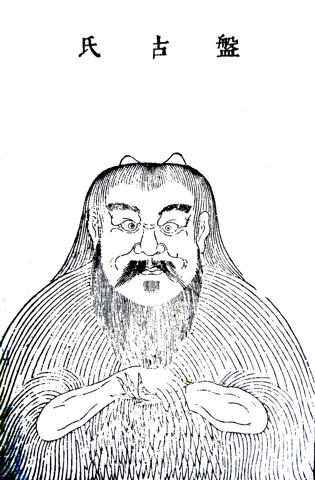
The primordial giant who split chaos into heaven and earth, and whose body at death became the mountains, rivers, winds, and stars of the world.
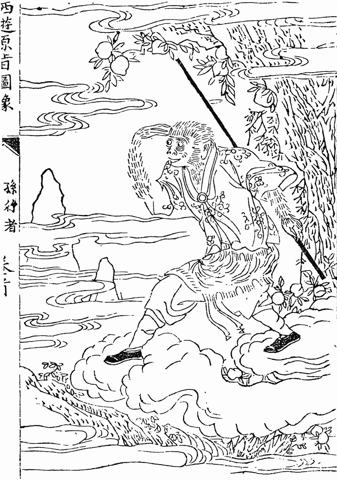
The Monkey King — a stone-born immortal with seventy-two transformations who fought heaven to a standstill, then walked to India as a monk's disciple.
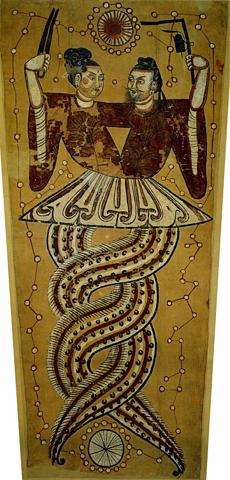
The serpent-bodied creator goddess who shaped the first humans out of yellow earth and patched the broken sky with five-coloured stone.
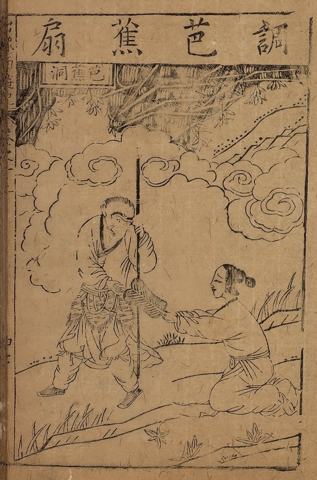
The 13,500-catty iron pillar that once measured the ocean floor — bullied out of a dragon king and shrunk to a needle behind Sun Wukong's ear.
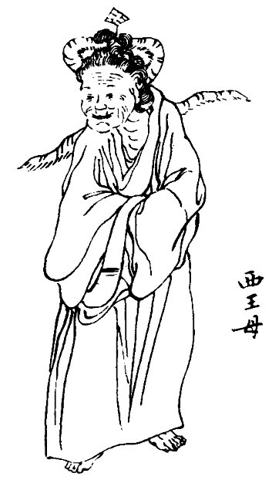
China's oldest surviving catalogue of mountains, monsters, and gods — a text nobody can name an author for, and half this Codex's bestiary depends on.
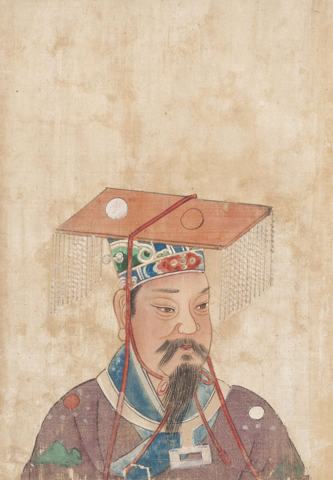
Legendary founder of Chinese civilization who defeated the horned rebel Chiyou at Zhuolu and gave his name to the medical canon that shaped Chinese medicine.
Sources & Further Reading
- 1.Shangshu (Book of Documents), 'Yu gong' (Tribute of Yu) and 'Yi ji' chapters.
- 2.Mengzi (Mencius), 3A.4 and 4B.29 — Yu's labour and the eight years away from home.
- 3.Sima Qian, Shiji, chapter 2, 'Xia benji' (Annals of the Xia), c. 91 BC.
- 4.Bin Gong xu bronze vessel inscription, c. 9th century BC (Poly Art Museum, Beijing) — the earliest known text naming Yu and the flood.
- 5.Gu Jiegang et al., eds. Gushi bian (Debates on Ancient History), 7 vols., 1926-1941.
- 6.Lewis, Mark Edward. The Flood Myths of Early China. State University of New York Press, 2006.
- 7.Wu Qinglong et al. 'Outburst flood at 1920 BCE supports historicity of China's Great Flood and the Xia dynasty.' Science 353 (2016), 579-582.
- 8.Technical comments on Wu et al., Science 355 (2017).
Spot an error or have a source to suggest? Write to info@viseterna.com. We cite primary sources and modern scholarship, and we correct fast.