
Guanyin
The bodhisattva who hears the cries of the world — an Indian Buddhist figure who became, in China, the most beloved of all female deities.
Bodhisattva Avalokiteshvara in Water Moon Form (Shuiyue Guanyin), wood with pigment, Liao dynasty, 11th century (The Metropolitan Museum of Art) · CC0 · source
Who Guanyin Is
Guanyin (觀音) is the bodhisattva of compassion: the figure who hears the cry of any being in distress and answers it. The Chinese name is a translation, not a Chinese invention. It renders the Sanskrit Avalokitesvara, and in Kumarajiva's influential 406 CE version of the Lotus Sutra the full form is Guanshiyin, "the one who perceives the sounds of the world" 1,4. Later Chinese usage shortened this to Guanyin; a traditional explanation is that the character shi was dropped to avoid the personal name of the Tang emperor Taizong, though the abbreviated form appears to be older than that taboo, and Yü treats the story as a convenient rationalisation rather than the cause 4.
Guanyin is not a god of the Chinese pantheon in origin but a Buddhist bodhisattva — a being who has attained enlightenment and postponed final nirvana in order to help others. What happened in China was that this imported figure was absorbed so thoroughly, and reimagined so freely, that by the late imperial period Guanyin was worshipped in Buddhist monasteries, Daoist temples, popular shrines and family homes alike 4.
The Scriptural Guanyin
The founding text is chapter 25 of the Lotus Sutra, circulated separately in China as the Guanyin jing. Its promise is unusually concrete: anyone who calls the bodhisattva's name single-mindedly will be saved from fire, flood, storm at sea, demons, execution, imprisonment, and bandits, and women who wish for children will receive them 1. The same chapter lists thirty-three forms in which the bodhisattva appears to teach — buddha, monk, king, general, boy, girl, nun, laywoman, and more — on the principle that the shape taken is whatever the person needing help can receive 1. That doctrine of expedient manifestation matters enormously for what came later: within the text itself, Avalokitesvara already has no fixed body and no fixed sex 1,4.
Pure Land scripture gives Guanyin a second role, as one of the two great attendants of the Buddha Amitabha, coming with him to receive the dying into the Western Paradise — the reason so many Chinese deathbed and funerary images show the bodhisattva descending 2,4.
The Question of Gender
Indian and early Chinese images of Avalokitesvara are male or deliberately sexless, often shown with a moustache; that remains the norm in China through the Tang 4. From the Song onwards, distinctly feminine images multiply, and by the Ming and Qing the great majority of Chinese depictions are of a woman — the White-Robed Guanyin, the Water-and-Moon Guanyin seated by a rocky shore, the Fish-basket Guanyin, the child-granting Songzi Guanyin, and Guanyin of the South Sea attended by the boy Shancai and the dragon girl Longnü 4,6.
Yü's study, which is the standard treatment, argues against any single cause. The shift was carried by indigenous Chinese scriptures, by miracle-tale collections, by pilgrimage to Mount Putuo (the Chinese Potalaka), by precious-scroll narratives sung to lay audiences, and above all by artists who kept producing new iconographies for which no Indian model existed 4. It is worth stating precisely what did and did not change: in doctrinal terms Guanyin never stopped being a bodhisattva whose form is provisional, and Chinese Buddhist authors were generally comfortable with both male and female representations. What changed was popular imagination and visual convention, not scripture 1,4.
Princess Miaoshan
The story that did most to fix Guanyin as female is the legend of Princess Miaoshan. In it, the third daughter of King Miaozhuang refuses the marriage her father demands, is persecuted, sent to hard labour and finally condemned to death; she passes through the underworld, whose torments are eased by her presence, returns to the world of the living, and at last gives up her own eyes and hands to make the medicine that cures her father's illness — after which she is revealed in her true form, the thousand-armed and thousand-eyed Guanyin 3,5.
Dudbridge's study traces the legend to a stele inscription composed in 1100 CE by the official Jiang Zhiqi for the Xiangshan monastery in Henan, and follows its spread through gazetteers, dramas and precious scrolls thereafter 5. The tale is a careful piece of religious work: it makes the bodhisattva Chinese, gives her a human biography and a father, and reconciles the Buddhist demand for renunciation with the Confucian demand for filial piety by having the daughter save her parent through an extreme act of self-sacrifice 5,6. The related precious-scroll narratives of Shancai and Longnü extend the same pattern to her acolytes 6.
Guanyin in Story and Practice
In Journey to the West Guanyin is the mission's architect: she selects the pilgrim monk, recruits the disciples, and hands over the golden fillet that lets Tripitaka control Sun Wukong — compassionate, but entirely willing to use restraint 7. She intervenes repeatedly when the pilgrims are outmatched, and the novel treats her as the most reliably competent power in the cosmos 7.
In practice she remains one of the most widely venerated figures in Chinese religion, invoked for protection at sea, for healing, for safe childbirth and for children; the Mount Putuo pilgrimage in Zhejiang has been a major destination since the Song 4. Her mercy is also asked for the dead, which is why she appears so often in imagery of Diyu, the courts of the underworld, easing the sentences passed there 4,5.
Beyond China the same figure is Kannon in Japan, Gwaneum in Korea, and Quan Am in Vietnam; the Tibetan tradition, which kept the male form, identifies the Dalai Lamas as his emanations 4.
Continue Exploring
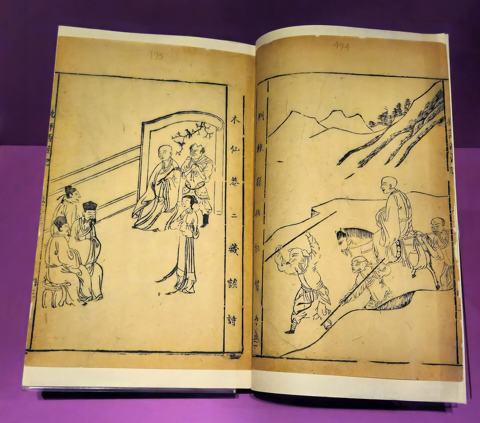
The Ming novel that sent a monk and three monster disciples across demon country for Buddhist scripture — and gave Sun Wukong to the world.
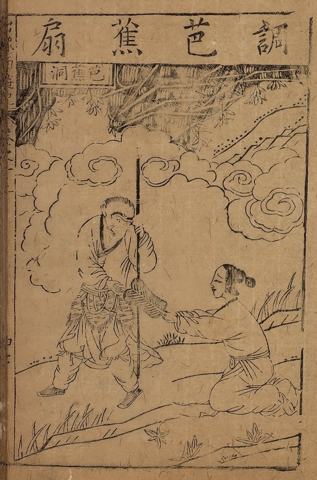
The Monkey King — a stone-born immortal with seventy-two transformations who fought heaven to a standstill, then walked to India as a monk's disciple.
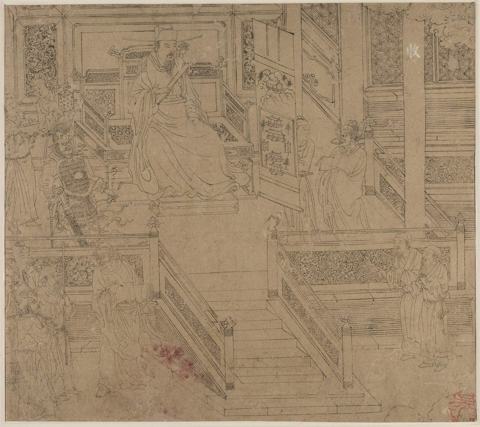
The Chinese underworld — a bureaucracy of ten courts where the dead are tried, serve sentences for what they did, and are then sent back into rebirth.
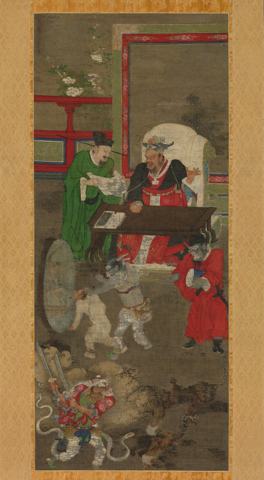
The magistrate-king of the Chinese underworld, who tries every soul against a written record and a mirror that shows what they actually did.
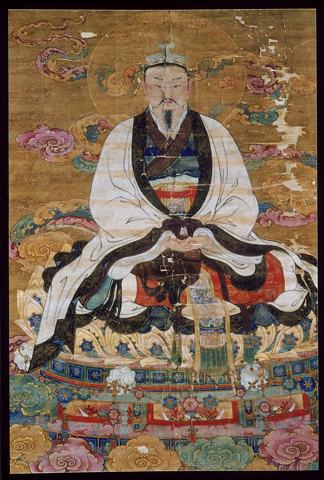
Sovereign of Heaven and head of the celestial bureaucracy — the emperor of the gods, who governs the cosmos the way a dynasty governs a realm.
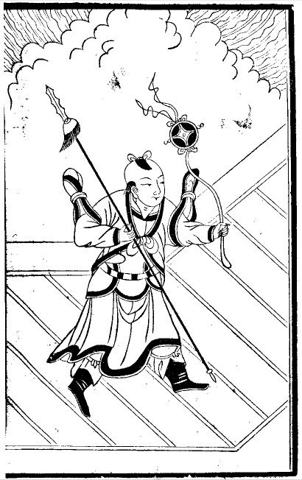
The child god who killed a dragon prince, returned his flesh to his parents, and was rebuilt out of lotus — China's most rebellious divine infant.
Sources & Further Reading
- 1.Saddharmapundarika Sutra — The Lotus Sutra, chapter 25, 'The Universal Gateway of the Bodhisattva Perceiver of the World's Sounds'; Chinese translation by Kumarajiva, 406 CE; English trans. Burton Watson, Columbia University Press, 1993.
- 2.Guan Wuliangshou jing — The Sutra on the Contemplation of the Buddha of Immeasurable Life, and related Pure Land scriptures, in which Avalokitesvara attends the Buddha Amitabha.
- 3.Jiang Zhiqi, stele inscription for the Xiangshan monastery, 1100 CE — the earliest datable account of the Princess Miaoshan legend; and the later Xiangshan baojuan (Precious Scroll of Fragrant Mountain).
- 4.Yü, Chün-fang. Kuan-yin: The Chinese Transformation of Avalokitesvara. Columbia University Press, 2001.
- 5.Dudbridge, Glen. The Legend of Miao-shan. Revised edition, Oxford University Press, 2004.
- 6.Idema, Wilt L. Personal Salvation and Filial Piety: Two Precious Scroll Narratives of Guanyin and Her Acolytes. University of Hawai'i Press, 2008.
- 7.Wu Cheng'en (attrib.), Xiyouji — Journey to the West (16th century); trans. Anthony C. Yu, The Journey to the West, revised edition, University of Chicago Press, 2012.
Spot an error or have a source to suggest? Write to info@viseterna.com. We cite primary sources and modern scholarship, and we correct fast.