
Surya (Hindu Sun God)
The Vedic sun god, drawn across the sky by seven horses — a deity whose foreign-looking boots and slow retreat from worship still puzzle scholars.
Surya, stone stele (Indian Museum, Kolkata) · CC BY-SA 4.0 · source
The Sun of the Rigveda
Surya (सूर्य) is the sun itself, addressed in the Rigveda as the eye of the gods Mitra and Varuna, the one who "unrolls" like a piece of cloth across the sky and measures the days of mortal life 1. Jamison and Brereton's translation shows a deity described almost entirely in physical, visible terms — light, warmth, and travel — riding a chariot pulled by seven horses (or, in an older figure, one horse with seven names) across heaven from dawn to dusk, driven by his charioteer Aruna, the reddish glow that precedes him 1. He overlaps closely in the earliest texts with Savitr, the sun as impeller and awakener, to the point that scholars generally treat the two as different aspects of one solar power rather than fully separate gods 1,6.
Saranyu, Chhaya, and the Sun's Children
Surya's mythology accumulates a family. His wife Saranyu (later called Sanjna), daughter of the divine craftsman Tvashtr, finds his brilliance unbearable and, according to the fuller Puranic version of the story, leaves behind a shadow-double of herself, Chhaya, to stand in for her while she withdraws to the wilderness in the form of a mare. Surya eventually pursues her in the form of a stallion, and their reunion produces the twin horse-headed physician gods, the Ashvins 3. The scandal in the story is corrected by Tvashtr, who shaves down some of Surya's excess brilliance on a grinding wheel to make him bearable to look at — a myth Bhattacharji reads as a late rationalisation explaining both the sun's slightly reduced blaze and the existence of his divine children by two different mothers 3,6. Among Surya's other offspring by tradition are Yama, lord of the dead, and Manu, ancestor of the current human age.
The Sun in Boots
Surya's iconography carries one genuinely odd detail that iconographers keep returning to: in nearly every surviving image from the Gupta period onward, he wears boots reaching to the calf, a garment no other major Hindu deity is shown in and one without a clear indigenous origin. Srinivasan's study of multiplicity and form in Indian religious art treats the boots, together with a distinctive belted tunic, as evidence of contact with Iranian sun-worship transmitted through the Maga priesthood — Zoroastrian-linked Brahmins the Bhavishya Purana credits with founding organised Surya worship in India after being invited from "Shakadvipa" to serve a temple no local priest could properly consecrate 4,5. The Bhavishya Purana attaches this priesthood to a specific legend: Samba, a son of Krishna, is cursed with leprosy for his arrogance and cured only after bathing and worshipping at a sun shrine, after which he imports the Maga priests to maintain proper solar ritual — a foundation story scholars read as a later, temple-building community's account of its own origins rather than literal history, but one that consistently attaches itself to real, still-standing Surya temples 4,5.
Aditya Hridayam
Surya's most quoted appearance outside his own mythology comes in someone else's crisis. In the Yuddha Kanda of the Ramayana, as Rama stands exhausted before his final duel with Ravana, the sage Agastya teaches him the Aditya Hridayam, "the heart of the sun," a hymn of praise to Surya under his many names, promising victory to whoever recites it with focused mind. Rama recites it and immediately finds new strength for the fight 2. The hymn is recited independently today by devotees as a text of protection and vitality, detached from its narrative frame in the epic 2.
A God in Eclipse
Surya's career runs a version of the same arc scholars have traced for Indra: commanding devotion in the oldest layer of text, then gradually absorbed into the ritual background as the great sectarian gods of later Hinduism took the foreground 6. He never disappears — he keeps a permanent place as one of the navagraha, the nine seizers of astrology invoked in temple consecration and daily domestic ritual across the subcontinent, and stone Surya temples were built at real scale, most famously the thirteenth-century Sun Temple at Konark, built as a giant stone chariot, and the earlier temples at Martand in Kashmir and Modhera in Gujarat, all now ruined or partly ruined but still standing as evidence of how seriously the cult was once funded 4,6,7. Bhattacharji reads his gradual retreat from being anyone's primary object of devotion as characteristic of the older Vedic nature-gods generally, ritually retained long after they stopped being anyone's personal god 6.
Surya Today
Surya remains the most ritually active of the old Vedic gods in everyday practice, if not the most devotionally central. Surya Namaskar, the sun salutation sequence, is a fixture of yoga practice worldwide, detached from any explicit worship context for most practitioners 6. In Bihar and eastern India, Chhath Puja, a multi-day fast and riverbank ritual offering arghya to the setting and then the rising sun, remains one of the most intensively observed festivals in the region, sustained largely by lay devotion outside brahmanical temple structures rather than through them 6.
Continue Exploring
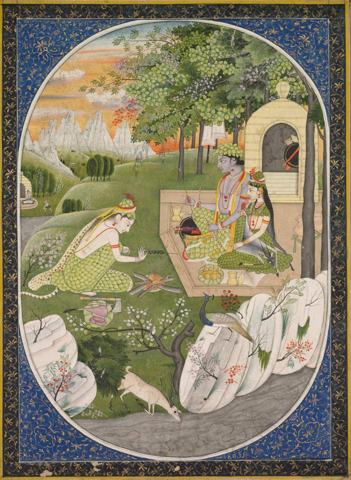
Prince of Ayodhya and seventh avatar of Vishnu — exiled hero of the Ramayana, slayer of Ravana, and the ideal of dharma.
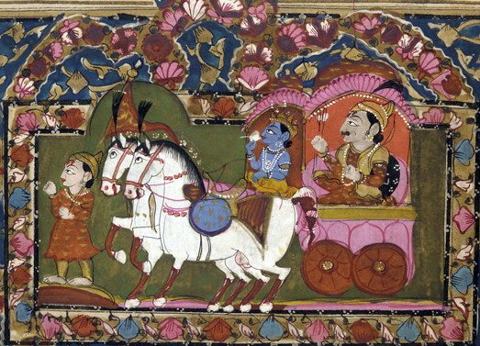
Cowherd, lover, statesman and charioteer — the avatar of Vishnu who speaks the Bhagavad Gita and anchors India's largest devotional tradition.
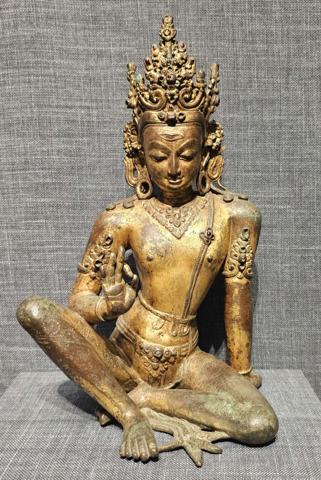
King of the gods and lord of storm and war — wielder of the thunderbolt, slayer of the serpent Vritra, and the deity Hinduism gradually demoted.
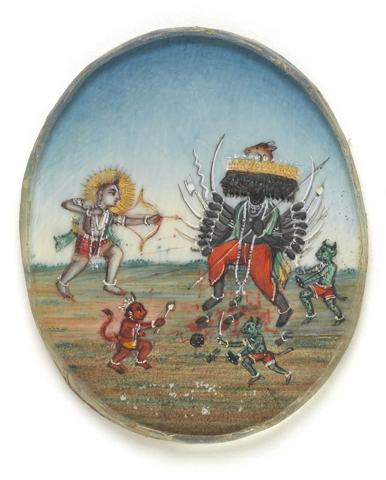
Lanka's rakshasa king, ten-headed abductor of Sita in the Ramayana and a devoted worshipper of Shiva — a villain regional traditions read very differently.
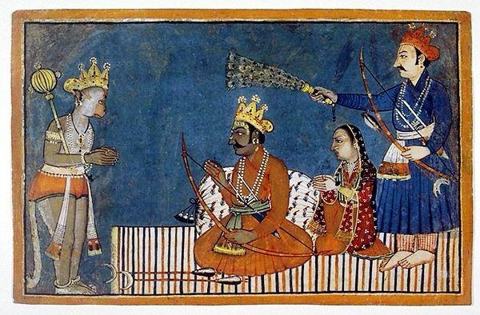
Son of the wind, greatest of the vanaras, and Rama's perfect servant — the leaper of oceans who became one of India's most worshipped gods.
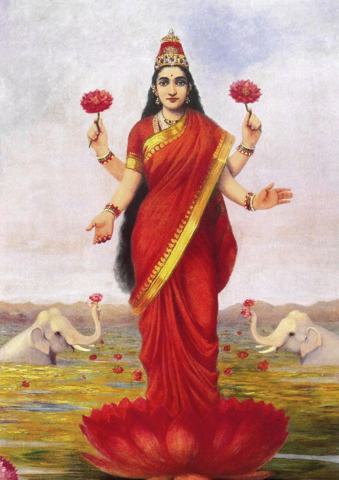
Goddess of wealth, beauty and good fortune, born from the churning of the ocean and inseparable consort of Vishnu.
Sources & Further Reading
- 1.The Rigveda (c. 1500-1200 BCE); translated by Stephanie W. Jamison and Joel P. Brereton. Oxford University Press, 2014.
- 2.Valmiki. Ramayana, Yuddha Kanda — the Aditya Hridayam hymn; translated by Robert P. Goldman et al. Princeton University Press, 1984-2017.
- 3.Markandeya Purana (the myth of Saranyu, Chhaya, and Surya's descendants).
- 4.Bhavishya Purana (the legend of Samba and the Maga priests of sun worship).
- 5.Srinivasan, Doris Meth. Many Heads, Arms, and Eyes — Origin, Meaning, and Form of Multiplicity in Indian Art. Brill, 1997.
- 6.Bhattacharji, Sukumari. The Indian Theogony — A Comparative Study of Indian Mythology from the Vedas to the Puranas. Cambridge University Press, 1970.
- 7.Flood, Gavin. An Introduction to Hinduism. Cambridge University Press, 1996.
Spot an error or have a source to suggest? Write to info@viseterna.com. We cite primary sources and modern scholarship, and we correct fast.