
Sita
Wife of Rama and heroine of the Ramayana — found in a furrow, abducted by Ravana, tested by fire, and read differently across the tradition's many tellings.
Sita in Ashoka Grove, oil painting by Raja Ravi Varma, 1894 · Public domain · source
Found in a Furrow
Sita enters Valmiki's Ramayana not as a birth but as a discovery: King Janaka of Mithila, ploughing a field as part of a royal ritual (or, in some tellings, simply clearing ground for a sacrifice), finds an infant girl lying in the furrow and raises her as his own. Her name comes directly from that furrow, sita, and the epic tradition reads her as literally earth-born, a daughter of the goddess Bhumi rather than of any mortal union — a detail that later becomes central to how her story ends 1. She is won by Rama, eldest son of King Dasharatha of Ayodhya, at her svayamvara in Mithila, when he alone strings and breaks the great bow that other suitors cannot lift 1.
The Choice to Follow
When Rama is exiled to the forest for fourteen years by a political intrigue at his father's court, Sita is not sent with him — she insists on going, over his own objection that forest life is too hard for a princess, arguing that a wife's place is beside her husband regardless of comfort 1. The tradition treats this insistence as the first of several moments in which Sita's choices, not Rama's, drive the plot rather than merely following it 1,4.
In the forest, the rakshasa king Ravana of Lanka, avenging an insult to his sister Shurpanakha, has Rama lured away by a golden deer and abducts Sita in his flying chariot while she is alone at the hermitage. She is carried to Lanka and held in the Ashoka grove, a guarded garden under threat rather than direct assault: Valmiki's text is explicit that Ravana cannot force himself on an unwilling woman without incurring a fatal curse, so her year of captivity becomes an ordeal of pressure and waiting rather than violence outright 1.
Fire and the Question of Proof
After Hanuman locates her and Rama's alliance with the vanaras defeats Ravana's armies, the reunion is not the simple happy ending the war has been building toward. Rama's first words to the recovered Sita are cold — he says publicly that he fought to clear his own honour, not to reclaim her, and questions whether she remained untouched during her captivity. Sita responds by entering a blazing fire, the agni pariksha, and emerges unburnt, vindicated by the fire god Agni himself, who returns her to Rama as proof of her purity 1. Modern readers have generally found this scene the hardest in the epic to sit with, and Sutherland's study of the epic's two most prominent women argues that Sita's forced self-vindication, set against her sustained agency everywhere else in the story, is exactly the kind of contradiction the Sanskrit epics build into their female leads rather than resolve 6.
Banishment and the Return to Earth
The Ramayana's seventh book, generally judged by scholars to be a later addition to the core narrative, pushes the ordeal further. Back in Ayodhya and pregnant, Sita is banished by Rama after he hears rumours among his subjects doubting her fidelity during the captivity — a decision the text itself frames as politically motivated rather than morally certain. She takes refuge at the sage Valmiki's own hermitage and bears twin sons, Lava and Kusha, who are raised there and eventually recite the Ramayana itself before their unknowing father's court 1. Asked once more, years later, to prove her purity before the assembled court, Sita instead calls on her mother the Earth to receive her if her devotion has been true — and the ground opens and takes her back, ending the story on her own terms rather than Rama's 1. Tulsidas's widely performed sixteenth-century retelling keeps this arc while softening its harshest edges for a more devotionally focused audience, and the Ramlila stage cycles drawn from his text are how most North Indians actually encounter the story today 2.
Other Sitas
Valmiki's is not the only Sita. The Adbhuta Ramayana gives her a strikingly different final act: confronted by a thousand-headed double of Ravana whom Rama cannot defeat, Sita herself takes on a fierce, Kali-like form and kills the demon, a warrior ending found nowhere in the mainstream text 3. Richman's two edited volumes on the plurality of Ramayana traditions collect tellings, especially from women's oral and song traditions in Bengal and South India, that are markedly more sympathetic to Sita and considerably harder on Rama's conduct toward her than Valmiki's Sanskrit original 4,5. These are not corruptions of a single correct version; the scholarly consensus represented in Richman's volumes treats the plurality itself as the tradition's real shape 4,5.
Worship and Reading Her
Sita is worshipped alongside Rama in nearly every Rama temple, invoked in the same breath, and her name carries independent devotional weight as an example of steadfastness and dignity under trial. She is also, in Lakshmi's theology, one of the forms the goddess Shri takes when Vishnu descends as Rama — earth, fortune and wife converging in one figure 1. Contemporary readers remain divided on how to hold her story together: as a model of unwavering fidelity, as a portrait of enforced silence, or, in Richman's collected essays, as a figure different communities have never stopped rewriting to match their own sense of what justice toward her would look like 4,5,6.
Continue Exploring
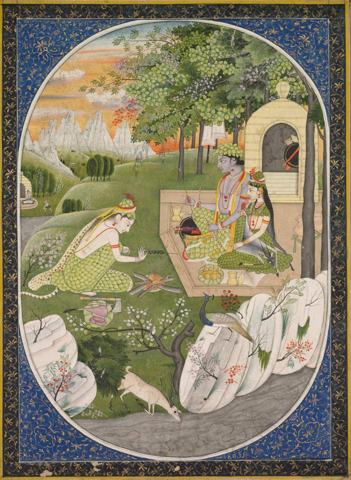
Prince of Ayodhya and seventh avatar of Vishnu — exiled hero of the Ramayana, slayer of Ravana, and the ideal of dharma.
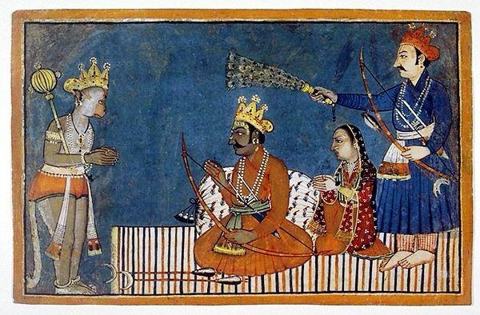
Son of the wind, greatest of the vanaras, and Rama's perfect servant — the leaper of oceans who became one of India's most worshipped gods.
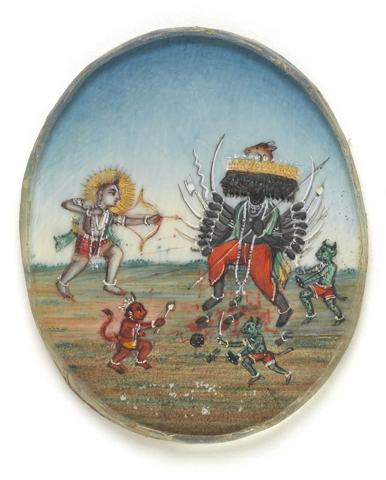
Lanka's rakshasa king, ten-headed abductor of Sita in the Ramayana and a devoted worshipper of Shiva — a villain regional traditions read very differently.
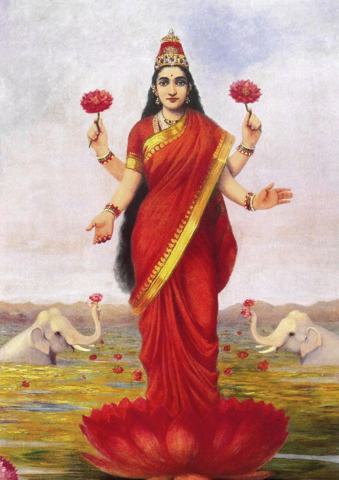
Goddess of wealth, beauty and good fortune, born from the churning of the ocean and inseparable consort of Vishnu.
The festival of lights lit around the new moon of Kartika — explained across regions and faiths by at least four different founding stories.
Cowherd, lover, statesman and charioteer — the avatar of Vishnu who speaks the Bhagavad Gita and anchors India's largest devotional tradition.
Sources & Further Reading
- 1.Valmiki. Ramayana, translated by Robert P. Goldman et al. as The Ramayana of Valmiki — An Epic of Ancient India. Princeton University Press, 1984-2017.
- 2.Tulsidas. Ramcharitmanas (Awadhi, 1574).
- 3.Adbhuta Ramayana (Sanskrit, date uncertain; attributed to Valmiki by tradition).
- 4.Richman, Paula, ed. Many Ramayanas — The Diversity of a Narrative Tradition in South Asia. University of California Press, 1991.
- 5.Richman, Paula, ed. Questioning Ramayanas — A South Asian Tradition. University of California Press, 2001.
- 6.Sutherland, Sally J. "Sita and Draupadi — Aggressive Behavior and Female Role-Models in the Sanskrit Epics." Journal of the American Oriental Society 109, no. 1 (1989).
Spot an error or have a source to suggest? Write to info@viseterna.com. We cite primary sources and modern scholarship, and we correct fast.