
Arjuna
The Pandava hero of the Mahabharata, winner of Draupadi's hand and wielder of the bow Gandiva, whose crisis on the battlefield draws out the Bhagavad Gita.
Arjuna Wins Draupadi, Kalighat painting, Calcutta, India, circa 1885 · Public domain · source
The Third Pandava
Arjuna is the third of the five Pandava brothers, born to Kunti not by her husband Pandu — cursed against fathering children himself — but through her invocation of the god Indra, which makes Arjuna, in the epic's own terms, a son of heaven as much as of the Kuru line 1. He grows up the acknowledged favorite of his teacher Drona, the most gifted archer among his classmates including his great rival Karna, and the epic gives him a stack of epithets that each mark a different feat or trait: Dhananjaya ("winner of wealth"), Partha (son of Pritha, Kunti's other name), Savyasachin ("ambidextrous," for his ability to draw a bow with either hand) 1,3. Van Buitenen's translation of the early books treats this accumulation of names less as ornament than as a running record of a hero whose identity is built, episode by episode, out of what he does 1.
Draupadi and the Gandiva
Two formative episodes define him before the war ever begins. At Draupadi's svayamvara, disguised with his brothers as a wandering brahmin during their exile, Arjuna alone strings an impossibly stiff bow and puts five arrows through a revolving target by watching only its reflection, winning Draupadi's hand — and, in one of the epic's more debated turns, sharing her as wife among all five brothers at Kunti's unwitting instruction, an arrangement the text itself treats as unusual enough to require its own justification 1,3. Doniger's sourcebook includes several of the epic's own attempts to explain the polyandry, none of them fully satisfying to modern readers, which she presents as evidence of how much the detail troubled even ancient audiences 4.
Soon after, Arjuna and Krishna help the fire god Agni, weakened and hungry, consume the vast Khandava forest by holding off the gods and creatures who try to stop the blaze. In gratitude, the ocean god Varuna gives Arjuna the bow Gandiva, two quivers that never run out of arrows, and a chariot bearing Hanuman's banner — the equipment that defines him as a warrior for the rest of the epic 1.
Exile and the Field of Kurukshetra
After the Pandavas lose their kingdom in a rigged dice game, Arjuna spends part of their thirteen-year exile disguised as Brihannala, a eunuch dance and music teacher at the court of King Virata, a episode the epic uses to strip its greatest archer of every outward mark of status before restoring him for the climactic war 1,3. When war finally comes, it is Arjuna who asks Krishna, serving as his charioteer, to drive between the two armies for a final look at the enemy — and there recognizes grandfathers, teachers, and cousins arrayed against him. His resolve collapses; he lets the Gandiva fall and tells Krishna he will not fight a war that requires killing his own family 1,2.
The Bhagavad Gita
Krishna's answer to that collapse is the Bhagavad Gita, eighteen chapters embedded in the Bhishma Parva that have become, independently of the epic around them, one of the most influential texts in Hindu thought 2. Krishna's core argument is that Arjuna's duty (svadharma) as a warrior exists apart from his attachment to the outcome of fighting — action performed without craving its fruits, he says, binds no one, while withdrawal from a rightful duty out of fear or grief is itself a failure of understanding 2. He widens the argument through several linked teachings: the imperishability of the self behind the body it inhabits, the equal validity of paths through disciplined action, devotion, and knowledge, and finally a terrifying vision of his own cosmic form, revealed at Arjuna's request, in which Krishna appears as the totality of time and destruction devouring the very warriors on the field below 2.
Hiltebeitel's study of Krishna's role in the epic argues against reading the Gita as a philosophical essay awkwardly inserted into a war story, treating it instead as continuous with the Mahabharata's own theology of sacrifice and kingship — Arjuna's crisis is not solved by leaving the epic's logic but by having that logic explained to him in full 5. Van Buitenen's own introduction to his bilingual edition makes the same case from the manuscript tradition, arguing the Gita was composed as part of the epic rather than absorbed into it later 2.
After the Gita
Arjuna fights, and the Pandavas win a war that costs nearly everyone on both sides their lives. What endures beyond the battlefield is the dialogue itself: the Gita has been read, translated, and argued over far more widely than the rest of Arjuna's story, so that the peerless archer of the early books is now known to most readers chiefly as the man who asked the questions that needed Krishna's answers 2,6. Flood notes that this afterlife has made the Gita a touchstone across very different strands of later Hindu thought, quoted by reformers, renunciants, and political leaders who otherwise agree on little else 6.
Continue Exploring
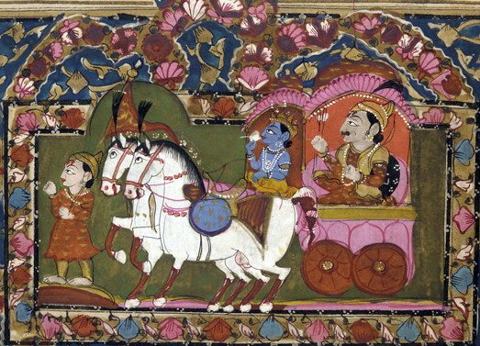
Cowherd, lover, statesman and charioteer — the avatar of Vishnu who speaks the Bhagavad Gita and anchors India's largest devotional tradition.
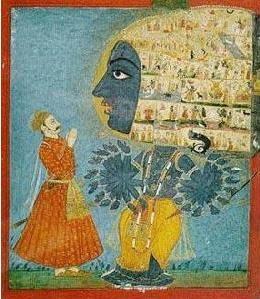
Eighteen chapters embedded in the Mahabharata where Krishna counsels Arjuna — read, translated and argued over more than any other Hindu text.
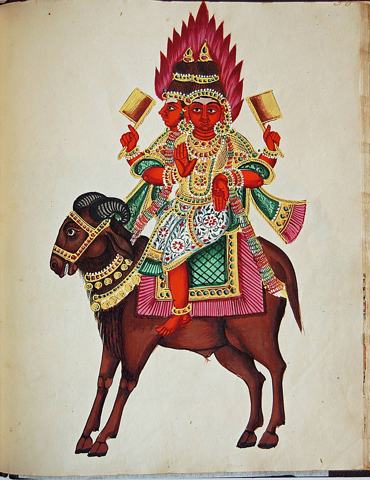
The fire god who opens the Rigveda — household priest among men and messenger among the gods, carrying every offering from the altar to the deities themselves.
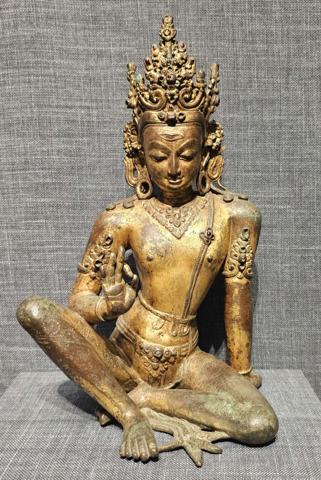
King of the gods and lord of storm and war — wielder of the thunderbolt, slayer of the serpent Vritra, and the deity Hinduism gradually demoted.
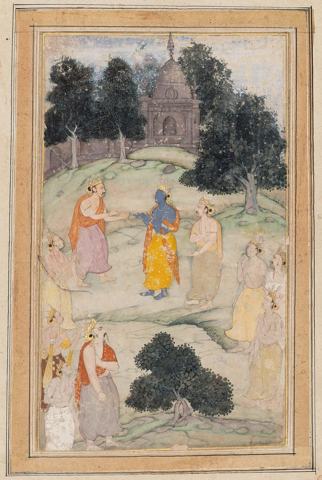
Roughly 100,000 verses attributed to the sage Vyasa — the frame for most of Hindu myth, including the Bhagavad Gita, and still the longest epic poem known.
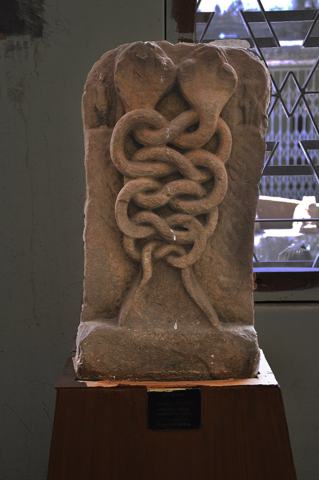
Semi-divine serpent beings of the waters and the underworld — hooded and jewel-crowned guardians of treasure, of rain, and of hidden knowledge.
Sources & Further Reading
- 1.Mahabharata, translated by J. A. B. van Buitenen as The Mahabharata, Volumes 1-3. University of Chicago Press, 1973-1978.
- 2.Bhagavad Gita, in the Mahabharata, translated by J. A. B. van Buitenen as The Bhagavadgita in the Mahabharata. University of Chicago Press, 1981.
- 3.Mahabharata, translated by Kisari Mohan Ganguli, 1883-1896.
- 4.O'Flaherty, Wendy Doniger, trans. Hindu Myths — A Sourcebook Translated from the Sanskrit. Penguin Classics, 1975.
- 5.Hiltebeitel, Alf. The Ritual of Battle — Krishna in the Mahabharata. Cornell University Press, 1976.
- 6.Flood, Gavin. An Introduction to Hinduism. Cambridge University Press, 1996.
Spot an error or have a source to suggest? Write to info@viseterna.com. We cite primary sources and modern scholarship, and we correct fast.