
The Mahabharata
Roughly 100,000 verses attributed to the sage Vyasa — the frame for most of Hindu myth, including the Bhagavad Gita, and still the longest epic poem known.
Krishna Mediating between the Pandavas and Kauravas, folio from an illustrated Razmnama manuscript, c. 1600 (Museum of Fine Arts, Boston) · Public domain · source
A Text That Claims to Hold Everything
The Mahabharata calls itself, in its own closing lines, the Shatasahasri Samhita, "the collection of a hundred thousand" — a boast that is close to literal, since the poem runs to roughly 100,000 couplets, some four times the length of the Ramayana and, by most countings, the longest single poem in world literature 1,6. Tradition credits its composition entirely to the sage Vyasa, who is also, unusually, a character inside his own story: the biological great-grandfather of both warring sides of the war he narrates 1. A famous line near the poem's opening states its own ambition directly — that whatever is not found here is found nowhere else — a claim about totality that later Indian culture has largely taken it at its word on, treating the epic as an encyclopedia of law, politics, and cosmology as much as a war story 1,7.
Layers Beneath the War
Like its sister epic, the Mahabharata was not composed once. Scholars generally read it as built up over centuries from an oral bardic core — the war between the Pandava and Kaurava cousins at Kurukshetra — through successive waves of expansion that added genealogy, philosophy, and law, with the whole process running from roughly the fourth century BCE to the fourth century CE 1,6. Older philology, working from a Homeric model, tended to treat the martial narrative as the epic's authentic core and its vast didactic sections — including the Bhagavad Gita — as later padding grafted onto it. Hiltebeitel's study argues against that assumption directly, reading the didactic material as integral to a single, coherently theological design rather than an accretion diluting an older heroic poem 7. The dispute has never been fully resolved, because the manuscript tradition itself only goes back to the medieval period, long after any of the proposed layers would have been added 6.
Eighteen Books
The finished epic runs to eighteen parvans, or books, plus the Harivamsa, a later appendix supplying Krishna's genealogy and childhood that the main narrative largely skips 1. The Adi Parva sets out origins and the births of the rival cousins; the Sabha Parva stages the rigged dice game that strips the Pandavas of their kingdom; twelve years of forest exile and a year in disguise follow before the Udyoga Parva prepares both sides for war. The Bhishma, Drona, Karna, and Shalya Parvas cover the eighteen-day battle itself, and the Shanti and Anushasana Parvas that follow — Bhishma's deathbed teaching on kingship and duty — are, by verse count, among the largest single blocks in the entire epic 1. The poem does not end at the battlefield: the Mausala Parva narrates the Yadava clan's mutual destruction years later, and the epic closes with the Mahaprasthanika and Svargarohana Parvas, the Pandavas' final journey and ascent to heaven 1.
A Story Told at a Snake Sacrifice
The epic frames its own telling twice over. It is recited to King Janamejaya during a sarpasatra, a snake sacrifice meant to exterminate the naga race in revenge for his father's death — the same rite that, according to the epic itself, is only halted partway through — and that recitation is in turn framed as a story told to sages gathered in the Naimisha forest by a travelling bard 1. The device puts the entire poem, all hundred thousand verses of it, inside the pause of an unfinished ritual killing, a structural irony scholars have long noted without fully explaining 6,7. Read this way, the Mahabharata is a poem about telling the poem almost as much as it is about the war it describes 1.
Reconstructing a Living Tradition
Unlike a work with a single fixed original, the Mahabharata survived as a text that regional traditions kept adding to for centuries, which makes recovering "the" Mahabharata a different problem from recovering a lost manuscript. Between 1933 and 1966 scholars at the Bhandarkar Oriental Research Institute in Pune, beginning under V. S. Sukthankar, collated manuscripts from across India to produce a critical edition that strips out material attested only in one regional family of texts, arriving at the oldest reconstructible common version rather than any single author's final draft 2. Kisari Mohan Ganguli's complete English translation, finished in 1896, predates that project by decades and remains the only full public-domain English Mahabharata, still read for its completeness even though it draws on an uncritical printed text 5. J. A. B. van Buitenen began a modern scholarly translation from the critical edition itself in the 1970s, covering the first five books before his death in 1979; James Fitzgerald later continued the project with a translation of Books 11 and 12 3,4.
Still Being Read
No other Sanskrit text has generated as much continuous commentary, performance, and retelling. Regional Mahabharatas, television adaptations, and modern literary rewrites keep adding new readings to a poem whose own scholarly reconstruction is, by design, provisional rather than final 6,7. The war it describes ends in near-total loss on both sides, and the poem's own oldest layers already treat that outcome as a caution rather than a triumph — a note that the didactic material added in later centuries only deepens 7.
Related entries: Krishna, Arjuna, The Bhagavad Gita, Naga.
Continue Exploring
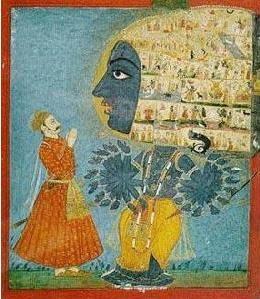
Eighteen chapters embedded in the Mahabharata where Krishna counsels Arjuna — read, translated and argued over more than any other Hindu text.
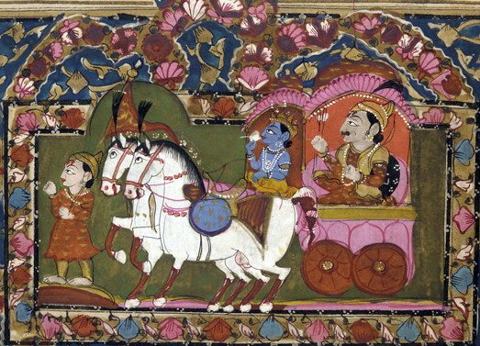
Cowherd, lover, statesman and charioteer — the avatar of Vishnu who speaks the Bhagavad Gita and anchors India's largest devotional tradition.
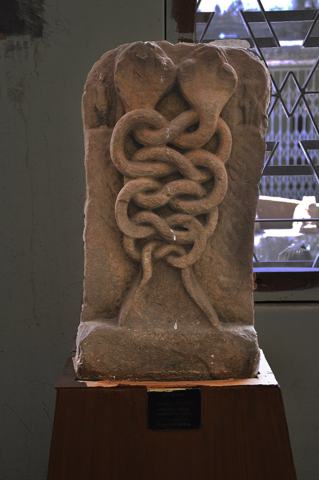
Semi-divine serpent beings of the waters and the underworld — hooded and jewel-crowned guardians of treasure, of rain, and of hidden knowledge.
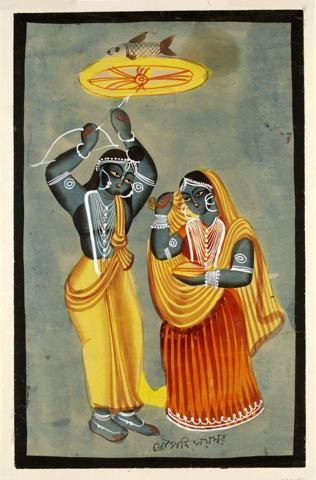
The Pandava hero of the Mahabharata, winner of Draupadi's hand and wielder of the bow Gandiva, whose crisis on the battlefield draws out the Bhagavad Gita.
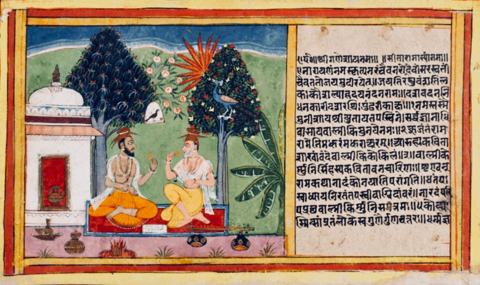
Valmiki's Sanskrit epic of Rama's exile and Sita's rescue — one telling among dozens across Asia, critically re-edited only in the twentieth century.
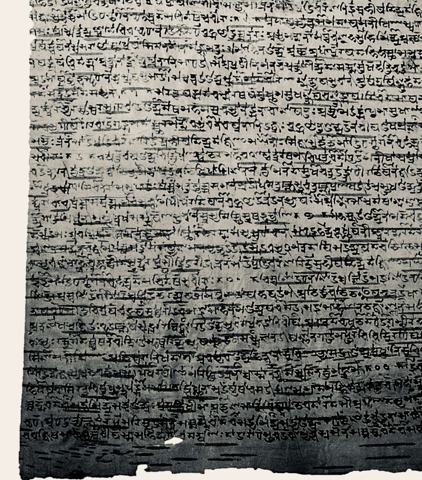
Ten books of hymns to Agni, Indra and Soma — the oldest surviving Sanskrit text, kept by memory alone for two millennia before it was ever written down.
Sources & Further Reading
- 1.The Mahabharata, traditionally composed by the sage Vyasa; Sanskrit epic compiled in layers, c. 4th century BCE - 4th century CE, in eighteen parvans plus the Harivamsa appendix.
- 2.Sukthankar, V. S., et al., eds. The Mahabharata: For the First Time Critically Edited. Bhandarkar Oriental Research Institute, 1933-1966.
- 3.van Buitenen, J. A. B., trans. The Mahabharata, Volumes 1-3. University of Chicago Press, 1973-1978.
- 4.Fitzgerald, James L., trans. The Mahabharata, Volume 7. University of Chicago Press, 2003.
- 5.Mahabharata, translated by Kisari Mohan Ganguli, 1883-1896.
- 6.Brockington, John. The Sanskrit Epics. Brill, 1998.
- 7.Hiltebeitel, Alf. The Ritual of Battle: Krishna in the Mahabharata. Cornell University Press, 1976.
Spot an error or have a source to suggest? Write to info@viseterna.com. We cite primary sources and modern scholarship, and we correct fast.