
Yama (Hindu God of Death)
The Rigveda's first mortal to find the path of death, later Lord of the Dead — met by the boy Nachiketas in the Katha Upanishad and once outwitted by Savitri.
Savitri, Satyavan and Yama, M. V. Dhurandhar, 1924 · Public domain · source
The First to Die
Yama is, by the Rigveda's own account, not originally a god of death so much as its first casualty. He is a son of Vivasvat (the sun) and Saranyu, and hymn 10.14 calls him the one "who was the first to find the path we travel," the man who crossed over first and so became guide and gatherer for everyone who followed 1. That founding logic — ancestor before authority — matters: early Vedic Yama presides over the pitrs, the honored dead, more as a welcoming king of a realm of light and feasting than as a judge or punisher 1,6.
His most unsettling early appearance is hymn 10.10, a dialogue in verse with his twin sister Yami, who presses him toward incest so that humankind might continue, and whom Yama refuses on grounds of propriety even as the poem leaves their argument unresolved 1. Jamison and Brereton's translation treats the hymn as one of the Rigveda's most deliberately uncomfortable set pieces, a myth about the origin of moral boundaries told through the two people who would have had the least reason to keep them 1.
From Ancestor-King to Judge of the Dead
The later tradition sharpens Yama considerably. By the time of the Puranas he is Dharmaraja, "king of righteousness," seated in judgment over the record of each soul's deeds, dispatching messengers (Yamadutas) to fetch the dying and weighing merit against sin before assigning the soul's next path 4,6. He rides a black buffalo, carries a noose (pasha) to bind the departing spirit and a mace (danda) as the instrument of impartial justice, and the Garuda Purana's funeral chapters describe the soul's difficult journey to his hall in vivid, cautionary detail meant to be read aloud at Hindu death rites even now 4. The cremation fire that sends a body on that journey is itself Agni's domain, so the two gods divide the passage between them: one consumes the body, the other receives what is left of the person 4,6. Flood situates this shift as part of a broader move in post-Vedic religion toward moral accounting and rebirth, in which a figure who once simply welcomed the dead becomes the one who decides what they have earned 6.
Nachiketas at Death's Door
The Katha Upanishad gives Yama his most philosophically important scene. A man named Vajashravasa, performing a sacrifice that requires giving away everything he owns, gives away only his old and useless cattle; his son Nachiketas, troubled by the hollowness of the gift, asks his father to whom he himself will be given. Pressed a third time, the father snaps, "To Death I give you" 2. Nachiketas takes the words seriously and goes to Yama's house, where he waits unfed for three nights because the god is away. On his return, Yama, mortified at having left a brahmin guest unattended, offers three boons in atonement 2.
The first two — safe passage home for his father's sake, and instruction in a particular fire ritual — Yama grants without difficulty. The third is the one that matters: Nachiketas asks what happens to a person after death, and Yama tries repeatedly to buy him off with wealth, long life, and pleasure instead, warning him the question is too difficult even for gods. Nachiketas refuses every substitute, and Yama finally teaches him about the atman, the self that is never born and never dies, likening the individual to a rider in a chariot whose horses are the senses and whose driver is the discerning intellect 2. Olivelle's translation treats this as one of the oldest and clearest statements in the Upanishadic corpus of a self that survives the body's death — taught, pointedly, by Death himself 2.
Savitri and Satyavan
The Mahabharata's Vana Parva preserves a rarer kind of story: one in which Yama is met not with philosophical submission but with argument, and loses. Princess Savitri chooses to marry Satyavan knowing a sage has foretold he will die within a year, and when the appointed day comes, she follows her husband into the forest and watches Yama himself arrive, in visible form, to draw out his soul 3. Rather than turn back, Savitri walks after the god as he departs, speaking with him on duty, virtue, and hospitality until he grants her boons out of sheer respect for her persistence — the restoration of her blind father-in-law's sight, a hundred sons for her own father, and, granted almost as an afterthought, a hundred sons for herself. Only after Yama has agreed does Savitri point out that the last boon is impossible unless Satyavan lives, and Yama, bound by his own word, returns her husband's life 3. Van Buitenen's translation renders the exchange as courteous throughout, a contest of reasoning rather than pleading, which is part of why the story is remembered as a triumph of dharma over even Death's authority 3.
Yama Today
Yama is also counted among the dikpalas, guardians of the cardinal directions, presiding over the south as Indra presides over the east — a piece of cosmological housekeeping that keeps him fixed in temple and ritual geography quite apart from any single myth about him 6. Despite that structural importance, he receives strikingly little dedicated temple worship in present-day practice, a scarcity he shares with the creator god Brahma: both are named constantly in ritual and cosmology and rarely given a temple built to them alone 6.
Yama remains part of living observance rather than settled history. The festival of Yama Dvitiya, better known as Bhai Dooj, reenacts a reconciliation between Yama and his twin Yami — the same pair whose uneasy dialogue opens his story in the Rigveda — in which sisters welcome and bless their brothers, a domestic echo of hymn 10.10 that Doniger's sourcebook traces directly back to that Vedic exchange 4,5. Hindu funeral rites still invoke Yama's name and cite the Garuda Purana's account of the soul's journey to his court 4. He is feared and formally honored in the same breath — a rare balance for a god whose oldest hymns already treated him as more traveler than tyrant 1,6.
Continue Exploring
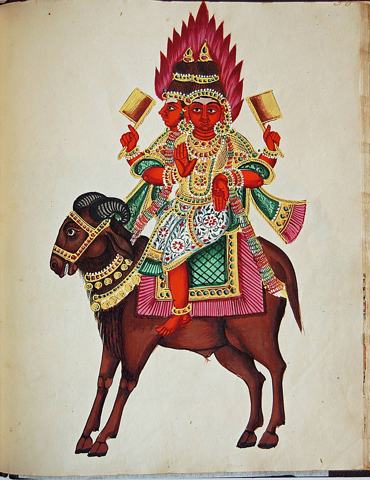
The fire god who opens the Rigveda — household priest among men and messenger among the gods, carrying every offering from the altar to the deities themselves.
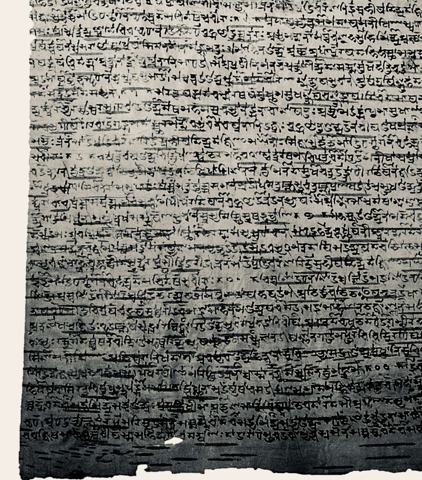
Ten books of hymns to Agni, Indra and Soma — the oldest surviving Sanskrit text, kept by memory alone for two millennia before it was ever written down.
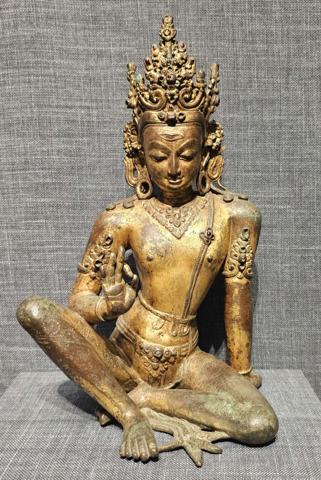
King of the gods and lord of storm and war — wielder of the thunderbolt, slayer of the serpent Vritra, and the deity Hinduism gradually demoted.
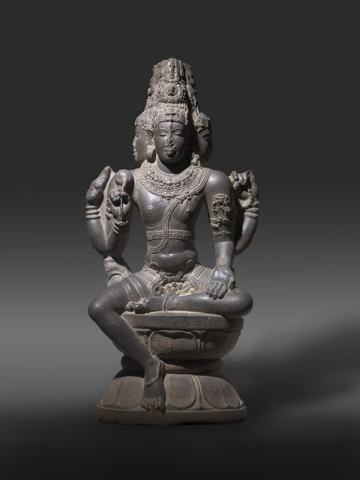
The four-faced creator from whom the worlds issue at the dawn of each cosmic day — immensely powerful in myth, and almost never worshipped in temples.
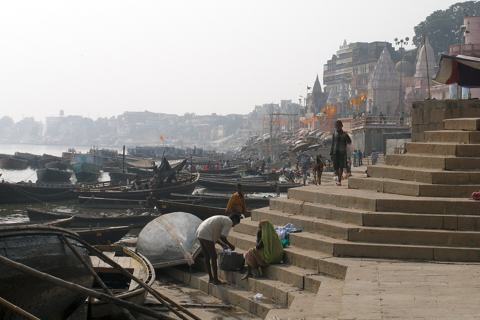
The Ganges-side city where dying is said to grant liberation outright — one of Shiva's twelve jyotirlingas and a living pilgrimage center for three millennia.
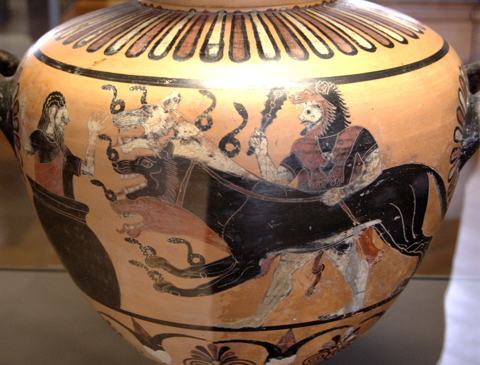
The many-headed hound who guards the gates of the underworld. He fawns on everyone who enters and devours anyone who tries to leave.
Sources & Further Reading
- 1.The Rigveda, translated by Stephanie W. Jamison and Joel P. Brereton as The Rigveda — The Earliest Religious Poetry of India. Oxford University Press, 2014.
- 2.Katha Upanishad, in Patrick Olivelle, trans., Upanisads. Oxford World's Classics, 1996.
- 3.Mahabharata, Vana Parva, translated by J. A. B. van Buitenen as The Mahabharata, Volume 2 — Book 2, The Book of Assembly; Book 3, The Book of the Forest. University of Chicago Press, 1975.
- 4.Garuda Purana, Preta Kanda.
- 5.O'Flaherty, Wendy Doniger, trans. Hindu Myths — A Sourcebook Translated from the Sanskrit. Penguin Classics, 1975.
- 6.Flood, Gavin. An Introduction to Hinduism. Cambridge University Press, 1996.
Spot an error or have a source to suggest? Write to info@viseterna.com. We cite primary sources and modern scholarship, and we correct fast.