
The Hero Twins
Hunahpu and Xbalanque — the ballplaying twins of the Popol Vuh who outwitted the lords of Xibalba, avenged their father, and rose as sun and moon.
Painted plate with the Hero Twins and Vucub Caquix, Classic Maya (Museo Maya de Cancun, INAH) · CC BY-SA 4.0 · source
The Book They Come From
Almost everything told in narrative form about the Hero Twins comes from one book. The Popol Vuh is a K'iche' Maya account of creation, the twins, and the ancestry of the ruling lineages of highland Guatemala, written down in the K'iche' language using Latin letters around the middle of the sixteenth century 1,2. The original is lost. What survives is a copy made around 1701–1703 by the Dominican friar Francisco Ximenez in Chichicastenango, with a Spanish translation in a parallel column; that manuscript is now in the Newberry Library in Chicago 1,2.
This matters for how the twins are read. The text was set down by Christianised K'iche' nobles a generation after the conquest, and scholars disagree about how much of its shape — the opening cosmogony in particular — reflects contact with Genesis 2,3. But the twins themselves are demonstrably not a colonial invention: they appear, named, on Classic Maya painted pottery of the seventh to ninth centuries, roughly eight hundred years before the manuscript 4,5.
Hunahpu and Xbalanque
Hunahpu (Hun Ajaw, "One Lord" or "One Blowgunner") and Xbalanque (Yax Balam, roughly "Young Jaguar Sun") are the sons of Hun Hunahpu and the maiden Xquic, "Blood Moon" 1,2. Their conception is one of the strangest in world myth. Their father and his brother, ballplayers whose noise disturbed the lords of the underworld, were summoned to Xibalba, defeated and killed; Hun Hunahpu's severed head was hung in a calabash tree, where it spoke to the daughter of an underworld lord and spat into her hand, making her pregnant 1,3. She fled to the surface and bore the twins there.
They grow up mistreated by their older half-brothers, Hun Batz and Hun Chouen, patrons of writing, art and music — whom the twins eventually trick into climbing a tree and turn into monkeys 1,2. Classic-period vases show exactly this scene, monkey scribes with brushes and paint pots, which is one of the clearest confirmations that the story is old 4,5.
Seven Macaw
Before the underworld, the twins put down a false god. Vucub Caquix, "Seven Macaw", is a brilliant bird who claims to be both the sun and the moon while the world is still dim, and his sons Zipacna and Cabracan claim to make and unmake mountains 1,2. Hunahpu shoots Seven Macaw out of a fruit tree with his blowgun, shattering his jaw; the twins then disguise themselves as healers and, on the pretext of treatment, take out his jewelled teeth and eyes, and he dies of the loss of his splendour 1,2.
The episode is attested independently and early. Preclassic monuments at Izapa and elsewhere show a great bird descending on a figure with a blowgun, and painted plates of the Classic period show the same confrontation — including the plate shown with this article 4,5,6.
The Trials of Xibalba
Summoned in their turn, the twins go down the road to the underworld. Where their father failed the entrance tests, they pass them: they refuse the burning seat, they identify the underworld lords' wooden mannequins from the real thing by sending a mosquito ahead to bite each one and hear its name 1,3.
Then come the houses, each a night's ordeal. The Dark House; the Razor House, whose knives they persuade to be still; the Cold House; the Jaguar House, where they distract the animals with bones; the Fire House; and the Bat House, where the great bat Camazotz takes Hunahpu's head 1,2. Xbalanque substitutes a carved squash for his brother's head, recovers the real one from the ballcourt during play, and the twins go on 1,3.
Their final move is deliberate self-destruction. Knowing they cannot simply out-fight the lords, they let themselves be burned in an oven; their ground bones are thrown into the river, and after five days they return, first as fish-men and then as ragged travelling dancers who perform miracles — burning houses and restoring them, sacrificing one another and coming back 1,2. The lords Hun Came and Vucub Came, delighted, ask to be sacrificed themselves. The twins oblige, and do not revive them 1,2,3.
Sun, Moon, and Maize
Xibalba is not destroyed but demoted: its lords are stripped of tribute and left with only the guilty and the wretched, a settlement the text presents as the reason the underworld no longer rules the surface 1,2. The twins then rise into the sky, one as the sun and the other as the moon — though translators and commentators differ on the details, and Dennis Tedlock and Allen Christenson do not read the final lines identically 2,3.
Classic Maya art suggests a further chapter that the Popol Vuh handles only glancingly. On a well-known group of painted vessels the twins attend the rebirth of the maize god, who rises from a cracked turtle carapace as a plant rises from a seed; many specialists identify that figure with the twins' father, resurrected 4,5,6. If so, the Classic version placed the agricultural meaning — descent, burial, germination — at the centre of a story the sixteenth-century text tells mainly as dynastic prehistory 5,6.
The twins are also the divine patrons of the ball game itself, whose court functions in Maya thought as a mouth of the underworld, and whose play stages the same descent and return 7. Related figures appear in Mesoamerican art far from the K'iche' highlands, which is why scholars generally speak of a widely shared twin-and-ballgame tradition of which the Popol Vuh preserves one late, literate version 5,6,7.
Continue Exploring
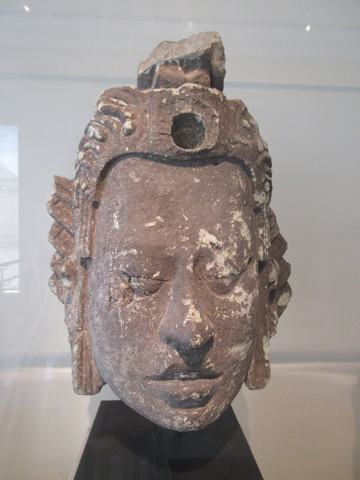
The youthful Classic Maya god of maize, God E of the codices, whose death and rebirth many scholars connect to the Popol Vuh's Hun Hunahpu.
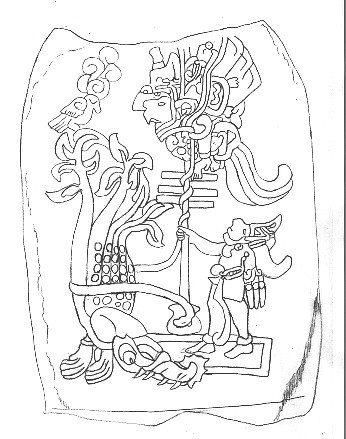
The vain bird who declared himself sun and moon in the Popol Vuh, brought down by the Hero Twins along with his sons Zipacna and Cabracan.
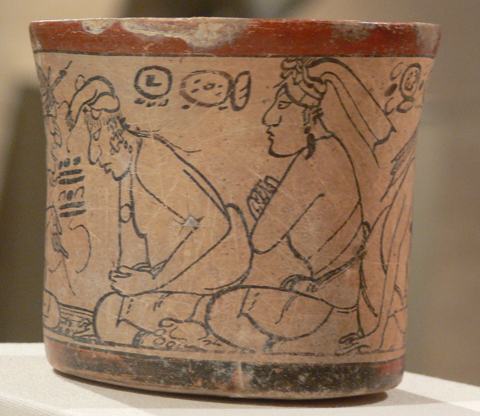
"Place of Fear" — the K'iche' Maya underworld of the Popol Vuh, a court of disease lords whose houses of trial the Hero Twins survived and overturned.
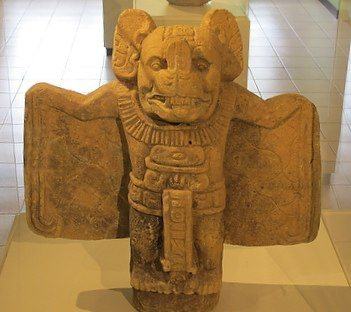
The death bat — the snatching bat-demon of the K'iche' underworld who takes off a hero's head in the dark, and the long Mesoamerican cult behind him.
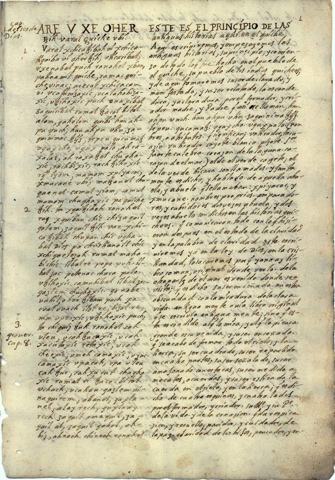
The K'iche' Maya "Book of Council" — creation, the Hero Twins, and a dynasty's history, saved by one Dominican friar's copy of a lost original.
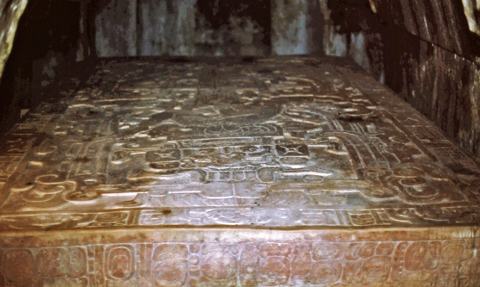
The carved limestone lid over King Pakal's tomb at Palenque — a scene of death and rebirth at the World Tree, and the most misread monument in Maya art.
Also mentioned inChichen ItzaHuracan (Heart of Sky, Maya Storm God)Kinich AhauThe Maya Ballgame (Pitz)The Maya World TreeTikalXolotlXquic (Blood Moon)
Sources & Further Reading
- 1.Popol Vuh (K'iche' Maya, mid-16th century; sole surviving copy transcribed by Francisco Ximenez at Chichicastenango, c. 1701–1703; Newberry Library, Chicago).
- 2.Christenson, Allen J. (trans.). Popol Vuh: The Sacred Book of the Maya. University of Oklahoma Press, 2007.
- 3.Tedlock, Dennis (trans.). Popol Vuh: The Definitive Edition. Rev. ed., Simon & Schuster, 1996.
- 4.Coe, Michael D. The Maya Scribe and His World. The Grolier Club, 1973.
- 5.Miller, Mary & Karl Taube. The Gods and Symbols of Ancient Mexico and the Maya. Thames & Hudson, 1993.
- 6.Taube, Karl. Aztec and Maya Myths. British Museum Press / University of Texas Press, 1993.
- 7.Tokovinine, Alexandre. 'Divine Patrons of the Maya Ballgame'. Mesoweb.
Spot an error or have a source to suggest? Write to info@viseterna.com. We cite primary sources and modern scholarship, and we correct fast.