
The Sarcophagus Lid of Pakal
The carved limestone lid over King Pakal's tomb at Palenque — a scene of death and rebirth at the World Tree, and the most misread monument in Maya art.
Sarcophagus lid of K'inich Janaab Pakal, Temple of the Inscriptions, Palenque, Late Classic Maya, 683 CE (photograph in situ) · CC BY-SA 3.0 · source
A Lid Almost No One Has Seen in Person
Inside the Temple of the Inscriptions at Palenque, at the base of a stairway that descends through the body of the pyramid, a single block of limestone weighing several tonnes covers the sarcophagus of K'inich Janaab Pakal, who ruled Palenque from 615 to 683 CE 1,5. The tomb chamber is sealed to protect it, so almost everyone who knows this carving knows it from photographs, casts, and museum replicas rather than the original in its dim vault 5.
What those images show is one continuous relief covering the whole upper face of the lid: a reclining human figure at the centre, a great cross-shaped tree rising from his body, and a bird perched at the tree's summit, the whole scene framed by a border of hieroglyphs and by portraits of the king's ancestors 2,3.
The King at the World Tree
Linda Schele and David Freidel's reading of the composition, now the standard one, identifies the vertical element as the Wakah-Chan, the World Tree that in Maya cosmology stands at the centre of creation, its roots in the underworld and its branches in the sky, marked here by a bar of intertwined serpents and topped by the Principal Bird Deity — the avian aspect associated elsewhere with the aged creator Itzamna 3,4. Pakal is shown neither simply dead nor simply alive: he reclines at the point where the tree emerges from a skeletal, centipede-jawed opening in the earth, the conventional Maya sign for the mouth of the underworld 3,4.
Schele and Freidel read the scene as a moment of transition rather than an end — Pakal falling into Xibalba at the World Tree's foot, poised to be reborn from it as the Maize God rises from buried seed, the same cycle of descent and return told at length of the Hero Twins in the Popol Vuh 3. Around the lid's border, Pakal's royal ancestors are carved emerging from cracks in the earth as fruit-bearing trees, extending the same imagery of death feeding new growth to the whole dynasty, not just the king at the centre 3,4.
The Border Text
The hieroglyphic band running around the lid's edge gives Pakal's name and titles, a sequence of his royal predecessors, and calendrical information tying the monument to specific dates in his reign and death 1,2. Merle Greene Robertson's detailed study of the temple's sculpture documents the lid alongside the rest of the tomb's carved and painted program, situating it as one part of a unified funerary design rather than an isolated image 2.
"Ancient Astronaut," and Why It Fails
In 1968 the Swiss writer Erich von Daniken published Chariots of the Gods?, arguing that the lid shows an astronaut leaning forward in a rocket-like vehicle, operating controls with his hands and feet, breathing through a tube, with an antenna at his nose — evidence, he claimed, of an ancient encounter with visiting extraterrestrials. It remains one of the most widely repeated claims in pseudoarchaeology 6.
Kenneth Feder's survey of pseudoscience in archaeology sets out why the reading does not hold up. The "rocket" is the World Tree and serpent bar, a motif carved on other Palenque monuments — the Tablet of the Cross among them — with no spacecraft in sight; the king's semi-reclining posture is a documented Maya convention for a falling or transitional figure, paralleled on other monuments and in the codices, not a novel pose invented for this scene; and the "controls" and "antenna" resolve, under an iconography read fluently by specialists, into jade ornaments, a serpent head, and the stylised earth-monster jaws beneath him 4,6. Von Daniken's account also offered no reading of the hieroglyphic text that names the very man in the image, a text since deciphered and confirmed to identify Pakal and his ancestors, not a stranger from the sky 1,6.
What the Lid Actually Argues
Read in its own terms, the lid is doing something more interesting than a spacecraft would be: making a public, permanent argument that a specific king's death was not an ending but a passage, folded into the same cosmic order that also governed the maize harvest and the rising of the sky 3,4. That argument depended on an audience who could read Maya royal iconography fluently — and it is exactly that fluency, recovered by decades of epigraphic and art-historical work since Alberto Ruz Lhuillier first opened the tomb in 1952, that lets modern scholarship describe the scene with confidence today 1,5.
Continue Exploring
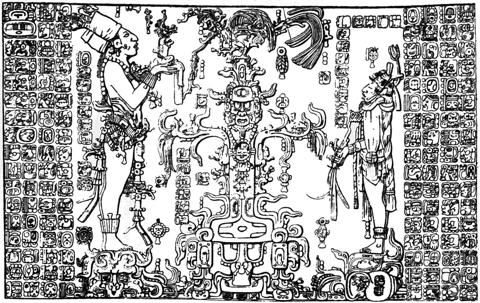
The great ceiba that joins underworld, earth and sky in Maya cosmology — carved at Palenque's Temple of the Cross and reborn each time maize is planted.
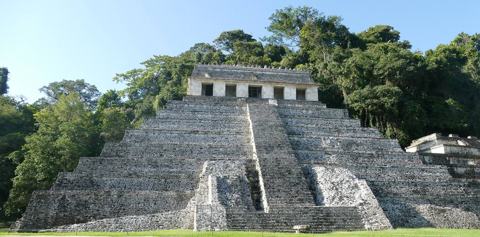
Palenque's funerary pyramid, raised over the tomb of King Pakal and carved with one of the longest surviving Classic Maya hieroglyphic texts.
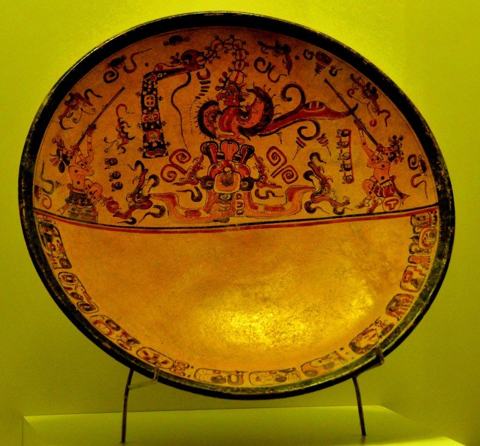
Hunahpu and Xbalanque — the ballplaying twins of the Popol Vuh who outwitted the lords of Xibalba, avenged their father, and rose as sun and moon.
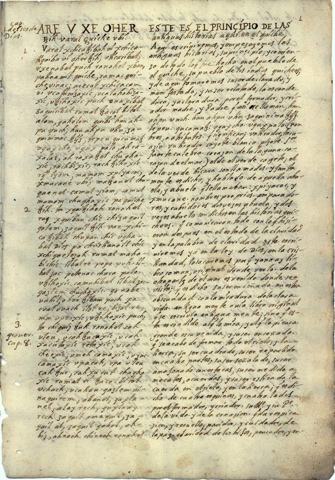
The K'iche' Maya "Book of Council" — creation, the Hero Twins, and a dynasty's history, saved by one Dominican friar's copy of a lost original.
The youthful Classic Maya god of maize, God E of the codices, whose death and rebirth many scholars connect to the Popol Vuh's Hun Hunahpu.
The great Classic Maya city of the Peten rainforest — a dynasty two thousand years deep, a war with Calakmul, and a king's tomb built as a mountain.
Also mentioned inKinich Ahau
Sources & Further Reading
- 1.Ruz Lhuillier, Alberto. El Templo de las Inscripciones, Palenque. Instituto Nacional de Antropologia e Historia, 1973.
- 2.Robertson, Merle Greene. The Sculpture of Palenque, Volume I: The Temple of the Inscriptions. Princeton University Press, 1983.
- 3.Schele, Linda & David Freidel. A Forest of Kings: The Untold Story of the Ancient Maya. William Morrow, 1990.
- 4.Miller, Mary & Karl Taube. The Gods and Symbols of Ancient Mexico and the Maya. Thames & Hudson, 1993.
- 5.Stuart, David & George Stuart. Palenque: Eternal City of the Maya. Thames & Hudson, 2008.
- 6.Feder, Kenneth L. Frauds, Myths, and Mysteries: Science and Pseudoscience in Archaeology. McGraw-Hill.
Spot an error or have a source to suggest? Write to info@viseterna.com. We cite primary sources and modern scholarship, and we correct fast.