
The Maya Ballgame (Pitz)
Pitz, the rubber-ball game played across the Maya world for three thousand years — real sport, staged myth, and sometimes an execution.
Ballplayer figure, Guatemala, Peten region, Classic Maya, 500-850 CE (LACMA) · Public domain · source
Court and Costume
Pitz is the Classic Maya name recorded in hieroglyphic captions for the ballgame played on masonry courts across the Maya world; the later Yucatec term pok-ta-pok is a modern coinage imitating the sound of the ball, not an ancient word 3,6. Players struck a solid rubber ball, heavy enough to break bone, with the hip, thigh, or forearm — hands and feet were forbidden. The equipment that survives is stone, not the perishable gear it copies: carved yokes worn as a belt to protect the hip and ribs, and the palm-shaped palmas and axe-shaped hachas that seem to be ceremonial versions of handstones and deflectors used in play 3,4.
The courts themselves are the clearest fingerprint the game left in the archaeological record. Over a thousand ballcourts are known from Mesoamerica, built to a recognizable plan: a long alley shaped like a capital I, flanked by sloped or vertical benches the ball could rebound from, sometimes fitted with stone rings set high on the walls as an additional, harder-to-use target 3,4,6.
Older Than "the Maya"
The game predates the Maya civilization that made it famous. The oldest known ballcourt, at Paso de la Amada on the Chiapas coast, dates to roughly 1400 BCE — a thousand years before any Classic Maya city existed — and Preclassic and Classic Maya centers inherited and elaborated a sport that had already spread across Mesoamerica 4,6. That long, shared history is one reason the game shows up in the myth and iconography of the Aztec, Zapotec, and other Mesoamerican peoples as well as the Maya, each attaching their own cosmology to the same rules 4.
Pitz in the Popol Vuh
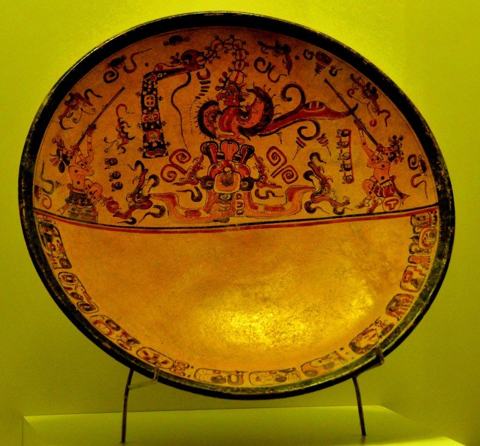
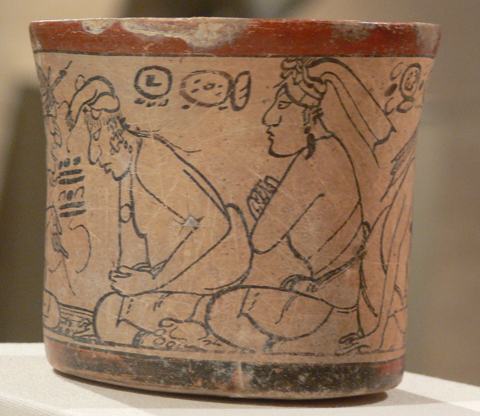
The one narrative account that survives comes from the Popol Vuh. The ballgame is the reason the underworld and the surface world first collide: the noise of Hun Hunahpu and Vucub Hunahpu playing overhead annoys the lords of Xibalba, who summon the brothers down, defeat them, and kill them 1,2. Their sons, the Hero Twins Hunahpu and Xbalanque, are summoned in turn, survive the underworld's trials, and beat its lords at their own game before rising as sun and moon 1,2. Every ballgame played afterward, in this reading, restages that contest — a court is a mouth of the underworld, and to play is to reenact a story that already ended in death and reversal 2,6.
The Great Ballcourt and Its Stakes
Chichen Itza's Great Ballcourt is the largest that survives, and its sculpted panels are the most explicit statement anywhere of what a losing outcome could mean: a kneeling player is decapitated, blood shown streaming from his neck as intertwined serpents and vegetation, while a standing figure holds the severed head and a ball marked with a skull 3,6. Reliefs of the same kind appear at other Classic sites, and their consistent grammar — a beheading tied directly to the game — is the strongest physical evidence that Pitz could end in real sacrifice, not only myth 5,6.
Who Paid the Price
Whether the sacrificed figure in these scenes is the losing player or, less intuitively, the winner is genuinely unsettled. The older assumption — that defeat meant death — is the plainer reading of the Chichen Itza panels, but Schele and Miller argued that Maya art built its ballgame imagery around a deliberate ambiguity between victory and sacrifice, since a captured king forced to play for his life could "win" only by being killed with honor 5. The idea that circulates in popular retellings today — that winners were routinely put to death as an offering, as a straightforward rule of the game — goes beyond what the carvings and the Popol Vuh actually support; the sources describe elite captives and mythic losers dying, not a fixed rule that victory itself was fatal 1,5,6. Most games, for most players across two thousand years, were almost certainly sport and gambling with no sacrifice attached at all 3,4.
Still Played
The game did not end at the conquest. Ulama, played hip-to-hip with a solid rubber ball on an open dirt court, survives today in a handful of communities in Sinaloa, the last living continuation of a game whose rules the Spanish tried hard to stamp out along with the religion built around it 3. Modern revival leagues and cultural programs have since carried variants of the game back into other parts of Mexico and Central America, consciously reconnecting with a sport older than writing in the region 3,4.
Continue Exploring
Hunahpu and Xbalanque — the ballplaying twins of the Popol Vuh who outwitted the lords of Xibalba, avenged their father, and rose as sun and moon.
"Place of Fear" — the K'iche' Maya underworld of the Popol Vuh, a court of disease lords whose houses of trial the Hero Twins survived and overturned.
The underworld maiden of the Popol Vuh who is impregnated by a talking skull, survives her own execution, and becomes the mother of the Hero Twins.
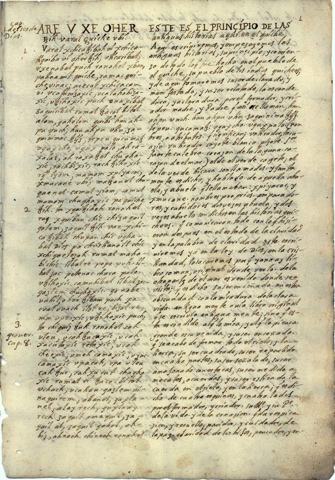
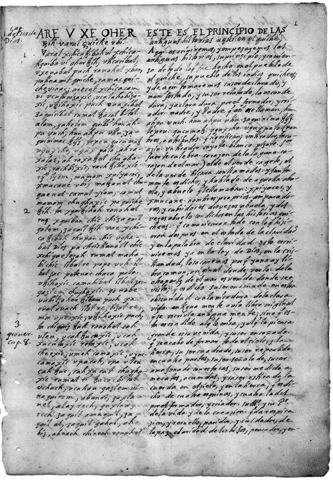
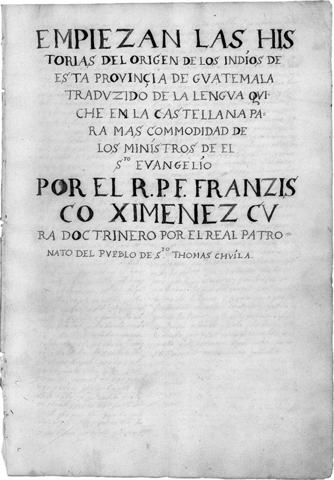
The K'iche' Maya "Book of Council" — creation, the Hero Twins, and a dynasty's history, saved by one Dominican friar's copy of a lost original.
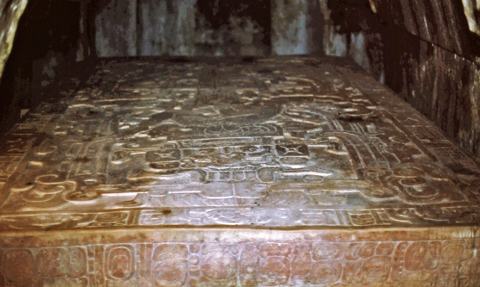
The carved limestone lid over King Pakal's tomb at Palenque — a scene of death and rebirth at the World Tree, and the most misread monument in Maya art.
The K'iche' Maya storm god who speaks the world into being in the Popol Vuh — and the contested claim that he gave the hurricane its name.
Sources & Further Reading
- 1.Popol Vuh (K'iche' Maya, mid-16th century; sole surviving copy transcribed by Francisco Ximenez at Chichicastenango, c. 1701-1703; Newberry Library, Chicago).
- 2.Christenson, Allen J. (trans.). Popol Vuh: The Sacred Book of the Maya. University of Oklahoma Press, 2007.
- 3.Whittington, E. Michael, ed. The Sport of Life and Death: The Mesoamerican Ballgame. Thames & Hudson, 2001.
- 4.Scarborough, Vernon L. & David R. Wilcox, eds. The Mesoamerican Ballgame. University of Arizona Press, 1991.
- 5.Schele, Linda & Mary Miller. The Blood of Kings: Dynasty and Ritual in Maya Art. Kimbell Art Museum, 1986.
- 6.Miller, Mary & Karl Taube. The Gods and Symbols of Ancient Mexico and the Maya. Thames & Hudson, 1993.
Spot an error or have a source to suggest? Write to info@viseterna.com. We cite primary sources and modern scholarship, and we correct fast.