
The Maize God (Hun Hunahpu)
The youthful Classic Maya god of maize, God E of the codices, whose death and rebirth many scholars connect to the Popol Vuh's Hun Hunahpu.
Stone head of the Maize God, Copan, Classic Maya (New Orleans Museum of Art) · CC BY 2.0 · source
Hun Hunahpu, Once
The Popol Vuh names Hun Hunahpu ("One Hunahpu") as one of two ballplaying brothers summoned to Xibalba, defeated by its lords, and sacrificed; his severed head is hung in a calabash tree, where it speaks to the maiden Xquic and engenders the Hero Twins by spitting into her open hand 1,2. That is nearly everything the text itself says about him directly — he is remembered as a father and an ancestor, not as a character who returns to the story in his own body 1,3. Everything else attached to Hun Hunahpu comes from reading the K'iche' epic alongside a much older and separate body of evidence: Classic Maya painted pottery.
God E in the Codices
In the codices, Mayanists know the deity of maize as God E, following the alphabetical system Paul Schellhas assigned to the recurring figures of the Dresden and Madrid manuscripts in 1904 — the same scheme that later numbers the death god Ah Puch as God A — before any of the names could be read 5,6. He is unmistakable: a youthful, serene face, frequently shown with an elongated head shaped like a ripening ear of maize, and hair or foliage sprouting from the crown like husk leaves 5,6. Specialists distinguish two related types in Classic-period art in particular — a Tonsured Maize God, whose head is partly shaved but for a single long lock, and a Foliated Maize God, whose head produces literal maize leaves — and treat them as related aspects of one complex rather than strictly interchangeable figures 4,5.
The Rebirth Scene
The most striking Classic imagery shows this young god emerging from a cracked turtle carapace lying on the earth, sometimes rising to dance, sometimes flanked by two young attendants armed with blowguns. In an influential 1985 study, Karl Taube argued that this resurrection scene is Hun Hunahpu himself: the turtle shell stands for the cracked earth over his grave, and the two attendant youths are his sons, restoring their father exactly as the maize plant restores itself from a buried seed 4. The identification caught on quickly and is repeated in most general accounts of Maya religion written since 5,7.
It is also an inference, not a citation. The Popol Vuh narrates Hun Hunahpu's death and his sons' eventual triumph over his killers; it does not narrate a scene of him rising from a turtle shell, and some specialists have pushed back on collapsing the Classic maize god directly into the K'iche' text's Hun Hunahpu rather than treating them as related but not identical figures separated by centuries and by region 4,7. The honest position is that Classic Maya art preserves a maize death-and-rebirth cycle that the sixteenth-century Popol Vuh likely draws on and partly explains, without the two sources being proven to describe literally the same event 4,5.
Maize, Kingship, and Creation
Maize is not incidental to any of this. Later in the Popol Vuh, after wood and mud both fail as materials for people, the makers grind white and yellow maize into dough and shape the first true human ancestors from it — the origin story ends with the substance the maize god personifies becoming the substance of humanity itself 1,2. Classic rulers drew on the same association directly: portraits at sites across the lowlands show kings adopting the maize god's slim, youthful body and dancing pose, a visual claim to the fertility and renewal the god represented rather than a literal portrait of the ruler 4,5,7. Carved royal imagery at Palenque has been read by some scholars as another instance of this pattern, a dying king pictured falling toward the underworld like a planted seed; the reading is influential but contested, and other specialists describe the same scenes differently 5,7.
What Can Be Said Plainly
Two things can be kept apart without losing either. Maya religion, from the Preclassic period onward, told a story of maize dying into the earth and returning as a green shoot, and gave that story a young, beautiful god. The K'iche' Popol Vuh, written down after the conquest, gave the story of a father destroyed by the lords of death and avenged by his sons a name — Hun Hunahpu. That the two are connected is close to a scholarly consensus; that they are simply the same telling of the same event, with nothing lost or changed across a thousand years and a change of language, is the part that still deserves a question mark 4,5,7.
Continue Exploring
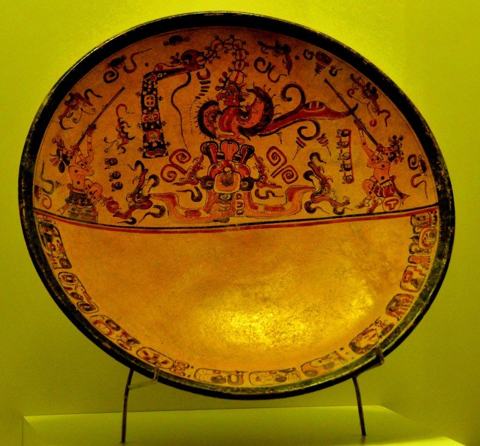
Hunahpu and Xbalanque — the ballplaying twins of the Popol Vuh who outwitted the lords of Xibalba, avenged their father, and rose as sun and moon.
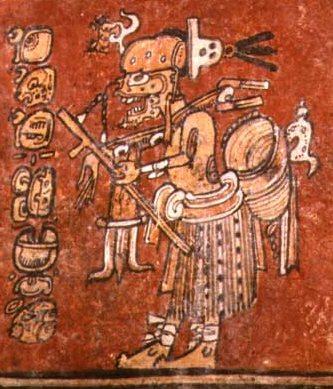
Schellhas's God A, the skeletal Maya death deity behind the name Ah Puch — a label colonial and modern sources actually apply in different ways.
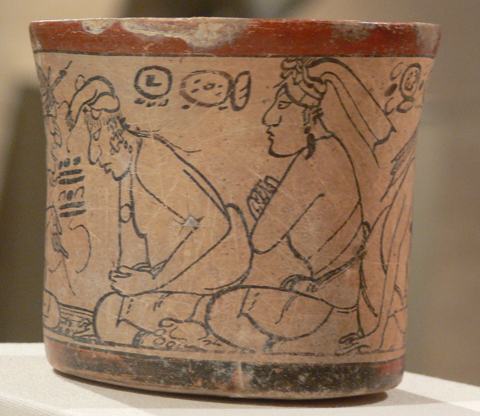
"Place of Fear" — the K'iche' Maya underworld of the Popol Vuh, a court of disease lords whose houses of trial the Hero Twins survived and overturned.
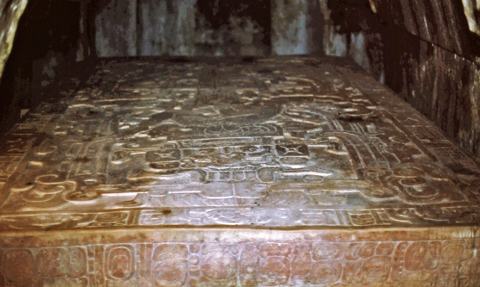
The carved limestone lid over King Pakal's tomb at Palenque — a scene of death and rebirth at the World Tree, and the most misread monument in Maya art.
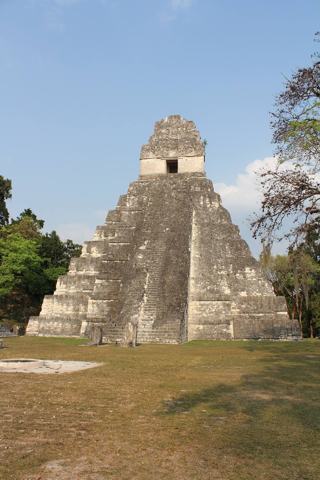
The great Classic Maya city of the Peten rainforest — a dynasty two thousand years deep, a war with Calakmul, and a king's tomb built as a mountain.
The K'iche' Maya storm god who speaks the world into being in the Popol Vuh — and the contested claim that he gave the hurricane its name.
Sources & Further Reading
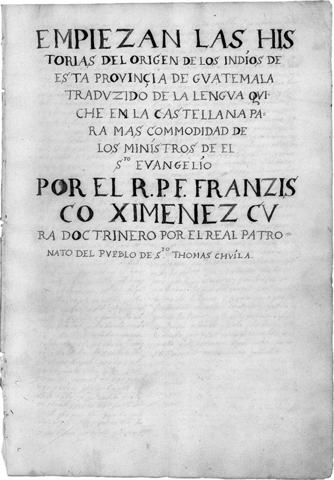
- 1.Popol Vuh (K'iche' Maya, mid-16th century; sole surviving copy transcribed by Francisco Ximenez at Chichicastenango, c. 1701-1703; Newberry Library, Chicago).
- 2.Christenson, Allen J. (trans.). Popol Vuh: The Sacred Book of the Maya. University of Oklahoma Press, 2007.
- 3.Tedlock, Dennis (trans.). Popol Vuh: The Definitive Edition. Rev. ed., Simon & Schuster, 1996.
- 4.Taube, Karl A. 'The Classic Maya Maize God: A Reappraisal.' In Fifth Palenque Round Table, 1983, edited by Merle Greene Robertson and Virginia M. Fields, 171-181. Pre-Columbian Art Research Institute, San Francisco, 1985.
- 5.Miller, Mary & Karl Taube. The Gods and Symbols of Ancient Mexico and the Maya. Thames & Hudson, 1993.
- 6.Schellhas, Paul. Representation of Deities of the Maya Manuscripts. Peabody Museum, Harvard University, 1904.
- 7.Sharer, Robert J. with Loa P. Traxler. The Ancient Maya, 6th edition. Stanford University Press, 2006.
Spot an error or have a source to suggest? Write to info@viseterna.com. We cite primary sources and modern scholarship, and we correct fast.