
Huracan (Heart of Sky, Maya Storm God)
The K'iche' Maya storm god who speaks the world into being in the Popol Vuh — and the contested claim that he gave the hurricane its name.
Title page, Ximenez manuscript of the Popol Vuh, c. 1701-1703 (Newberry Library, Chicago) · Public domain · source
Heart of Sky
In the Popol Vuh, the K'iche' Maya account of creation, the sky itself thinks, deliberates, and speaks. Its name is Huracan — K'iche' Juraqan, usually translated "One Leg" — and the text treats it not as a solitary figure but as three aspects named together and called, collectively, Heart of Sky: Thunderbolt Huracan (Kaqulja Juraqan), Newborn Thunderbolt (Ch'ipi Kaqulja), and Sudden Thunderbolt (Raxa Kaqulja) 1,2,3. Tedlock and Christenson render the three names with slightly different English shades — "youngest" against "newborn," "sudden" against "raw-green" — a reminder that a translation is being read, not a fixed original 2,3.
The epithet "One Leg" has invited a specific image: lightning as a single leg planted where it strikes the ground. Some Mayanists connect the idea to K'awiil, the Classic-period god of lightning and royal power, regularly shown with one leg tapering into a serpent — but no Classic Maya text names a figure "Huracan," and the link between the Postclassic K'iche' name and the Classic serpent-footed god is an inference from shared imagery, not a documented identity 4,5.
Speaking the World into Being
Heart of Sky's central act opens the book. Together with Sovereign Plumed Serpent — K'iche' Q'uq'umatz, the highland form of Kukulkan — Huracan confers over a world that is only sea and motionless sky. They speak "Earth," and the earth rises: mountains, valleys, the separation of the waters, accomplished by agreement and word rather than by combat or labour 1.
The beings that follow are made and unmade under the same authority. Animals cannot praise their makers; people of mud dissolve; people of wood have no memory of who made them. When the wood people fail, it is Heart of Sky who sends the resin rain and the flood that ends them, clearing the way for the age that follows 1,2.
Not a Codex God
The honest comparison is with Chaac, the Maya rain and storm deity attested continuously from Classic-period inscriptions and painted vessels through the Postclassic codices and into colonial Yucatan. Huracan has no comparable paper trail. He belongs specifically to the Popol Vuh, a document produced by K'iche' Maya nobles in highland Guatemala around the middle of the sixteenth century and preserved only in a copy made roughly a century and a half later 1. No figure named Huracan appears in the Dresden, Madrid, or Paris codices, and no Classic-period inscription has been read as naming him 4,6.
Popular retellings often merge Huracan and Chaac into one generic "Maya storm god." The sources keep them as two things that share a function without being shown to share an identity: a highland K'iche' sky power known mainly from a single book, and a lowland deity with an eight-century visual record 4,5,6.
Does "Hurricane" Really Come From Him?
The claim that the English word "hurricane" descends from Huracan is repeated constantly and needs careful handling. The documented chain runs through Spanish huracán, recorded by colonists in the Caribbean from the Taino word for a storm deity, entering English by the mid-sixteenth century — a borrowing that reflects contact with Taino-speaking islands, not with the K'iche' highlands of Guatemala 4.
Whether the Taino term and the K'iche' Juraqan are themselves historically related, through some older contact between Caribbean and Mesoamerican languages, or are simply similar-sounding names for a similar idea that arose independently, is not something linguists have settled. Popular sources routinely state the connection as fact when it remains a live and disputed question, and the honest summary is a strong resemblance and a shared subject — a named storm power violent enough to end a world — rather than a proven lineage for the English word 4,6.
Legacy
Heart of Sky's two interventions bracket the Popol Vuh's best-known stretch of narrative. His flood clears away the wood people and opens the age that the false sun Seven Macaw briefly rules, and the same book carries forward to the Hero Twins and their triumph over Xibalba. Huracan speaks the opening line of that whole sequence and does not return as a character once the world is finished — a sky power whose entire recorded role is to get things started correctly, and then step back 1,2.
Continue Exploring
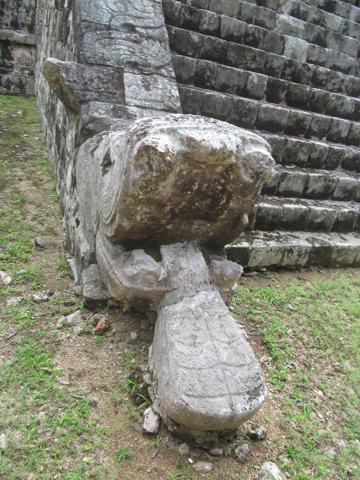
The Feathered Serpent of the Maya — creator's voice in the Popol Vuh, patron of Chichen Itza, and the shadow that descends its pyramid at the equinox.
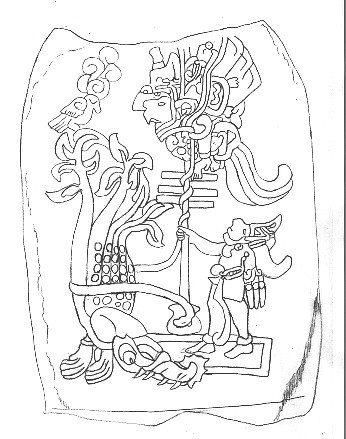
The vain bird who declared himself sun and moon in the Popol Vuh, brought down by the Hero Twins along with his sons Zipacna and Cabracan.
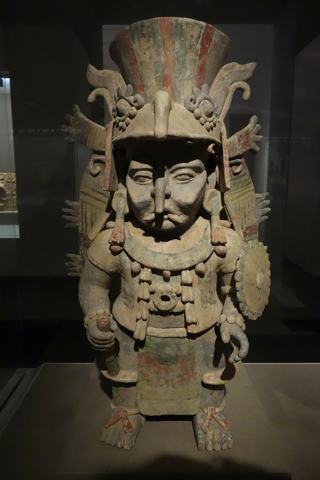
The rain god who splits the clouds with a lightning axe — one god and four, the most frequently depicted deity in the surviving Maya books.
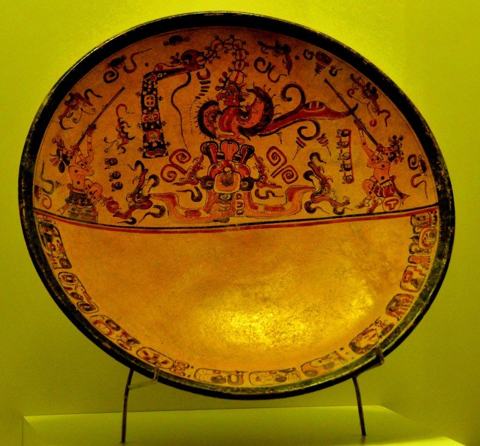
Hunahpu and Xbalanque — the ballplaying twins of the Popol Vuh who outwitted the lords of Xibalba, avenged their father, and rose as sun and moon.
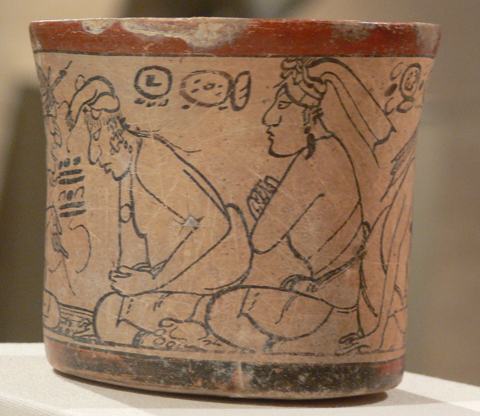
"Place of Fear" — the K'iche' Maya underworld of the Popol Vuh, a court of disease lords whose houses of trial the Hero Twins survived and overturned.
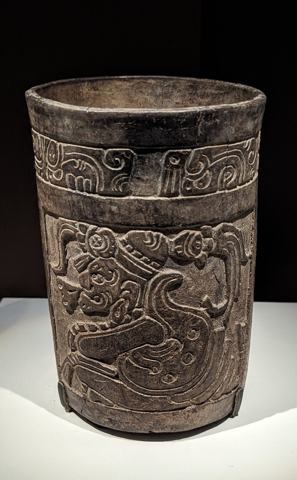
The four brothers who hold up the sky at the world's corners, tied to colours and directions in Landa's account of Maya cosmology and calendar.
Sources & Further Reading
- 1.Popol Vuh (K'iche' Maya, mid-16th century; sole surviving copy transcribed by Francisco Ximenez at Chichicastenango, c. 1701-1703; Newberry Library, Chicago).
- 2.Christenson, Allen J. (trans.). Popol Vuh: The Sacred Book of the Maya. University of Oklahoma Press, 2007.
- 3.Tedlock, Dennis (trans.). Popol Vuh: The Definitive Edition. Rev. ed., Simon & Schuster, 1996.
- 4.Taube, Karl. Aztec and Maya Myths. British Museum Press / University of Texas Press, 1993.
- 5.Miller, Mary & Karl Taube. The Gods and Symbols of Ancient Mexico and the Maya. Thames & Hudson, 1993.
- 6.Sharer, Robert J. with Loa P. Traxler. The Ancient Maya, 6th edition. Stanford University Press, 2006.
Spot an error or have a source to suggest? Write to info@viseterna.com. We cite primary sources and modern scholarship, and we correct fast.