
Tikal
The great Classic Maya city of the Peten rainforest — a dynasty two thousand years deep, a war with Calakmul, and a king's tomb built as a mountain.
Temple I (Temple of the Great Jaguar), Tikal, Peten, Guatemala, Late Classic Maya, c. 734 CE · CC BY 2.0 · source
The City Among the Bajos
Tikal — known to its own Classic-period rulers as Yax Mutal — rises out of the rainforest of the Peten in northern Guatemala, one of the largest and longest-occupied cities the Classic Maya built 3,6. Unlike the cenote-fed cities of the Yucatan, Tikal has no natural water source at all; its builders surrounded the ceremonial core with plastered reservoirs that caught and held rainwater through the dry season, an engineering solution as essential to the city's survival as any temple 6.
Occupation stretches from roughly the sixth century BCE to the collapse of Classic-period kingship around 900 CE, and the dynastic list reconstructed from its own monuments names rulers across more than eight centuries, beginning with a founder later kings called Yax Ehb Xook 3. William Coe's field handbook, the product of the University of Pennsylvania Museum's long excavation of the site from 1956 to 1970, remains a standard guide to the physical city those rulers left behind 1.
The Entrada of 378
Tikal's history turns on one especially disputed date: 14 January 378 CE, when the inscriptions record the arrival of a figure named Siyaj K'ak', "Fire Is Born," associated in the texts with the distant central Mexican city of Teotihuacan. The reigning king, Chak Tok Ich'aak I, died the same day, and a new king, Yax Nuun Ahiin I — linked by name to a Teotihuacan lord called Spearthrower Owl — was installed soon after 3,6.
Whether this was a military conquest, a diplomatic marriage alliance, or an elite takeover dressed in the language of arrival, scholars still argue; Martin and Grube lay out the competing readings without settling on one, noting only that Tikal's art and architecture afterward absorb Teotihuacan-style warrior imagery in a way too pervasive to be coincidence 3. What is not disputed is the effect: Tikal's dynasty, and its material culture, visibly change course from this date 3,6.
Defeat, Silence, and Return
Tikal's great regional rival was Calakmul, seat of the Snake-head dynasty roughly 100 kilometres to the north, and the two cities spent much of the sixth and seventh centuries locked in a contest fought through proxy wars and shifting alliances among smaller kingdoms 2,3. In 562 CE Tikal suffered a major defeat, traditionally linked to Calakmul and its ally Caracol; monument carving at Tikal all but stops for the next 130 years, a gap epigraphers call the hiatus 2,3,6.
Recovery came under Jasaw Chan K'awiil I, who took the throne in 682 and, in 695, defeated Calakmul's king Yich'aak K'ahk' in battle, breaking Calakmul's dominance and restoring Tikal to the first rank of Maya powers 2,3. It was Jasaw who rebuilt the city's monumental core on the scale still visible today.
A Tomb Built as a Mountain
Jasaw was buried around 734 CE beneath Temple I, also called the Temple of the Great Jaguar, a steep nine-tiered pyramid raised directly over his tomb, Burial 116, discovered by the University Museum project in 1962 1,2. The tomb held jade, pearl, and shell ornaments, painted ceramics, and a remarkable set of bones and bone tubes carved with fine hieroglyphic and figural scenes 1,2.
Several of those bones show the Maize God travelling by canoe, paddled by a pair of aged deities toward the watery mouth of Xibalba, the Maya underworld — a mythic scene David Freidel, Linda Schele, and Joy Parker read as a direct model for the king's own death-journey, casting Jasaw's burial as a re-enactment of the Maize God's descent and eventual rebirth, the same cycle of death feeding renewal told of the Hero Twins in the Popol Vuh and carved a few hundred kilometres away on the sarcophagus lid of Pakal at Palenque's Temple of the Inscriptions 5. Schele and Freidel describe the pyramid raised above such a tomb as itself standing for a sacred mountain, a stone version of the living, maize-bearing earth under which the king was returned to the source of that renewal 4,5.
The Great Plaza as Sacred Landscape
Temple I faces its near-twin, Temple II, across Tikal's Great Plaza, flanked by the North Acropolis — a dense stack of temples and royal burials rebuilt on the same spot across centuries, effectively the city's dynastic necropolis — and the palace compound of the Central Acropolis 3,6. Beyond the plaza, the complex called the Mundo Perdido preserves one of the Maya lowlands' great E-Groups, a paired pyramid-and-platform arrangement built to mark sunrise on the solstices and equinoxes, tying the city's ritual calendar to observable sky events 6.
Tikal's rulers also raised twin-pyramid complexes at the close of successive k'atuns, the roughly twenty-year periods of the Maya calendar, turning the passage of time itself into a recurring building project — a civic ritual repeated across the reigns of Jasaw and his successors 3,6.
Rediscovery and Preservation
Spanish colonial records show little awareness of Tikal, and the ruins passed out of active use after the ninth-century Classic collapse. Modesto Mendez, a Guatemalan government commissioner, and Ambrosio Tut reported the site to the outside world in 1848, and sustained excavation began only with the University Museum project of the mid-twentieth century, the source of most of what is now known about the city 1,6. UNESCO inscribed Tikal National Park as a World Heritage Site in 1979, recognizing both the ruins and the rainforest that still surrounds them 6.
Continue Exploring
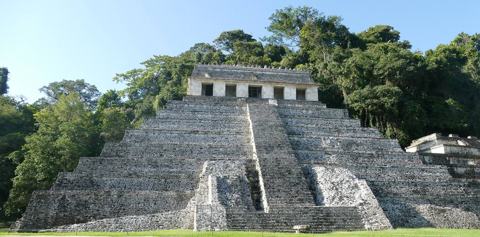
Palenque's funerary pyramid, raised over the tomb of King Pakal and carved with one of the longest surviving Classic Maya hieroglyphic texts.
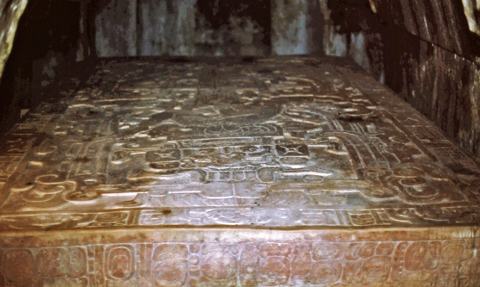
The carved limestone lid over King Pakal's tomb at Palenque — a scene of death and rebirth at the World Tree, and the most misread monument in Maya art.
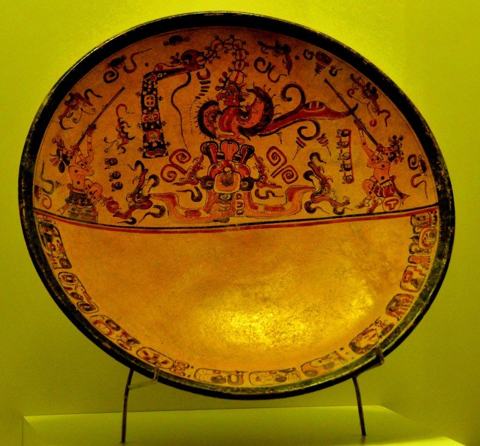
Hunahpu and Xbalanque — the ballplaying twins of the Popol Vuh who outwitted the lords of Xibalba, avenged their father, and rose as sun and moon.
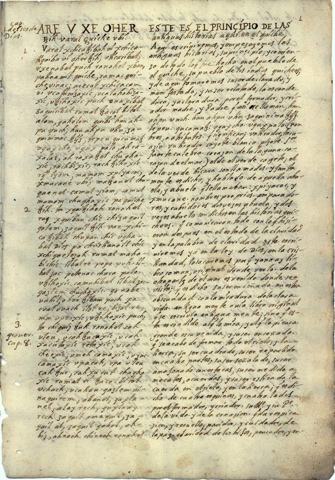
The K'iche' Maya "Book of Council" — creation, the Hero Twins, and a dynasty's history, saved by one Dominican friar's copy of a lost original.
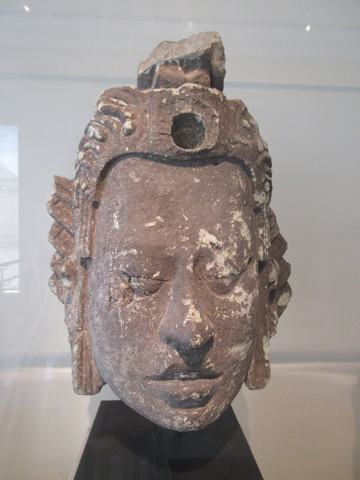
The youthful Classic Maya god of maize, God E of the codices, whose death and rebirth many scholars connect to the Popol Vuh's Hun Hunahpu.
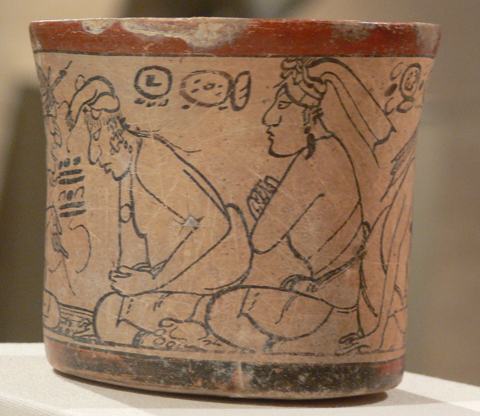
"Place of Fear" — the K'iche' Maya underworld of the Popol Vuh, a court of disease lords whose houses of trial the Hero Twins survived and overturned.
Also mentioned inChichen ItzaThe Maya Long Count Calendar
Sources & Further Reading
- 1.Coe, William R. Tikal: A Handbook of the Ancient Maya Ruins. University Museum, University of Pennsylvania, 1967.
- 2.Harrison, Peter D. The Lords of Tikal: Rulers of an Ancient Maya City. Thames & Hudson, 1999.
- 3.Martin, Simon & Nikolai Grube. Chronicle of the Maya Kings and Queens, 2nd edition. Thames & Hudson, 2008.
- 4.Schele, Linda & David Freidel. A Forest of Kings: The Untold Story of the Ancient Maya. William Morrow, 1990.
- 5.Freidel, David, Linda Schele & Joy Parker. Maya Cosmos: Three Thousand Years on the Shaman's Path. William Morrow, 1993.
- 6.Sharer, Robert J. with Loa P. Traxler. The Ancient Maya, 6th edition. Stanford University Press, 2006.
Spot an error or have a source to suggest? Write to info@viseterna.com. We cite primary sources and modern scholarship, and we correct fast.