
Camazotz
The death bat — the snatching bat-demon of the K'iche' underworld who takes off a hero's head in the dark, and the long Mesoamerican cult behind him.
Camazotz (Zotz), Maya bat deity, carved stone sculpture, Guatemala · CC BY-SA 2.0 · source
The Death Bat
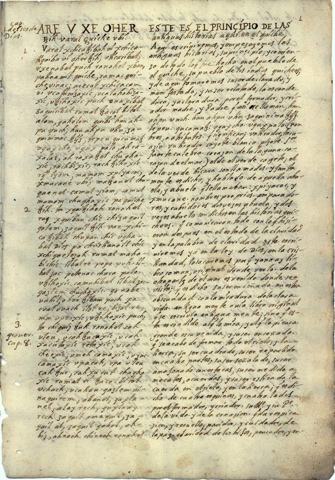
Camazotz is K'iche' Maya, from kame or kam, death, and sotz', bat — the death bat, or in Dennis Tedlock's rendering the "snatch-bat," the verb catching the way the creature takes something and is gone 1,2. He belongs to Xibalba, the K'iche' underworld, and his one extended appearance in surviving literature is short, sudden, and among the most memorable scenes in Mesoamerican myth 1.
Bats in Maya thought are creatures of caves, and caves are entrances to the underworld — so a bat is not primarily a nocturnal animal but a resident of the earth's interior, associated with darkness, blood, sacrifice and death 5,6. The vampire bat Desmodus rotundus, which does live in Mesoamerica and does feed on blood, sharpens the association without fully explaining it 5.
The House of Bats
In the Popol Vuh, the Hero Twins Hunahpu and Xbalanque descend to Xibalba to face its lords and are made to survive a sequence of deadly houses. The fifth is Zotz'i-ha, the Bat House, "crammed with bats," where the snatch-bats shriek and swoop through the dark all night 1,2.
The twins take shelter inside their blowguns and hold out until near dawn. Then the bats fall silent — and it is the silence, not the noise, that kills. Hunahpu puts his head out of the blowgun to see whether the sky is lightening, and a bat, Camazotz, takes his head off in one pass 1,2,3.
The scene continues into something stranger. The lords of Xibalba hang Hunahpu's head over their ballcourt and use it as a ball. Xbalanque, with the help of the animals, has a squash carved and painted to serve as a substitute head, plays the game with it, contrives to send the real head back onto his brother's shoulders, and leaves the Xibalbans batting a rotten squash around the court 1,2,3. The death bat performs a decapitation that the twins then reverse — sacrifice and restoration in a single episode, which is the Popol Vuh's central pattern 2,3.
Camalotz and the Wooden People
An earlier passage, from the creation sequence, is often folded into the same figure. When the creators destroy the people made of wood — beings who moved and spoke but had no minds and did not remember their makers — four destroyers are sent against them, and the second is named Camalotz 1,2.
Tedlock translates the four as Gouger of Faces, Sudden Bloodletter, Crunching Jaguar and Tearing Jaguar, and Christenson renders them comparably; the bat-named destroyer cuts off the heads of the wooden people 1,2,3. Whether Camalotz of the flood episode and Camazotz of the Bat House are the same being or two bat-demons in one tradition is not stated by the text, and translators handle the pair differently 2,3. The shared act — decapitation — is at least a strong family resemblance 2,3.
Bats in Maya and Zapotec Art
Camazotz is a name from one sixteenth-century K'iche' manuscript. The bat as a supernatural, however, has a much longer archaeological record across Mesoamerica 5,6.
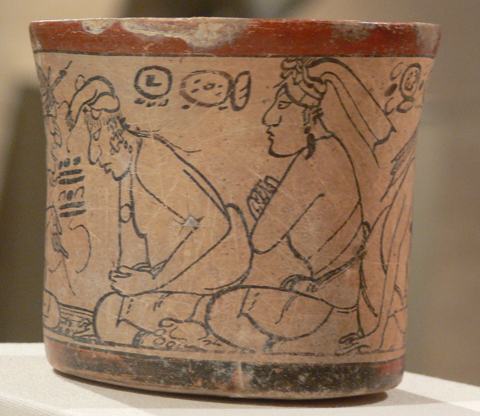
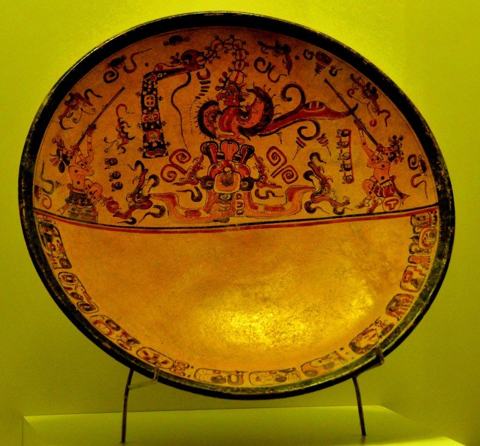
A leaf-nosed bat glyph, sotz', names a month in the Maya calendar and served as the emblem of the Classic city of Copan in Honduras 5,6. Late Classic painted vases show anthropomorphic bats with knives, severed heads, and death-related ornaments, of a kind consistent with the underworld role 4,5. Further west, at Zapotec Monte Alban in Oaxaca, a celebrated jade mosaic mask represents a bat deity, and bat imagery recurs in Zapotec urns 5.
These are not evidence for "Camazotz" under other names. They are evidence that the death-associated bat supernatural was widespread and old, and that the Popol Vuh episode draws on a tradition far larger than the manuscript that preserves it 4,5,6.
The Zotzil Lineage
The bat also appears as a lineage emblem. The highland Kaqchikel Maya, close neighbours and rivals of the K'iche', included a ruling lineage named Zotzil, "of the bat," and their annals — the Annals of the Kaqchikels — use the bat as a house sign 1,6. The Popol Vuh itself is in part a K'iche' dynastic document, and its geography of allies and enemies runs alongside its cosmology 2,6.
That context is worth keeping in view. A bat-named enemy in the underworld and a bat-named neighbouring lineage in the highlands sit in the same book's world, and the relationship between the two is a question scholars raise rather than settle 2,6.
What Can and Cannot Be Claimed
Popular accounts frequently promote Camazotz to a major Maya god of night and blood with a developed cult, temples and a pan-Maya following. The evidence does not support that 4,5.
What the sources give is precise and limited: a named underworld bat in a K'iche' epic recorded after the Spanish conquest, who decapitates a hero in the fifth house of trial; a possibly related destroyer in the same text's creation sequence; and a broad, well-attested Mesoamerican iconography of death-bats spanning centuries and several cultures 1,4,5,6. That is a striking enough creature without the additions 5.
Continue Exploring
"Place of Fear" — the K'iche' Maya underworld of the Popol Vuh, a court of disease lords whose houses of trial the Hero Twins survived and overturned.
Hunahpu and Xbalanque — the ballplaying twins of the Popol Vuh who outwitted the lords of Xibalba, avenged their father, and rose as sun and moon.
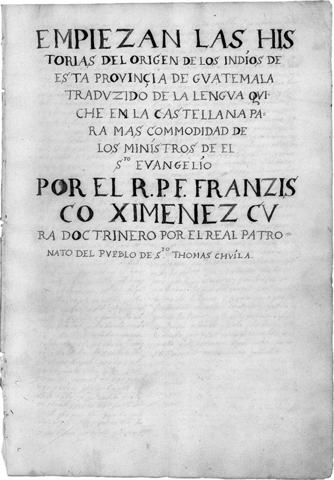
The K'iche' Maya "Book of Council" — creation, the Hero Twins, and a dynasty's history, saved by one Dominican friar's copy of a lost original.
Schellhas's God A, the skeletal Maya death deity behind the name Ah Puch — a label colonial and modern sources actually apply in different ways.
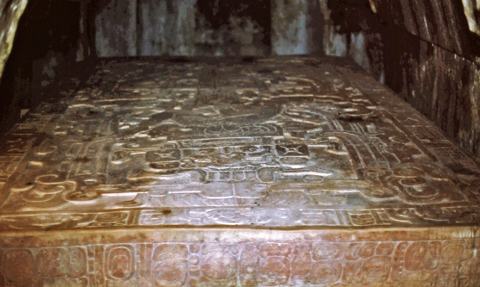
The carved limestone lid over King Pakal's tomb at Palenque — a scene of death and rebirth at the World Tree, and the most misread monument in Maya art.
The K'iche' Maya storm god who speaks the world into being in the Popol Vuh — and the contested claim that he gave the hurricane its name.
Sources & Further Reading
- 1.Popol Vuh — the K'iche' Maya creation epic (alphabetic text c. 1550s; Ximenez manuscript c. 1701).
- 2.Tedlock, Dennis. Popol Vuh: The Mayan Book of the Dawn of Life, revised edition. Simon & Schuster, 1996.
- 3.Christenson, Allen J. Popol Vuh: The Sacred Book of the Maya. University of Oklahoma Press, 2003.
- 4.Taube, Karl. The Major Gods of Ancient Yucatan. Dumbarton Oaks, 1992.
- 5.Miller, Mary & Karl Taube. The Gods and Symbols of Ancient Mexico and the Maya. Thames & Hudson, 1993.
- 6.Sharer, Robert J. with Loa P. Traxler. The Ancient Maya, 6th edition. Stanford University Press, 2006.
Spot an error or have a source to suggest? Write to info@viseterna.com. We cite primary sources and modern scholarship, and we correct fast.