
Xquic (Blood Moon)
The underworld maiden of the Popol Vuh who is impregnated by a talking skull, survives her own execution, and becomes the mother of the Hero Twins.
First page of the Popol Vuh manuscript, K'iche' text and Spanish in parallel columns, transcribed by Francisco Ximenez c. 1701-1703 (Newberry Library) · Public domain · source
Daughter of Xibalba
Xquic ("Blood Moon" or "Blood Girl" in most English translations, from K'iche' quic, blood) is the daughter of Cuchumaquic, one of the lesser lords of Xibalba, the underworld of the Popol Vuh 1,2. She belongs entirely to the world below before the story's central act pulls her to the surface, and unlike the twins she later bears, she has no independent cult or attestation outside this one text; everything known of her comes from the sixteenth-century K'iche' manuscript and its translators 1,3.
The Calabash Tree
Hun Hunahpu, father of the future Hero Twins, has already been defeated and killed by the lords of Xibalba by the time Xquic enters the story; his severed head has been hung in a calabash tree, which the lords then declare forbidden fruit and forbid anyone from approaching 1,2. Curious about the tree's sudden, strange harvest, Xquic goes to see it for herself, and the head, still able to speak, asks her to hold out her hand. It spits into her palm and tells her she will not see it again, but that she is now pregnant 1,3. Translators differ slightly on how explicit the text is about the mechanics of this conception, but all agree it is presented as neither ordinary intercourse nor a virgin birth in any Christian sense, a detail worth noting given how often the Popol Vuh's opening has been read against Genesis; this is a distinctly Mesoamerican logic of transmission through fluid and word 2,3.
Flight to the Surface
Pregnant and questioned by her own father, Xquic is condemned by the lords of Xibalba, who send owl messengers to kill her and bring back her heart as proof 1,2. She persuades the owls to spare her, offering an explanation of her situation that moves them, and they return instead with a lump of tree sap hardened into the shape of a heart, which the lords burn as incense without noticing the substitution 1,3. She then climbs out of the underworld to the house of Xmucane, grandmother of the man who fathered her unborn children, and asks to be taken in.
Proving Herself
Xmucane does not believe her story and sets a test: bring back a net full of maize from a single plant in the garden, a load the actual harvest could not supply 1,2. Xquic prays to the guardian spirits of the field, and by dawn the net is full, the maize replenished as fast as she picks it; Xmucane, seeing the impossible harvest, accepts her into the household 1,3. Xquic gives birth soon after to Hunahpu and Xbalanque, the twins whose own trials in Xibalba and triumph as ballplayers occupy most of the rest of the text 1,2.
A Name Harder Than It Looks
"Blood Moon" is the standard English rendering of her name, and it has encouraged a persistent modern habit of calling Xquic a moon goddess outright 4. The Popol Vuh itself does not make that identification; it is a later inference built on the name and on scattered, much-debated lunar associations elsewhere in Mesoamerican myth, and specialists are divided on how far to press it 4,5. What the text does support directly is Xquic's role as the crucial hinge between two generations of a single mythic lineage: without her, the deaths of Hun Hunahpu and his brother in the underworld's ballcourt would have been the end of the story, not its beginning 1,2,3.
The confusion is worth heading off directly because it runs the other way too: popular retellings sometimes merge Xquic with Ix Chel, the Yucatec goddess of childbirth and medicine, on the strength of a shared, very general connection to women's fertility 4,5. The two come from different regions, different centuries, and different bodies of source material — Xquic from a single sixteenth-century highland K'iche' narrative, Ix Chel from Yucatec colonial sources and the Dresden and Madrid codices — and nothing in either corpus identifies them with one another 4,5.
Continue Exploring
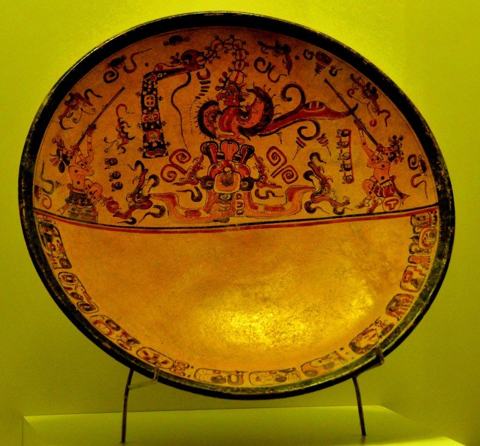
Hunahpu and Xbalanque — the ballplaying twins of the Popol Vuh who outwitted the lords of Xibalba, avenged their father, and rose as sun and moon.
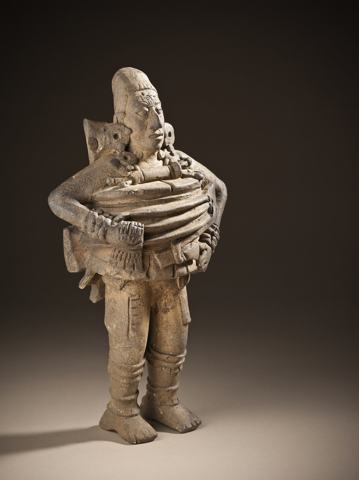
Pitz, the rubber-ball game played across the Maya world for three thousand years — real sport, staged myth, and sometimes an execution.
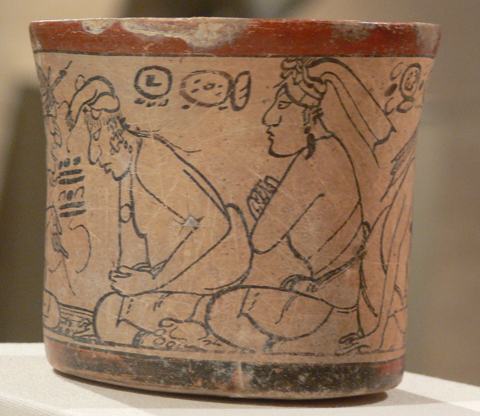
"Place of Fear" — the K'iche' Maya underworld of the Popol Vuh, a court of disease lords whose houses of trial the Hero Twins survived and overturned.
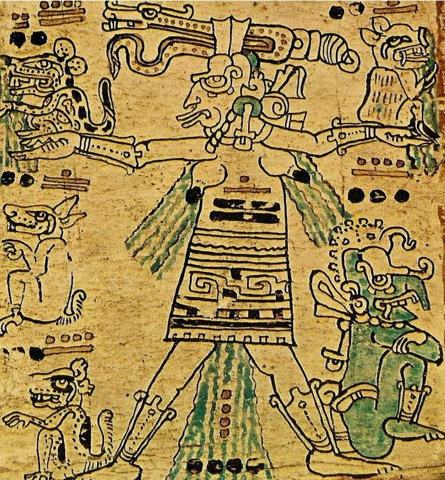
"Rainbow Lady" — the Maya goddess of childbirth, weaving, medicine and divination, and the two distinct goddesses tangled together behind her name.
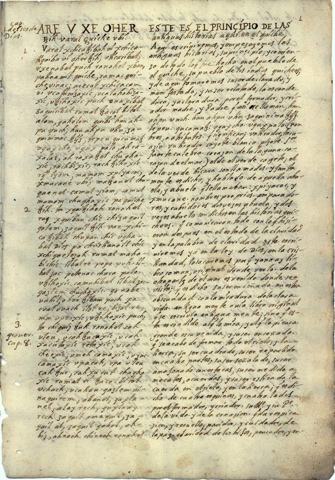
The K'iche' Maya "Book of Council" — creation, the Hero Twins, and a dynasty's history, saved by one Dominican friar's copy of a lost original.
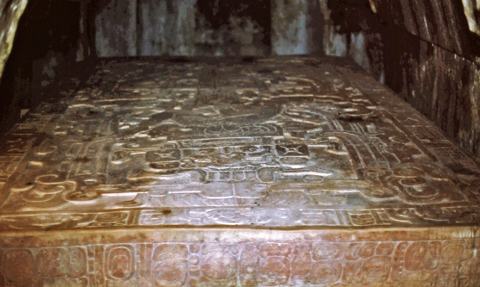
The carved limestone lid over King Pakal's tomb at Palenque — a scene of death and rebirth at the World Tree, and the most misread monument in Maya art.
Sources & Further Reading
- 1.Popol Vuh (K'iche' Maya, mid-16th century; sole surviving copy transcribed by Francisco Ximenez at Chichicastenango, c. 1701-1703; Newberry Library, Chicago).
- 2.Christenson, Allen J. (trans.). Popol Vuh: The Sacred Book of the Maya. University of Oklahoma Press, 2007.
- 3.Tedlock, Dennis (trans.). Popol Vuh: The Definitive Edition. Rev. ed., Simon & Schuster, 1996.
- 4.Miller, Mary & Karl Taube. The Gods and Symbols of Ancient Mexico and the Maya. Thames & Hudson, 1993.
- 5.Taube, Karl. Aztec and Maya Myths. British Museum Press / University of Texas Press, 1993.
Spot an error or have a source to suggest? Write to info@viseterna.com. We cite primary sources and modern scholarship, and we correct fast.