
The Popol Vuh
The K'iche' Maya "Book of Council" — creation, the Hero Twins, and a dynasty's history, saved by one Dominican friar's copy of a lost original.
Popol Vuh, Ximenez manuscript, c. 1701-1703 (Newberry Library, Chicago) · Public domain · source
One Copy, No Original
Almost everything told in narrative form about K'iche' Maya myth survives because of a single book. The Popol Vuh — "Book of Council," or "Book of the Community" — is an account of creation, the trials of the Hero Twins in Xibalba, and the ancestry of the ruling lineages of highland Guatemala, composed in the K'iche' language and written down using Latin letters not long after the Spanish conquest, during the same Postclassic-into-colonial transition that reshaped Maya political life across the region 1,6,7. Comparing its closing genealogy against dated colonial records, Dennis Tedlock and the historian Adrian Recinos both arrive at a composition date in the 1550s, a generation into Spanish rule 1,3.
That original manuscript is lost. What survives is a copy made around 1701-1703 by the Dominican friar Francisco Ximenez, parish priest at Chichicastenango, who set the K'iche' text and his own Spanish translation side by side in facing columns 1,2. Ximenez's volume also contains a Kaqchikel-K'iche'-Tz'utujil grammar and his own doctrinal writings, bound together as one working manuscript rather than a formal presentation copy 1.
How It Reached Chicago
The book's survival after Ximenez is a chain of near-misses. It passed through Dominican hands in Guatemala until 1855, when the French priest and antiquarian Charles Etienne Brasseur de Bourbourg found it in a university library in Guatemala City and took it with him to Europe 1,5. In 1861 Brasseur published the first French translation, under the title Popol Vuh, le livre sacre et les mythes de l'antiquite americaine, which is how the text first reached a wide non-Guatemalan readership 5.
After Brasseur's death in 1874 the manuscript passed to the French collector Alphonse Pinart, then by sale to the American businessman Edward E. Ayer, who in 1911 donated his library on Native American history to the Newberry Library in Chicago — where the Ximenez manuscript remains the only known copy of the text in existence 1. Every modern translation, without exception, is made from this one document.
What the Book Contains
The Popol Vuh opens before anything exists but sea and sky, and walks through four attempts by the creator pair to make beings who can speak their names — animals, mud, wood, and finally people shaped from maize 1,2. It then follows the ballplaying brothers Hun Hunahpu and Vucub Hunahpu into Xibalba, and their sons Hunahpu and Xbalanque — the Hero Twins — through the trials that avenge them, including the night in the house of Camazotz 1,2. A final long section leaves myth for dynastic history: the migrations, wars, and royal succession of the K'iche' lords down to Ximenez's own time 1,2.
The Feathered Serpent Kukulkan appears here too, under the highland name Q'uq'umatz, seated in the primordial water beside Heart of Sky as one of the creating powers — a reminder that the book is a K'iche' text with its own vocabulary for figures shared across the wider Maya world 1.
A Christian Book About a Pre-Christian World
The text is explicit about its own moment. Its preamble states that the community is writing "under the Law of God and Christianity" because the old book, the true Popol Vuh, "cannot be seen any more" — language that has driven a long debate over how much of the work, especially its opening cosmogony, was shaped by contact with Genesis 1,6. Van Akkeren's study of the manuscript's likely authors and political context argues that its K'iche' writers were working from genuine inherited memory rather than transcribing borrowed scripture, even while writing in a colonial idiom and for a colonial audience 6.
The deeper evidence for that view is not textual but archaeological. Painted pottery of the Classic period, roughly seven to nine centuries before Ximenez's copy, shows the Hero Twins named and in recognizable scenes — the monkey-scribe trick on their older brothers, the fall of the bird-monster Vucub Caquix — proving the core narrative long predates any missionary influence, whatever the colonial framing added around it 1,3.
Translating an Untranslatable Book
Modern versions differ sharply in method. Tedlock's English translation draws on his own fieldwork with K'iche' daykeepers in Guatemala and reads the text as performed oral literature 3. Christenson's translation is closer and more literal, built around the couplet structure of K'iche' ritual language 2. In Guatemala itself, the linguist and poet Luis Enrique Sam Colop produced a K'iche'-language edition in 1999 aimed at correcting what he judged to be accumulated errors in the Spanish and English lines of transmission, and at giving contemporary K'iche' speakers direct access to their own foundational text 4.
These are not small disagreements. Tedlock and Christenson render the twins' final ascent — as sun and moon, or as sun and Venus — differently, and neither claims certainty 2,3. The Popol Vuh is, in the end, a single fragile witness to a much larger oral tradition, read today through translators who do not all agree on what it says.
Continue Exploring
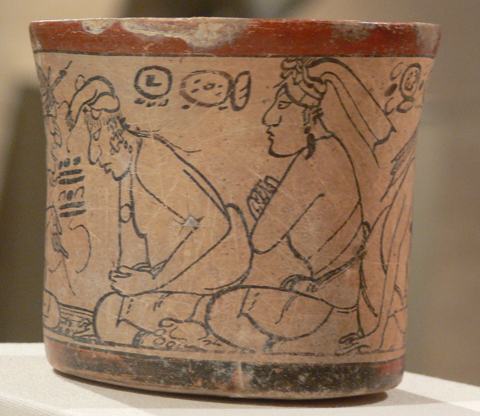
"Place of Fear" — the K'iche' Maya underworld of the Popol Vuh, a court of disease lords whose houses of trial the Hero Twins survived and overturned.
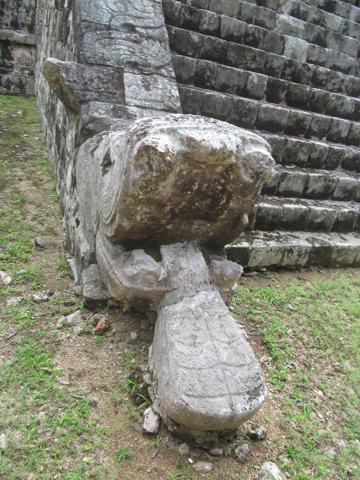
The Feathered Serpent of the Maya — creator's voice in the Popol Vuh, patron of Chichen Itza, and the shadow that descends its pyramid at the equinox.
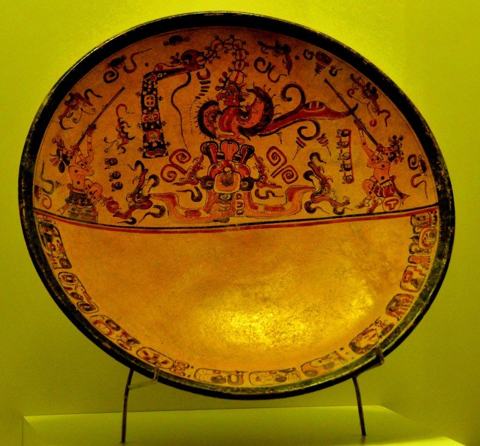
Hunahpu and Xbalanque — the ballplaying twins of the Popol Vuh who outwitted the lords of Xibalba, avenged their father, and rose as sun and moon.
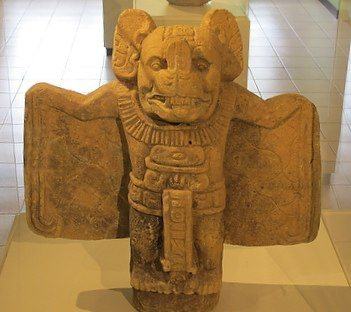
The death bat — the snatching bat-demon of the K'iche' underworld who takes off a hero's head in the dark, and the long Mesoamerican cult behind him.
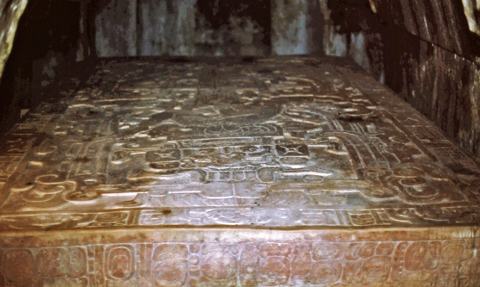
The carved limestone lid over King Pakal's tomb at Palenque — a scene of death and rebirth at the World Tree, and the most misread monument in Maya art.
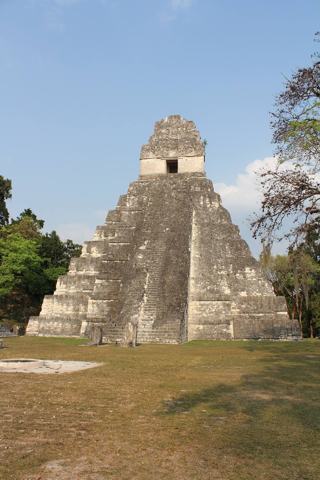
The great Classic Maya city of the Peten rainforest — a dynasty two thousand years deep, a war with Calakmul, and a king's tomb built as a mountain.
Also mentioned inRabinal AchiThe Maya World Tree
Sources & Further Reading
- 1.Popol Vuh — K'iche' Maya text (mid-16th century); sole surviving copy transcribed by Francisco Ximenez at Chichicastenango, c. 1701-1703 (Newberry Library, Chicago).
- 2.Christenson, Allen J. (trans.). Popol Vuh: The Sacred Book of the Maya. University of Oklahoma Press, 2007.
- 3.Tedlock, Dennis (trans.). Popol Vuh: The Definitive Edition. Rev. ed., Simon & Schuster, 1996.
- 4.Colop, Luis Enrique Sam. Popol Wuj: version poetica K'iche'. Guatemala, 1999.
- 5.Brasseur de Bourbourg, Charles Etienne (trans.). Popol Vuh, le livre sacre et les mythes de l'antiquite americaine. Paris, 1861.
- 6.Van Akkeren, Ruud. 'Authors of the Popol Vuh.' Ancient Mesoamerica 14, no. 2 (2003): 237-256.
- 7.Sharer, Robert J. with Loa P. Traxler. The Ancient Maya, 6th edition. Stanford University Press, 2006.
Spot an error or have a source to suggest? Write to info@viseterna.com. We cite primary sources and modern scholarship, and we correct fast.