
The Maya World Tree
The great ceiba that joins underworld, earth and sky in Maya cosmology — carved at Palenque's Temple of the Cross and reborn each time maize is planted.
Maya stone relief, from the Temple of the Foliated Cross, Palenque, illustration in Mexican Archaeology, 1914 · Public domain · source
A Tree That Holds the World Together
Maya cosmology pictures the universe as three layers — underworld, earth, and sky — joined and held apart by a great tree growing at the center of the world, its roots in the waters below and its crown carrying the sky itself 2,4. Epigraphers commonly cite the term wakah chan, sometimes glossed "raised-up sky" or "six sky," for this axis, though the reading of the relevant glyphs has been argued over since it was first proposed, and it should be treated as an influential working translation rather than a settled one 2,4. In everyday Yucatec the same tree is called yax che, "green tree" or "first tree," and its real-world counterpart is the ceiba (Ceiba pentandra), the tall buttress-rooted tree still left standing at the center of many Maya villages today 3,4.
The world tree is not unique to the Maya — comparable axis-trees appear across Mesoamerica — but Maya art gives it an unusually specific and consistent form: a cross-shaped or foliated trunk, often bearing a bird at its summit and sprouting maize foliage, jade, and serpents from its branches rather than ordinary leaves 2,4.
Carved at Palenque
The single most important surviving depiction is the Temple of the Foliated Cross at Palenque, part of a group of three temples — with the Temple of the Cross and the Temple of the Sun — raised in the late seventh century CE by the Palenque dynasty, one of the best-documented royal houses of the Classic Maya lowlands 3,5,6. Its inner tablet shows a cross-shaped tree, its foliage unmistakably that of a flowering maize plant, flanked by two human figures making offerings toward it — read by most specialists as the king K'inich Kan Bahlam and his father K'inich Janaab' Pakal, staging the ruler's connection to cosmic renewal at his own accession 3,6.
The neighboring Temple of the Cross tablet repeats the composition with a plainer cross-form tree, and together the three temples of the complex are usually read as a coordinated statement of dynastic and cosmological legitimacy carved into a single architectural program — not three unrelated buildings, but one argument in stone 3,6. A related, still more famous image is carved on the sarcophagus lid of Pakal himself in the nearby Temple of the Inscriptions, where a cross-shaped tree rises behind the falling figure of the king, read by most Mayanists as his descent into the underworld along the same axis the tree elsewhere represents 3,6.
The Tree as Resurrected Maize
The tree's clearest mythological anchor is agricultural. Classic-period painted vessels show the young maize god rising from a cracked turtle carapace or from the earth itself as a plant breaks through soil — germination staged as a god's rebirth — and many specialists connect this imagery directly to the ceiba-tree axis, reading the world tree as the maize plant's own form magnified to cosmic scale 2,4. The Popol Vuh supplies the narrative counterpart from the K'iche' highlands centuries later: the Hero Twins' father, Hun Hunahpu, is killed and his severed head hung in a calabash tree in Xibalba, where it speaks and impregnates the maiden who bears the twins — a tree of death that becomes, through the twins' own story, the occasion for the world's renewal 1,2.
That overlap is suggestive rather than proven identity: the Popol Vuh is a sixteenth-century K'iche' text and the Palenque tablets are seventh-century Classic Maya art from a different language and region, and specialists differ on how directly one illuminates the other 2,6. What both share is the same underlying logic — a tree connecting death below to growth above, standing in for the whole cycle by which maize, and by extension human life, returns each season 2,4.
Direction, Color, and the Bird at the Top
Maya cosmological diagrams typically multiply the single world tree into five: one at the center and one at each of the four cardinal directions, each associated with its own color in the pattern also seen in the four directional aspects of Chaac 4,6. A supernatural bird — the so-called Principal Bird Deity, connected to the aged creator Itzamna in his avian aspect — perches at the crown of the central tree in Classic art, marking the meeting point of the tree's trunk with the sky it supports 4,6.
A Living Tree, Still Planted at the Center
The ceiba's symbolic role did not end with the Classic period. Colonial and modern Yucatec Maya communities have continued to plant a ceiba at the center of towns and to treat it with particular respect, a continuity Freidel, Schele and Parker's ethnographically-informed study of Maya cosmology treats as a genuine living thread back to the Classic-period imagery rather than a coincidence of shared botany 2. The tree that once anchored royal dynastic claims at Palenque survives, in a much plainer form, as the actual tree still standing in a great many Maya town squares today 2,3.
Continue Exploring
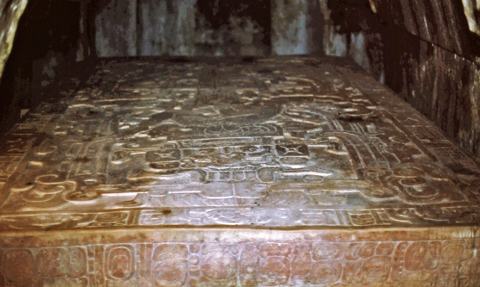
The carved limestone lid over King Pakal's tomb at Palenque — a scene of death and rebirth at the World Tree, and the most misread monument in Maya art.
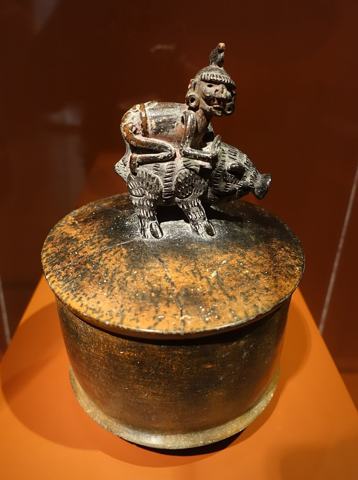
The aged creator — supreme sky god of the Maya, patron of writing, healing and divination, and the old man scholars know as God D.
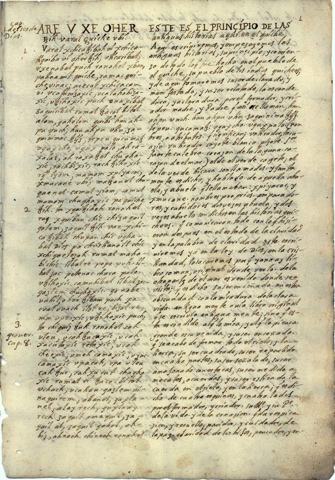
The K'iche' Maya "Book of Council" — creation, the Hero Twins, and a dynasty's history, saved by one Dominican friar's copy of a lost original.
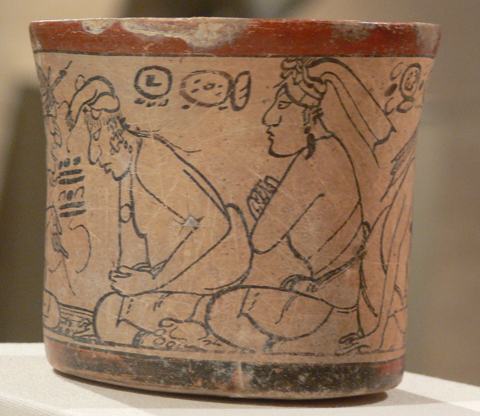
"Place of Fear" — the K'iche' Maya underworld of the Popol Vuh, a court of disease lords whose houses of trial the Hero Twins survived and overturned.
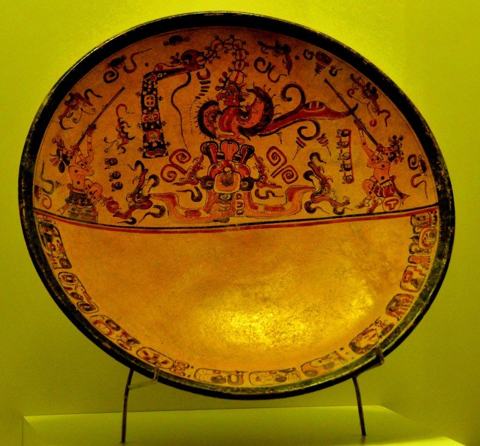
Hunahpu and Xbalanque — the ballplaying twins of the Popol Vuh who outwitted the lords of Xibalba, avenged their father, and rose as sun and moon.
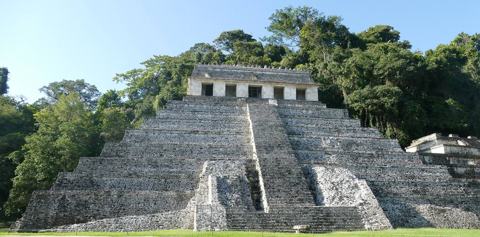
Palenque's funerary pyramid, raised over the tomb of King Pakal and carved with one of the longest surviving Classic Maya hieroglyphic texts.
Sources & Further Reading
- 1.Popol Vuh — K'iche' Maya creation epic (mid-16th century text; Ximenez manuscript, c. 1701-1703).
- 2.Freidel, David, Linda Schele, and Joy Parker. Maya Cosmos: Three Thousand Years on the Shaman's Path. William Morrow, 1993.
- 3.Schele, Linda, and Peter Mathews. The Code of Kings: The Language of Seven Sacred Maya Temples and Tombs. Scribner, 1998.
- 4.Miller, Mary & Karl Taube. The Gods and Symbols of Ancient Mexico and the Maya. Thames & Hudson, 1993.
- 5.Coe, Michael D., and Stephen Houston. The Maya, 9th edition. Thames & Hudson, 2015.
- 6.Sharer, Robert J. with Loa P. Traxler. The Ancient Maya, 6th edition. Stanford University Press, 2006.
Spot an error or have a source to suggest? Write to info@viseterna.com. We cite primary sources and modern scholarship, and we correct fast.