
Seven Macaw (Vucub Caquix)
The vain bird who declared himself sun and moon in the Popol Vuh, brought down by the Hero Twins along with his sons Zipacna and Cabracan.
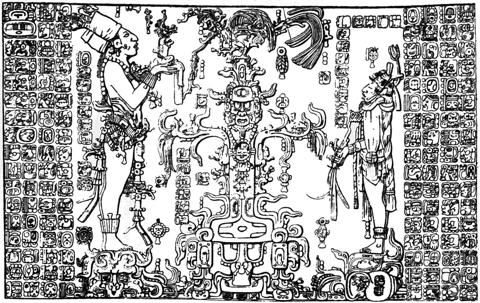
Izapa Stela 25, Late Preclassic Maya monument, Chiapas (line drawing after the original stone) · CC BY-SA 3.0 · source
A Bird Who Claimed the Sky
After Heart of Sky's flood destroys the people of wood, the Popol Vuh pauses on an age with no true sun. Into that dim world struts Vucub Caquix — K'iche' for "Seven Macaw" — a resplendent bird who declares himself both sun and moon before either exists 1,2. He is explicit about his claims: his eyes shine like the sky itself, his teeth are set with jewels, and his perch in a nance fruit tree is described as though it were a throne 1,2. The text is unambiguous that this self-coronation is false, and false in a way the rest of the episode exists to correct 3.
A Family of Overreach
Seven Macaw does not overreach alone. His sons Zipacna and Cabracan make matching claims over the solid earth rather than the sky. Zipacna boasts that he built the mountains in a single night, and when four hundred young men try to kill him for sport after he lifts a felled tree they could not move, he brings their house down on all of them while they celebrate his supposed death — the text says the dead youths rose into the sky as the Pleiades 1,2. Cabracan, "Earthquake," claims he can level any mountain by kicking it 1,3. Father and sons form one household of premature, unearned power, and the Hero Twins take each of them down in turn, by a different trick each time 1,2,3.
The Ambush in the Tree
Hunahpu and Xbalanque go after the father first. They wait beneath his fruit tree, and Hunahpu shoots him from below with a blowgun, shattering his jaw and knocking him from his perch — but Seven Macaw, in the fall, seizes Hunahpu's arm and tears it off, carrying it home to hang over his fire 1,2. The twins do not have their quarry yet; they have a wounded, furious bird still convinced of his own splendour, and an arm still to recover.
Healers in Disguise
They solve both problems with one plan. Their grandparents, the elderly Xpiyacoc and Xmucane, dress as travelling healers and offer to treat Seven Macaw's broken jaw and the eye that has begun to trouble him. Under cover of the cure they draw out his jewelled teeth and his shining, metal eyes — the very features he boasted of — and set plain kernels of white corn and pith in their place 1,2. Stripped of the ornaments that made his claim to be sun and moon credible, Seven Macaw sickens and dies, his wife Chimalmat with him, and the old healers recover Hunahpu's arm on their way out 1,2. Commentators have noted the neatness of the substitution — maize standing in for false brilliance, in a text that will shortly make maize the literal substance of true human beings — though the Popol Vuh itself does not spell out the parallel 2,4.
Two Sons, Two Tricks
The twins still have Zipacna and Cabracan to answer for. For Zipacna, who cannot resist food, they build an elaborate false crab and set it at the bottom of a ravine; when he crawls in after it, they collapse the mountainside on him, and the text leaves him buried there, turned to stone 1,2. Cabracan they catch with hunger of a different kind: they shoot a bird, coat it in white earth, and let him eat it roasted; the earth secretly saps his strength, and once he is weak they bind him and bury him in the ground he claimed to command 1,3. Each defeat answers the boast precisely — the mountain-maker is buried under a mountain, the earth-shaker is buried in the earth.
An Old Story in Stone
The episode is not a colonial invention riding on an older creation account. Izapa Stela 25, a carved monument from the Pacific coast of Chiapas dated to the Late Preclassic, shows a great bird perched in a tree above a one-armed figure holding a staff — read by Mesoamericanists as this same confrontation, centuries before the Ximenez manuscript was written down 4,5,6. Some specialists also connect Seven Macaw to the Principal Bird Deity of Classic art, an avian figure often read as an aspect of Itzamna; the two are visually related, but whether they represent one tradition or two that converged is still argued rather than settled 4,5.
Continue Exploring
The K'iche' Maya storm god who speaks the world into being in the Popol Vuh — and the contested claim that he gave the hurricane its name.
Hunahpu and Xbalanque — the ballplaying twins of the Popol Vuh who outwitted the lords of Xibalba, avenged their father, and rose as sun and moon.
The aged creator — supreme sky god of the Maya, patron of writing, healing and divination, and the old man scholars know as God D.
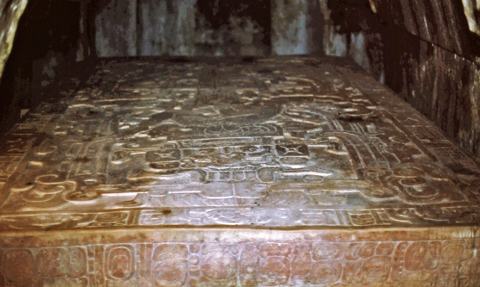
The carved limestone lid over King Pakal's tomb at Palenque — a scene of death and rebirth at the World Tree, and the most misread monument in Maya art.
The great ceiba that joins underworld, earth and sky in Maya cosmology — carved at Palenque's Temple of the Cross and reborn each time maize is planted.
K'inich Ajaw, the Maya sun god — crossed-eyed lord of day and kingship, who sinks each night into Xibalba and crosses it as a jaguar.
Sources & Further Reading
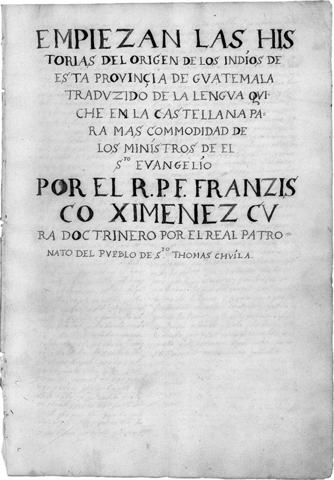
- 1.Popol Vuh (K'iche' Maya, mid-16th century; sole surviving copy transcribed by Francisco Ximenez at Chichicastenango, c. 1701-1703; Newberry Library, Chicago).
- 2.Christenson, Allen J. (trans.). Popol Vuh: The Sacred Book of the Maya. University of Oklahoma Press, 2007.
- 3.Tedlock, Dennis (trans.). Popol Vuh: The Definitive Edition. Rev. ed., Simon & Schuster, 1996.
- 4.Taube, Karl. Aztec and Maya Myths. British Museum Press / University of Texas Press, 1993.
- 5.Miller, Mary & Karl Taube. The Gods and Symbols of Ancient Mexico and the Maya. Thames & Hudson, 1993.
- 6.Sharer, Robert J. with Loa P. Traxler. The Ancient Maya, 6th edition. Stanford University Press, 2006.
Spot an error or have a source to suggest? Write to info@viseterna.com. We cite primary sources and modern scholarship, and we correct fast.