
Kinich Ahau
K'inich Ajaw, the Maya sun god — crossed-eyed lord of day and kingship, who sinks each night into Xibalba and crosses it as a jaguar.
Mask of Kinich Ahau, Palenque, Late Classic period, 600–900 CE (Museo Nacional de Antropologia, Mexico City); photograph by Gary Lee Todd · CC0 · source
The Sun-Faced Lord
Kinich Ahau — in the spelling now standard among epigraphers, K'inich Ajaw — combines k'in, the word for sun and for day, with ajaw, lord 4,5. The compound k'inich is usually rendered "sun-faced" or "radiant", so the name is something like "Radiant Lord" or "Sun-Faced Lord" 4. He is the principal solar deity of the Maya, attested from the Classic-period inscriptions of the lowlands through the Postclassic books of Yucatan and into the colonial accounts 4,5.
In the classification system that Mayanists still use for the codical gods, he is God G. Paul Schellhas, working only from the surviving screenfold manuscripts, sorted their recurring divine figures alphabetically in 1904 without knowing their names; later decipherment attached the names to the letters, and God G became K'inich Ajaw 4,5,6.
How to Recognise Him
His portrait is one of the most standardised in Maya art. He is shown as a mature man with square, crossed or squinting eyes; a large hooked nose, often exaggerated into a Roman profile; a single filed T-shaped upper incisor; and curling elements at the corners of the mouth sometimes described as barbels or a stylised beard 4,5. A k'in sign — the four-petalled solar glyph — is set on his forehead, cheek, torso or limbs, and it is the surest single diagnostic 4,5.
The crossed eyes are not a defect. Deliberately induced strabismus was regarded as beautiful among the Classic Maya, and here it also does semiotic work: to look directly at the sun is to be dazzled, and the god's own gaze is turned in on itself 4,5.
Sculpture repeats the type in stucco and stone masks, on incense burners, on the great modelled facades of Postclassic and Classic buildings, and on funerary urns; the Palenque mask shown with this article is a standard example 4,5.
Day, Night, and the Jaguar
The Maya sun does not stop at sunset. It enters the earth in the west, crosses the underworld through the night, and comes up again in the east, and the god changes as it goes 4,5.
The night form is conventionally identified as the Jaguar God of the Underworld, a figure with the sun god's crossed eyes and filed tooth but with jaguar ears, a jaguar's spotted body, and a twisted cord passing over the bridge of the nose 4,5. He is also identified as GIII, the third member of the Palenque Triad, the trio of patron deities whose births and rites are recorded in the inscriptions of the Cross Group at Palenque, where the Temple of the Sun is his 4,7. The equation of the night jaguar with the day sun is the standard reading and it is well supported, but it is an interpretation built from iconographic overlap rather than an explicit ancient statement, and specialists still argue about how far the two figures are one deity and how far they are relatives 4,5.
The passage itself is the subject of the best-known Maya narrative. In the Popol Vuh the road into Xibalba is travelled by the Hero Twins, who defeat its lords and rise into the sky as sun and moon; the sun's nightly transit through the land of the dead is the same journey told as cosmology rather than adventure 5.
The King as the Sun
No Maya deity is more entangled with politics. Classic-period rulers routinely took k'inich into their names and titles: K'inich Janaab Pakal of Palenque, K'inich Yax K'uk' Mo' the founder of the Copan dynasty, and dozens of others across the lowlands 7. The king was presented as a solar being — the source of order, of the calendar, of the year's return — and royal portraiture borrows the god's regalia deliberately 5,7.
That is one reason the sun god's image is so common on temple facades and in tomb assemblages. A ruler descending into his burial chamber was following the sun west, and the expectation of a corresponding rise is written into the architecture and the inscriptions 5,7.
Yucatan and the Fire Macaw
For the Postclassic and colonial north the evidence changes character. In the Dresden and Madrid codices, God G appears in almanacs governing agriculture, drought and ritual, working alongside Chaac the rain god and Itzamna 1,4. Some sources treat Kinich Ahau as an aspect or a manifestation of Itzamna rather than a wholly separate god; the two are close, and the relationship between them is one of the standing problems of Maya religious studies 4,5.
Landa and, later, Cogolludo describe the great pilgrimage centre of Izamal, where a pyramid was dedicated to Kinich Kakmo, "sun-faced fire macaw" 2,3. Their informants told them that the god descended at midday in the form of a macaw to burn up the offerings left for him, and that people came to the shrine in times of plague and drought 2,3. Both writers were describing the site well after its abandonment as a functioning cult centre, and the details reached them through several hands 2,3.
Curing is attached to him too, particularly of afflictions understood as excessive heat, and in the codices he is among the deities invoked over the calendar's most consequential days 1,4. Sun, kingship, fire, sight and time all sit in the same word: k'in names the day, and the day is the god.
Continue Exploring
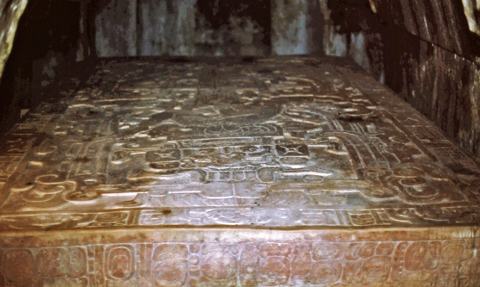
The carved limestone lid over King Pakal's tomb at Palenque — a scene of death and rebirth at the World Tree, and the most misread monument in Maya art.
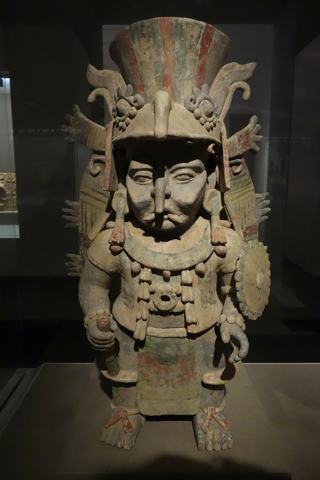
The rain god who splits the clouds with a lightning axe — one god and four, the most frequently depicted deity in the surviving Maya books.
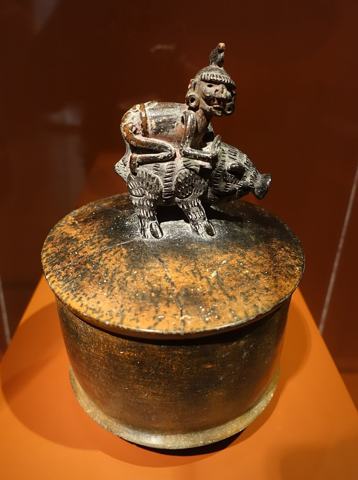
The aged creator — supreme sky god of the Maya, patron of writing, healing and divination, and the old man scholars know as God D.
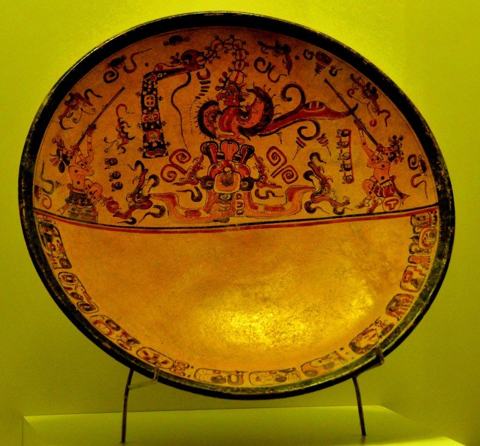
Hunahpu and Xbalanque — the ballplaying twins of the Popol Vuh who outwitted the lords of Xibalba, avenged their father, and rose as sun and moon.
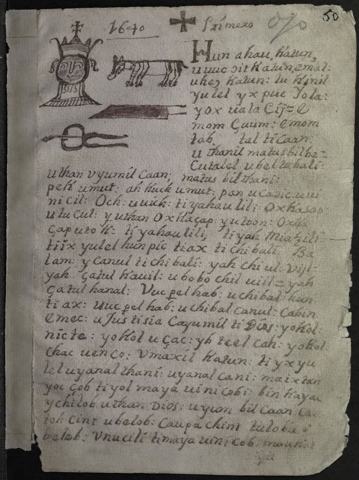
"The one god" of Yucatec Maya colonial texts — a name most scholars now read as a missionary translation for the Christian God, not an ancient Maya deity.
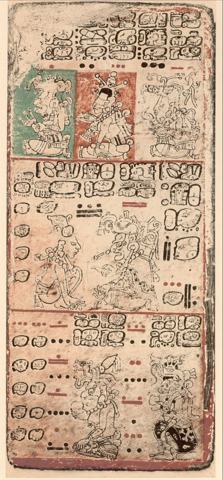
The oldest surviving book of the Americas — a Maya screenfold of astronomical tables, deciphered by a Dresden librarian, that survived a 1945 firestorm.
Sources & Further Reading
- 1.Dresden Codex and Madrid Codex (Postclassic Maya screenfold manuscripts).
- 2.Diego de Landa, Relacion de las cosas de Yucatan (c. 1566).
- 3.Diego Lopez de Cogolludo, Historia de Yucatan (1688).
- 4.Taube, Karl. The Major Gods of Ancient Yucatan. Dumbarton Oaks Research Library and Collection, 1992.
- 5.Miller, Mary & Karl Taube. The Gods and Symbols of Ancient Mexico and the Maya. Thames & Hudson, 1993.
- 6.Schellhas, Paul. Representation of Deities of the Maya Manuscripts. Peabody Museum, Harvard University, 1904.
- 7.Martin, Simon & Nikolai Grube. Chronicle of the Maya Kings and Queens. Thames & Hudson, 2nd ed., 2008.
Spot an error or have a source to suggest? Write to info@viseterna.com. We cite primary sources and modern scholarship, and we correct fast.