
Lamashtu
Daughter of Anu who preyed on pregnant women and infants, driven off by incantations, amulets, and the monstrous protection of Pazuzu.
Plaque against Lamashtu, bronze, 1st millennium BCE (Musee du Louvre, AO 22205) · CC BY-SA 3.0 fr · source
Daughter of Anu
Lamashtu is one of the few Mesopotamian demons given a full divine genealogy: the incantations against her call her marat Anim, "Daughter of Anu," and treat that parentage as an established fact rather than a boast 1,3. Unlike most named demons, who are simply malevolent forces without family, she has a father at the top of the pantheon and, according to the same texts, was thrown out of heaven for her nature and set loose to wander mountains, reed-thickets, and marshland at the edge of settled land 1,3.
Wiggermann's study of her profile across the sources stresses that she is never treated as a fallen or punished goddess in any sympathetic sense — the incantations describe her exile as simple removal of a menace, with no restoration and no possibility of appeasing her the way a slighted deity might be appeased with offerings 3. She answers to no one and negotiates with no one, which is part of what makes her different from a demon like Pazuzu, whose aid could at least be recruited 3,4.
What She Looks Like
Incantations and images agree closely on her appearance: a lion's head with bared teeth, sometimes described with a donkey's teeth and ears, a hairy body, bared and often sagging breasts, and the taloned feet of a bird 1,4. She is regularly shown kneeling or standing on a donkey, sometimes crossing water in a boat, and grips a snake in each raised hand — an image of a nursing mother inverted into something predatory, since her chosen victims are the mothers and infants she should, by the ordinary logic of a female body, be protecting rather than attacking 1,4.
Attacker of Mothers and Infants
The incantation series opens with an extended catalogue of what she does: she slips into houses uninvited, touches pregnant women to cause miscarriage, counts a woman's months to arrive exactly at the birth, seizes newborns from the breast, and brings on the fevers and wasting diseases that killed Mesopotamian infants at appalling rates 1,2. She is called fierce, furious, and raging line after line, an intensity Farber's edition shows was deliberately repetitive — the text works as much by accumulation and rhythm as by content, the way a chant is supposed to 2.
Adult victims were not entirely safe either; a smaller set of texts credits her with disturbing sleepers' dreams and causing general illness, though the core and by far the largest share of the material concerns pregnancy, birth, and infancy specifically 2,3.
Incantations and the Substitute
Protection against her combined verbal and physical ritual. A specialist reciting the Lamashtu incantations paired the words with concrete acts: hanging a Pazuzu amulet over the bed, tying stones or a figurine of Lamashtu to the patient and then carrying it out of the house and down to the river, and — in one of the more striking substitution rituals Farber's edition records — giving her a piglet or puppy to nurse in place of the human infant she wanted, on the logic that a demon redirected toward an animal substitute might leave the real target alone 1,2. This substitution shows up directly in the art: several surviving bronze plaques depict Lamashtu suckling a pig at one breast and a dog at the other, a detail that only makes sense beside the incantations that prescribe exactly that offering 2,4.
The Plaques and Pazuzu's Watch
The best-preserved Lamashtu plaques follow a fixed layout: registers of the great gods' symbols across the top, a scene of exorcism or a sickbed in the middle, and Lamashtu herself at the bottom, standing on her donkey and being marched toward the river and the underworld, flanked by fish 2,4. A head of Pazuzu projects from the top edge of several examples, looking down over the whole composition as the demon whose menace outranks hers and who is, in effect, supervising her expulsion 2,4. It is domestic protection at household scale, the same apotropaic logic that raised a colossal lamassu at a palace gate now compressed onto a bronze plaque small enough to hang over a bed 2,4.
Lamashtu and Later Legends
Lamashtu is sometimes presented in popular writing as a forerunner of the Jewish Lilith, the child-endangering night demon of later folklore, and the two do share a broad type: a female, infant-threatening demon operating outside any household's control 3,5. Scholars are considerably more cautious about a direct line of descent than popular accounts suggest, since the connecting evidence is thin and the two traditions developed in different languages and periods; what can be said safely is that Mesopotamia produced the type — a demon that preys specifically on birth and infancy — many centuries before it resurfaces in the Jewish and later medieval material 3,5.
Continue Exploring
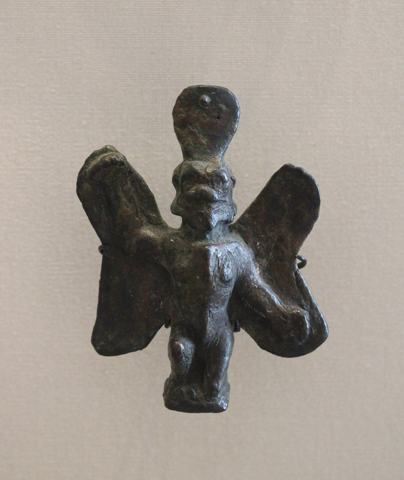
King of the lilu wind demons, invoked as a monstrous protector against the worse demon Lamashtu -- and, since 1973, the face of The Exorcist.
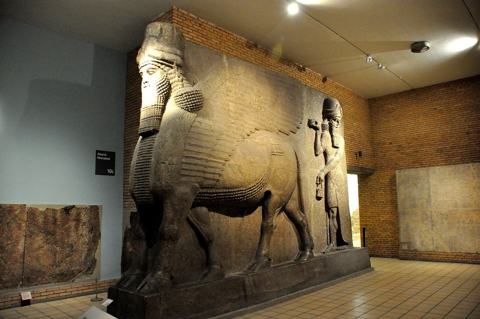
The human-headed winged bull that guarded Assyrian palace gates, sculpted with five legs so it reads correctly as both standing and walking.
Father of the gods — the Mesopotamian sky, whose written sign meant "god" itself; the source of all authority, and almost never the one who uses it.
The primordial salt sea — the first mother of the gods, who turned on her children and whose split body became the sky and the earth above us.
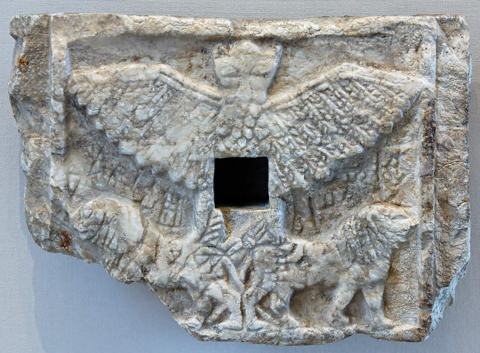
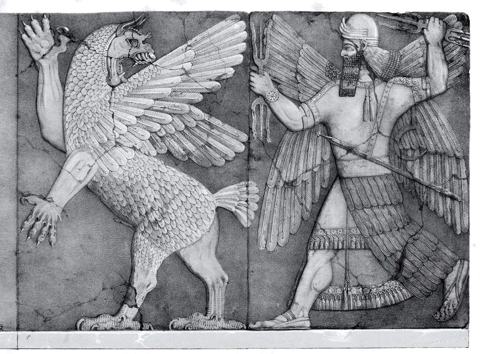
The monstrous lion-headed eagle who stole the Tablet of Destinies from Enlil's sanctuary and was hunted down by the god Ninurta.
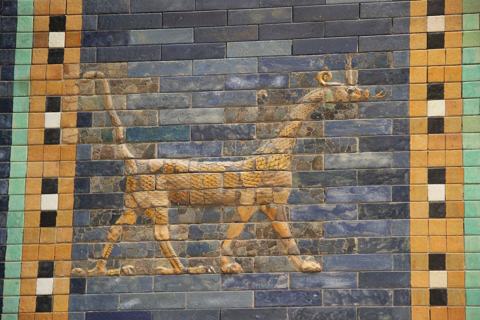
The scaled, horned dragon that once fought for Tiamat, was defeated by Marduk, and ended up as his tame guardian on the glazed brick of Babylon's Ishtar Gate.
Sources & Further Reading
- 1.The Lamastu Series (canonical incantations and rituals against Lamashtu, 2nd-1st millennia BCE).
- 2.Farber, Walter. Lamastu: An Edition of the Canonical Series of Lamastu Incantations and Rituals and Related Texts from the Second and First Millennia B.C. Mesopotamian Civilizations 17. Eisenbrauns, 2014.
- 3.Wiggermann, F.A.M. 'Lamastu, Daughter of Anu. A Profile.' In M. Stol, Birth in Babylonia and the Bible: Its Mediterranean Setting. Cuneiform Monographs 14. Groningen, 2000, 217-248.
- 4.Black, Jeremy & Anthony Green. Gods, Demons and Symbols of Ancient Mesopotamia: An Illustrated Dictionary. British Museum Press, 1992.
- 5.Dalley, Stephanie. Myths from Mesopotamia. Oxford University Press, rev. ed. 2000.
Spot an error or have a source to suggest? Write to info@viseterna.com. We cite primary sources and modern scholarship, and we correct fast.