
Prometheus
The Titan who tricked Zeus, stole fire for humanity, and paid with an eagle sent daily to eat his regenerating liver - freed, in the end, by Heracles.
Prometheus Bound, Peter Paul Rubens (with Frans Snyders), c. 1611-1618 (Philadelphia Museum of Art) · Public domain · source
Kin of the Titans
Prometheus is a second-generation Titan, son of Iapetus and the Oceanid Clymene (or, in other accounts, Themis), and brother to Atlas, Epimetheus and Menoetius, the last of whom is destroyed by Zeus's thunderbolt in the war between gods and Titans 1,6. Unlike most of his family, Prometheus does not fight on the losing side: Hesiod and the tradition behind Aeschylus's play agree that he sided with Zeus in the Titanomachy, reportedly because his gift of foresight, his name means "forethought," told him which side would win 1,3,6. That alliance makes what follows sharper: the antagonism between Prometheus and Zeus is not the leftover grudge of a defeated rebel, but a falling-out between former allies 6,7.
The Trick at Mecone
The break comes over a sacrifice. At a gathering of gods and mortals at Mecone, where the terms of their relationship are being settled, Prometheus is given the job of dividing a slaughtered ox between them, and he rigs the division: one pile hides the good meat inside the unappetising stomach, the other wraps the bare bones in glistening fat 1. Zeus, invited to choose first, picks the fat-wrapped pile. Hesiod insists Zeus was not fooled and chose it anyway, already plotting his revenge, a strange and much-discussed detail, and from that day forward this is the division Greek sacrificial practice actually followed: the gods received the bones and fat burned in smoke, the worshippers kept and ate the meat 1,6,7. Dougherty reads the story as less about a lie than about the moment humans and gods stop eating together, so that their relationship becomes a formal, one-directional cult, with sacrifice as its ritual expression from then on 7.
Fire in a Fennel Stalk
Zeus's retaliation is to withhold fire from humanity, and Prometheus's response is the act that defines him ever after: he steals a spark and smuggles it to earth hidden inside the pith of a giant fennel stalk, a plant whose dry, slow-burning core makes a genuinely plausible fire-carrier, and gives it to mortals 1,2. Hesiod frames this as the second of two crimes rather than a single isolated act of generosity; the trick at Mecone and the theft of fire are one long escalation, not two separate stories 1,2. Apollodorus adds a detail absent from Hesiod: that Prometheus had already shaped the first humans out of clay, which makes the gift of fire not a favour to a species he merely likes but the finishing of a species he made himself 4.
Pandora, Zeus's Answer
Zeus's reply to the theft is not aimed at Prometheus alone. He orders the first woman built, Hesiod calls her simply "Pandora" in Works and Days, "all-gifted," because every god contributes some quality to her, and sends her to Prometheus's brother Epimetheus, "afterthought," with a jar that Pandora opens, releasing every hardship into the world and leaving only Hope trapped inside 2. Prometheus had specifically warned Epimetheus never to accept a gift from Zeus, and Epimetheus, true to his name, accepts her anyway; the punishment for Prometheus's cleverness lands, with grim symmetry, on the brother who has none 2,6. Hesiod is explicit that this is where humanity's troubles as a species genuinely begin: before Pandora, he says, men lived free of sickness and hard toil 2.
Bound on the Caucasus
Prometheus's own punishment is separate from, and worse than, his brother's humiliation. Zeus has him chained to a crag in the Caucasus mountains, where an eagle, Zeus's own bird, arrives each day to tear out and eat his liver, which regrows overnight so the torture can begin again the next morning; because Prometheus is immortal, none of it kills him 1,3,4. Prometheus Bound, the play that gives this scene its fullest and most sympathetic voice, is traditionally credited to Aeschylus but has been doubted on stylistic grounds by a long line of modern scholars, who note that its Zeus is unusually crude and tyrannical compared with the god of Aeschylus's other surviving plays; the authorship remains genuinely unresolved 3,6. Whoever wrote it gives Prometheus a defiant, articulate voice that dominates the whole play, presenting him as a martyr for humanity's technologies, fire, writing, medicine, mathematics, navigation, rather than simply a thief being punished 3,7.
Freed, and Remembered Two Ways
The torment does not last forever. Apollodorus and later tradition have Heracles shoot the eagle during his own quest for the golden apples of the Hesperides and free Prometheus outright, with Zeus's consent, in a reconciliation that closes out the feud between them 4. A separate strand of the myth, tidier than a straightforward pardon, has Prometheus's immortality formally transferred to the wounded centaur Chiron, who wants to die and cannot, letting one being's endless pain replace another's 4,6. Ancient tradition was never of one mind about what kind of figure Prometheus actually was. Plato's dialogue Protagoras retells the fire-theft as a straightforward civilising myth, the origin of every human art, with none of the punishment's darker edge 5. Dougherty traces how later ages kept choosing between these two Prometheuses, willing rebel or generous teacher, right through the Romantic era's fascination with him as the archetype of the punished visionary, a reading so durable that "Promethean" still means exactly that in English today 7.
Continue Exploring
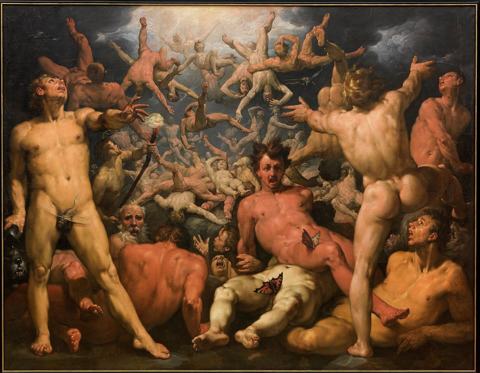
The twelve children of Sky and Earth who ruled before Zeus. Cronus, Rhea, Oceanus, Prometheus' line — and the ten-year war that buried them in Tartarus.
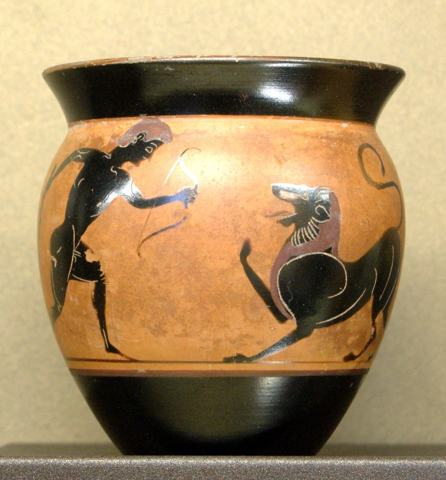
Zeus's mortal son, driven mad by Hera and set twelve impossible labours as penance - the strongest man in Greek myth, who died in agony and rose to Olympus.
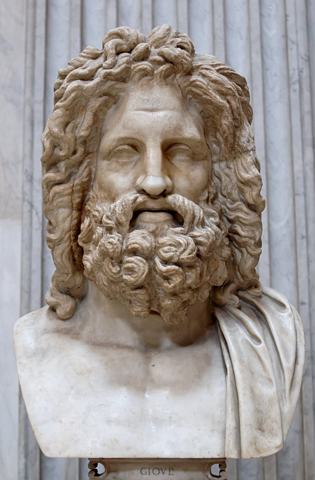
King of the gods and lord of the sky, thunder and justice. He overthrew his own father, divided the universe by lot, and guaranteed the laws of hospitality.

The first mortal woman, built by the gods and sent to open a sealed storage jar that let misery into the world — an ancient jar, not the box of later legend.
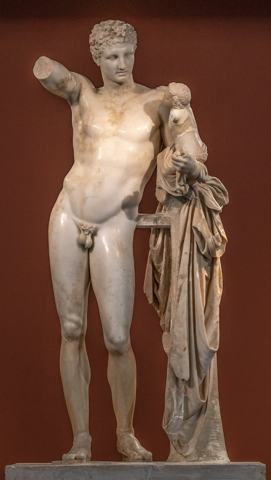
Messenger of the gods and guide of the dead. Patron of travellers, traders, heralds and thieves, and the only Olympian who crosses every boundary at will.
Twice-born god of wine, madness and the mask. He dissolves the boundary between god and beast, and destroys the cities that refuse him.
Sources & Further Reading
- 1.Hesiod, Theogony, lines 507-616 (c. 700 BCE).
- 2.Hesiod, Works and Days, lines 42-105 (c. 700 BCE).
- 3.Aeschylus (attrib.), Prometheus Bound (5th century BCE).
- 4.Apollodorus, Bibliotheca (Library), 1.7 (1st-2nd century CE).
- 5.Plato, Protagoras, 320c-322d (4th century BCE).
- 6.Gantz, Timothy. Early Greek Myth: A Guide to Literary and Artistic Sources. Johns Hopkins University Press, 1993.
- 7.Dougherty, Carol. Prometheus. Routledge, 2005.
Spot an error or have a source to suggest? Write to info@viseterna.com. We cite primary sources and modern scholarship, and we correct fast.