
Theogony (Hesiod's Genealogy of the Gods)
Hesiod's archaic poem tracing the gods from primordial Chaos to the reign of Zeus, the closest thing Greek religion has to an official genealogy.
Hesiode et la Muse, Gustave Moreau, 1891 (Musee d'Orsay, Paris) · Public domain · source
What the Theogony Is
The Theogony ("birth of the gods") is an archaic Greek poem of roughly 1,022 hexameter lines attributed to the poet Hesiod, composed around the same period as Homer's epics, probably the late eighth or early seventh century BCE 1,3. Unlike the Iliad or Odyssey, it is not a story with a human hero but a genealogy: a systematic account of how the universe and its ruling gods came into being, from formless Chaos down to the current order under Zeus 1,4. No other surviving Greek text attempts anything quite like it, which is why the Theogony functions, unofficially, as the closest thing Greek polytheism had to a canonical divine family tree, even though Greek religion had no single scripture and no central authority to enforce one 3,4.
Hesiod and the Muses on Helicon
The poem opens not with the gods but with Hesiod himself, describing how the Muses appeared to him while he was tending sheep on Mount Helicon and gave him a laurel staff and "a voice to sing of what will be and what was before," explicitly authorizing his account as divinely sanctioned truth mixed with falsehoods that sound like truth 1,2. This is one of the earliest surviving moments in Western literature where a poet names himself and claims personal authority for his composition, in contrast to Homer's anonymous narrators, and it has made Hesiod, however thin the biographical evidence, feel like a real individual in a way "Homer" never quite does 3,5. Ancient tradition placed him in Boeotia, a farmer-poet rather than a court singer, and paired the Theogony with his other major surviving work, the Works and Days, a poem of agricultural advice and moral complaint 2,5.
From Chaos to the Olympians
The genealogy begins with Chaos, Gaia (Earth), Tartarus, and Eros emerging first, followed by Gaia producing Uranus (Sky) to cover her, and their union producing the Titans, including Cronus 1,4. Cronus castrates his father Uranus at his mother's urging and swallows his own children by Rhea to prevent a prophesied overthrow, until Rhea hides the infant Zeus and tricks Cronus into swallowing a stone instead 1,3. Zeus grows up, forces Cronus to disgorge his siblings, and leads the Olympians through a ten-year war against the Titans, the Titanomachy, before defeating the monster Typhon and settling into supreme rule, distributing honors among the other gods 1,4. The poem closes with Zeus's marriages and a list of unions between gods and mortals that leads toward, but does not reach, the age of heroes 1,2.
A Poem of Order Through Violence
Clay reads the Theogony's real subject as the establishment of cosmic order, with each generational struggle, Uranus against his children, Cronus against his, the Titans against the Olympians, resolving into a more stable arrangement under Zeus, who unlike his predecessors secures his rule not just by force but by right of judgment, granting each god a permanent honor (timai) within a fixed cosmic bureaucracy 4. Nagy situates this alongside other Near Eastern succession myths, particularly Hittite and Mesopotamian accounts of younger gods overthrowing older ones, without claiming direct borrowing, and treats the poem's violence as the necessary process by which an unstable, undifferentiated cosmos becomes the settled, hierarchical world of Greek cult and poetry 5. Later Greek philosophers and playwrights would treat Hesiod's account as a starting point to argue with rather than scripture to defend, which is itself a sign of how much cultural authority the poem held 3.
Text, Transmission, and Modern Editions
Like Homer, Hesiod survived through a long, imperfect chain of ancient copying, Alexandrian scholarly editing, and medieval Byzantine manuscripts, none contemporary with the poem's composition 1,3. West's 1966 edition, with its extensive commentary on the poem's language, dialect mixture, and likely sources, remains the standard scholarly text against which translations are checked, while the Loeb Classical Library edition prepared by Most pairs the Greek with a facing English translation and gathers the ancient biographical testimonia about Hesiod, most of them written centuries after he lived and of uncertain reliability 1,3. Because so little is independently known about Hesiod as a historical person, scholars generally treat the poem's self-portrait, farmer, shepherd, prize-winning singer at a funeral games on Euboea, as a literary persona at least as much as a biography 2,5.
Legacy
The Theogony's genealogical scheme, more than any single myth within it, is what later Greek and Roman writers, and modern readers of Greek mythology, actually inherited: the standard family tree connecting the Titans, the Olympians, and the monstrous children of Gaia and Pontus back to a single common origin 1,4. Its account of the war between the old gods and the new remained the reference point against which later poets measured their own stories of Zeus's rule, and it is difficult to describe almost any Olympian god's parentage today without, ultimately, tracing the line Hesiod drew nearly 2,700 years ago 1,3,4.
Continue Exploring
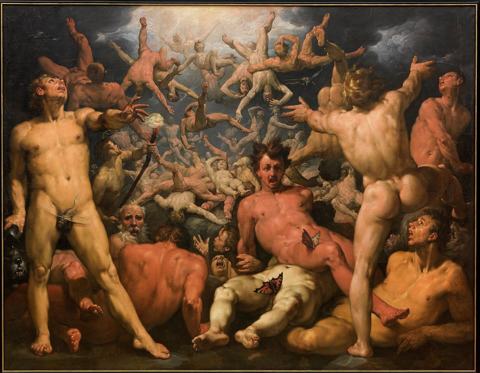
The twelve children of Sky and Earth who ruled before Zeus. Cronus, Rhea, Oceanus, Prometheus' line — and the ten-year war that buried them in Tartarus.
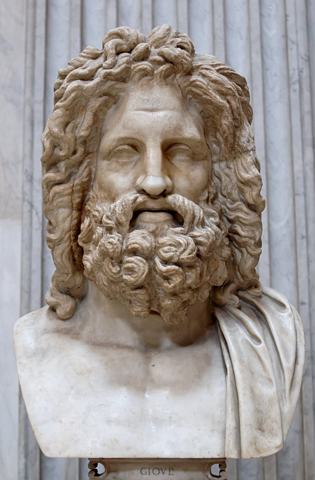
King of the gods and lord of the sky, thunder and justice. He overthrew his own father, divided the universe by lot, and guaranteed the laws of hospitality.
Homer's epic of the final weeks of the Trojan War, opening with Achilles's rage and closing with the ransom of Hector's body.
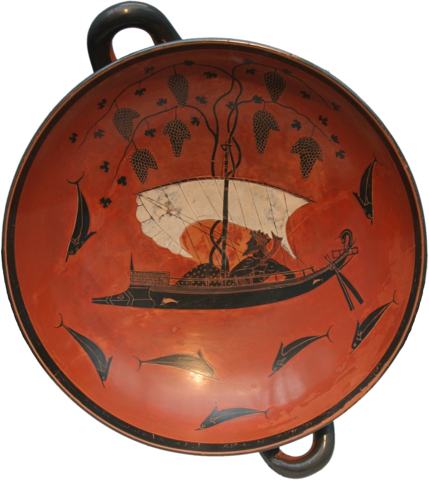
Twice-born god of wine, madness and the mask. He dissolves the boundary between god and beast, and destroys the cities that refuse him.
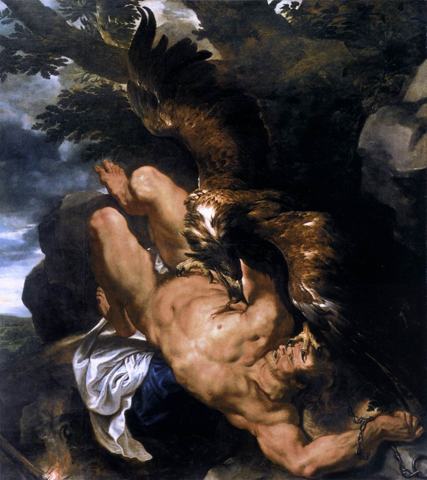
The Titan who tricked Zeus, stole fire for humanity, and paid with an eagle sent daily to eat his regenerating liver - freed, in the end, by Heracles.
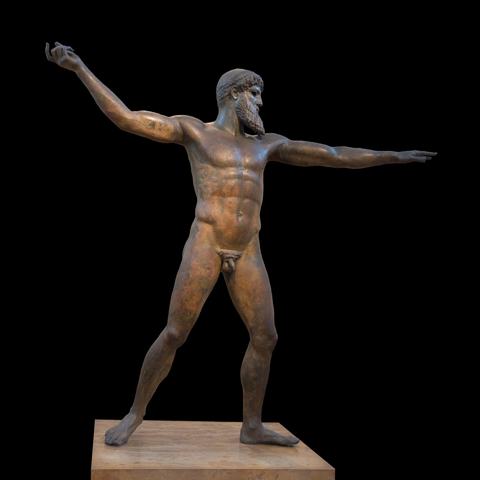
God of the sea, earthquakes and horses. Brother of Zeus, wielder of the trident, and the divine enemy who keeps Odysseus from reaching home.
Sources & Further Reading
- 1.Hesiod. Theogony. Edited with Prolegomena and Commentary by M.L. West. Clarendon Press, 1966.
- 2.Hesiod. Theogony and Works and Days. Translated by M.L. West. Oxford University Press, 1988.
- 3.Hesiod. Theogony, Works and Days, Testimonia. Edited and translated by Glenn W. Most. Loeb Classical Library, Harvard University Press, 2006.
- 4.Clay, Jenny Strauss. Hesiod's Cosmos. Cambridge University Press, 2003.
- 5.Nagy, Gregory. Greek Mythology and Poetics. Cornell University Press, 1990.
Spot an error or have a source to suggest? Write to info@viseterna.com. We cite primary sources and modern scholarship, and we correct fast.