
Apophis (Apep)
The great serpent who attacks the sun boat every night — Apophis is Egypt's embodiment of chaos, repelled again each dawn but never finally destroyed.
The Great Cat of Heliopolis slaying Apophis, wall painting, Tomb of Inherkhau (TT 359), Deir el-Medina, c. 1150 BCE; photo Ismoon, 2020 · CC BY-SA 4.0 · source
What Apophis Is
Apophis is the Greek form of the Egyptian Apep — a serpent of enormous size who lives in the darkness beyond the ordered world and exists for one purpose: to stop the sun. He is not a god with a temple, a priesthood or a festival. Egyptian religion classes him with isfet, the disorder that stands opposite maat, the truth-order-balance that the gods and the king exist to maintain 6,7. Where the pantheon is negotiable — gods merge, swap epithets, take on each other's functions — Apophis is the one figure with whom no accommodation is possible.
He is unattested in the Old Kingdom material and appears clearly from the Middle Kingdom onward, in the Coffin Texts, becoming a fixture of New Kingdom funerary literature 1,6,7. Descriptions give him a body of monstrous length — the netherworld books measure him in cubits by the hundreds — coiled across the route the sun must travel, sometimes shown pierced with knives, sometimes bound, sometimes hacked into segments.
The Nightly Attack
The setting is the night journey. Ra sails his barque through the twelve hours of the night, passing through the Duat to be reborn on the eastern horizon at dawn, and somewhere along that route Apophis lies in wait. In the Amduat the confrontation belongs to the seventh hour, at the "sandbank of Apep", where the serpent has swallowed the water so that the boat runs aground; the crew must repel him before the voyage can continue 2,8.
Ra does not fight alone. His barque carries a company of defenders — Set, who in these scenes stands in the prow and spears the serpent, the magician-god Heka, the serpent Mehen coiled protectively around the shrine, and Isis, whose spells paralyse the enemy 2,6,7. Another famous image assigns the killing blow to a cat: in Spell 17 of the Book of Going Forth by Day, the Great Cat of Heliopolis, understood as a form of the sun god himself, cuts off the serpent's head beneath the sacred ished tree, a scene painted on tomb walls at Deir el-Medina 3,7.
The crucial point is that Apophis is defeated every night and destroyed no night. The texts describe him dismembered, burned and thrown into pits, and then he is back the following evening. Erik Hornung's reading of the netherworld books stresses that this is the intended shape of the story: the Egyptian cosmos is not a finished creation but a nightly renewed one, and the serpent is the standing possibility of failure that makes the renewal meaningful 8.
The Book of Overthrowing Apep
Because the outcome was not taken for granted, the temple did something about it. The Book of Overthrowing Apep, preserved in columns 22–32 of Papyrus Bremner-Rhind and edited by R. O. Faulkner in 1937, sets out a ritual performed daily in the temple of Amun-Ra at Karnak to help the sun god win 4,5.
It is remarkably physical. The sections are titled as instructions — spitting on Apep, trampling him with the left foot, taking the knife to him, taking the lance to him, putting him on the fire, fettering him — and the accompanying rubrics direct the officiant to make an image of the serpent in wax, or draw it on new papyrus in green ink, write his name on it, bind it, spit on it, cut it, and burn it in a fire of a specified plant, so that the destruction is enacted rather than merely described 4,5. Egyptian magic held that the written name carried the being, which is why the name is written in order to be destroyed, and why hostile names in tombs and papyri are sometimes deliberately mutilated 5,7.
The same ritual texts extend the treatment to the king's earthly enemies, whose names could be added to the wax figure — a reminder that the theology was not abstract. Rebellion, invasion and famine were all species of the same disorder the serpent represented 5,7.
Storms, Eclipses and the Fear of the Gap
Egyptologists have long suggested that unusual solar events supplied the emotional charge behind the myth. A thunderstorm, an unseasonal darkness, or a solar eclipse could be read as Apophis briefly getting hold of the barque, and some texts describe him swallowing the sun or the waters 6,7. It is worth saying that this connection is an interpretation drawn from the imagery rather than a claim any surviving Egyptian text makes in so many words, and scholars differ over how far to press it 6,7.
What is not in doubt is the anxiety. Apophis also threatens the dead: spells among the Coffin Texts and in the Book of Going Forth by Day exist specifically to keep the serpent off the deceased in the netherworld, since anyone travelling with Ra shares Ra's enemies 1,3.
An Anti-God with No Cult
Apophis is sometimes drawn into the orbit of Set. In the earlier material Set is emphatically the serpent's killer, the violent god whose violence is useful; as Set was progressively demonised in the first millennium BCE, particularly under foreign rule, some late texts blur the two into a single principle of hostility 6,7. The older arrangement is more revealing of Egyptian thought, since it keeps a place inside the divine order for necessary aggression while placing Apophis wholly outside it.
He has no myth of origin worth the name and no end. He is, in the Egyptian sense, the thing that must be beaten daily — which is why one of the standard formulas of temple liturgy is not a prayer for victory but a report of one already achieved: Apep is fallen, Ra is triumphant.
Continue Exploring
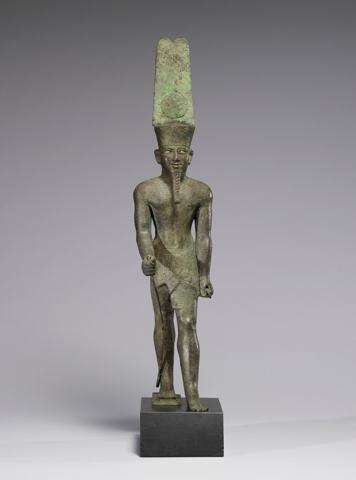
The imperial god of the New Kingdom — a once-minor Theban god whose name means "hidden," fused with Ra until Akhenaten tried to erase him from Egypt.
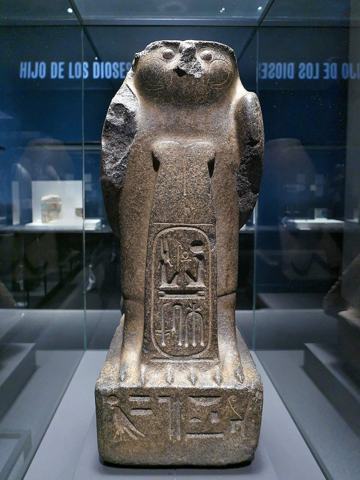
The sun itself as a god — Ra sails the sky by day, fights the serpent of chaos by night, and is reborn on the horizon every dawn.
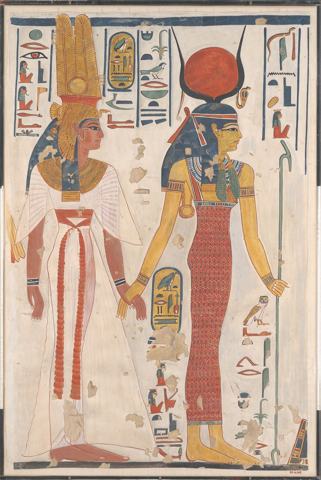
Goddess of magic — the widow whose spells restored Osiris, the mother who hid Horus in the marshes, and the one Egyptian deity Rome adopted whole.
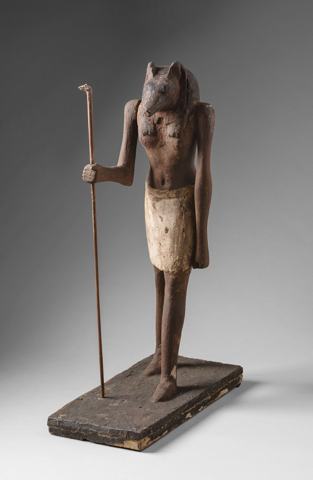
God of chaos — the red god of storm and desert who murdered Osiris, yet stood in the sun's boat each night to spear the serpent of nonexistence.
The Egyptian underworld — the night country crossed by the sun in twelve hours and by every dead Egyptian hoping to come out reborn at dawn.
Egypt's cat goddess — a lioness of the Eye of Ra who softened into the guardian of the home, honoured at Bubastis with the loudest festival in Egypt.
Sources & Further Reading
- 1.Coffin Texts (Middle Kingdom, c. 2000–1700 BCE).
- 2.The Amduat and the Book of Gates (New Kingdom royal netherworld books).
- 3.The Egyptian Book of the Dead (Book of Going Forth by Day), Spells 7, 17 and 39, New Kingdom.
- 4.The Book of Overthrowing Apep, Papyrus Bremner-Rhind (British Museum EA 10188), c. 4th–3rd century BCE.
- 5.Faulkner, R. O. "The Bremner-Rhind Papyrus III: D. The Book of Overthrowing 'Apep." Journal of Egyptian Archaeology 23, no. 2 (1937): 166–185.
- 6.Wilkinson, Richard H. The Complete Gods and Goddesses of Ancient Egypt. Thames & Hudson, 2003.
- 7.Pinch, Geraldine. Egyptian Mythology: A Guide to the Gods, Goddesses, and Traditions of Ancient Egypt. Oxford University Press, 2002.
- 8.Hornung, Erik. The Ancient Egyptian Books of the Afterlife. Trans. David Lorton. Cornell University Press, 1999.
Spot an error or have a source to suggest? Write to info@viseterna.com. We cite primary sources and modern scholarship, and we correct fast.